


Blog
India’s Plastic Ban in 2026: What It Actually Means for Your Business Packaging

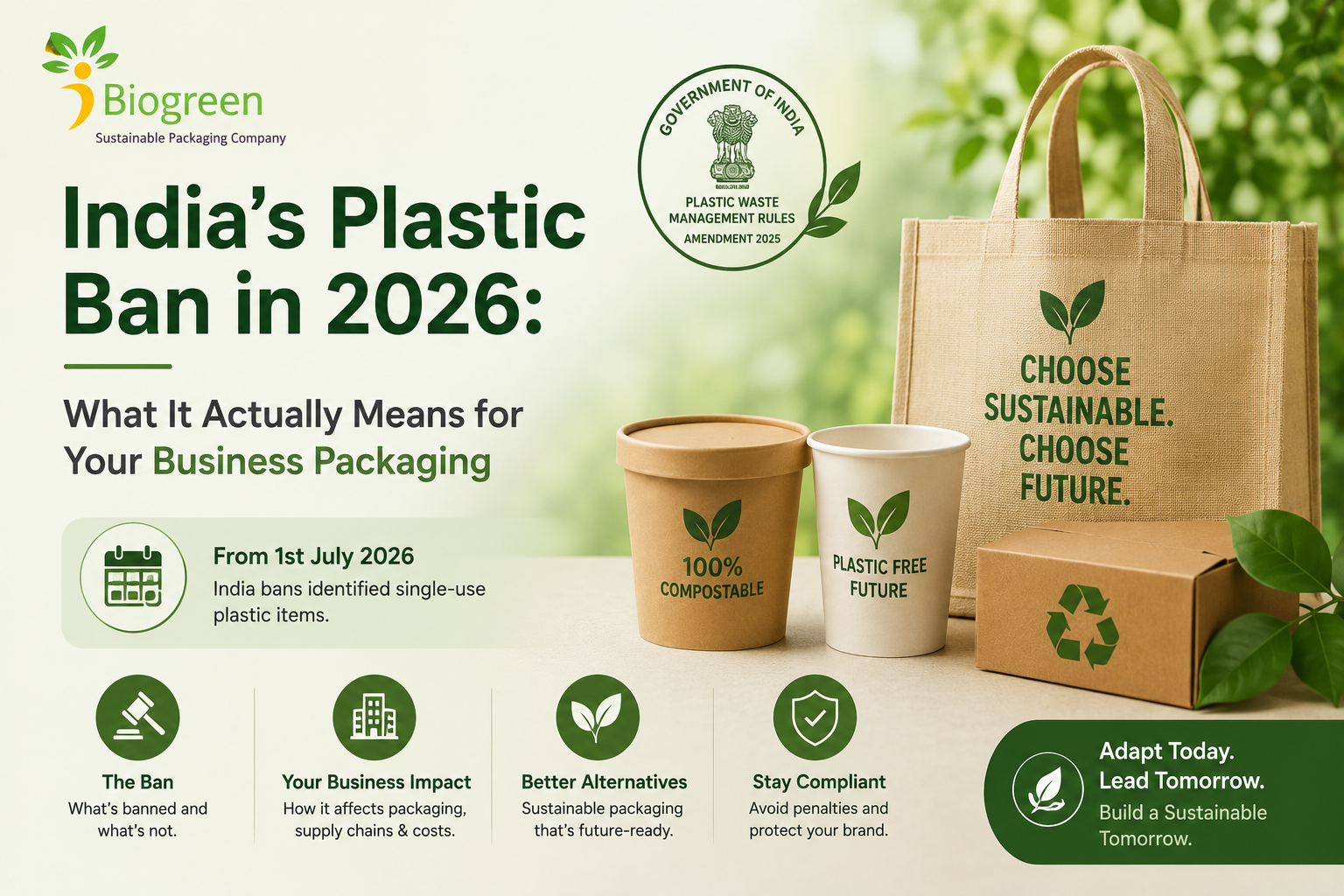
Let’s be direct about something. If your business still uses plastic carry bags, plastic-coated cups, plastic cutlery, or single-use poly mailers, you’re already operating in legally risky territory. And in 2026, that territory is shrinking fast.
India’s phased single-use plastic ban, which began in earnest in July 2022, has been steadily expanding its scope. Enforcement, which was initially patchy in many cities, has tightened considerably. State pollution control boards are conducting more frequent inspections. Penalties are being issued. And businesses that haven’t made the switch yet are increasingly finding themselves caught off guard.
This guide is for business owners, procurement managers, and packaging buyers who want a clear, honest picture of where things stand, what the regulations actually require, and how to transition to compliant packaging without disrupting operations or taking a hit on costs.
A Quick Recap: What India’s Plastic Ban Has Covered So Far
India’s Ministry of Environment, Forest, and Climate Change (MoEFCC) banned a specific list of single-use plastic items under the Plastic Waste Management (Amendment) Rules. The first major wave hit in July 2022 and targeted items with low utility and high littering potential.
The banned items from that phase included earbuds with plastic sticks, plastic sticks for balloons, plastic flags, candy sticks, ice cream sticks made of plastic, polystyrene (thermocol) for decoration, plates, cups, glasses, cutlery (forks, spoons, and knives), straws, trays, wrapping or packing films around sweet boxes, invitation cards, cigarette packets, plastic or PVC banners less than 100 microns, and stirrers.
That list already covers a significant chunk of what food businesses, event companies, and retailers use daily.
Then there’s the carry bag question. Plastic carry bags below 75 microns have been banned. From December 2022, the threshold moved to 120 microns. This is important because most of the thin polybags used in retail, grocery stores, and street-side businesses fall well below 120 microns.
What’s Changing in 2026 and Beyond
The broader trajectory isn’t just about adding more items to the banned list. The framework is shifting toward Extended Producer Responsibility (EPR), which places the burden of plastic waste management directly on producers, importers, and brand owners.
In 2026, EPR compliance is no longer optional. Businesses that manufacture, import, or sell products in plastic packaging are required to be registered on the Central Pollution Control Board (CPCB) EPR portal, have annual plastic waste collection and recycling targets, meet those targets or purchase EPR credits from registered recyclers, and report their plastic footprint annually.
This applies to a surprisingly wide range of businesses, not just large corporations. Even mid-size e-commerce brands, food manufacturers, and regional FMCG companies fall within the scope if they use packaged goods.
Items Now Prohibited Under the Single-Use Plastic Ban
To be clear about what’s currently banned, here’s a working summary:
- Carry bags below 120 microns (unless certified compostable under IS 17088)
- Plastic cutlery: spoons, forks, knives, straws, stirrers
- Plastic plates, cups, glasses, trays
- Thermocol items for food service and decoration
- Plastic wrapping for sweet boxes, invitation cards, and cigarette packets
- Plastic banners below 100 microns
- Plastic-coated paper cups (in several states, though enforcement varies)
What many businesses don’t realize is that “biodegradable” on a label isn’t enough. The product needs to meet IS 17088 (India’s compostability standard) or an equivalent recognized standard. A bag that simply says “biodegradable” without certification can still attract a penalty.
EPR — What Businesses Actually Need to Do
EPR sounds bureaucratic, but the practical requirements are straightforward once you understand them. If your business generates more than a certain threshold of plastic packaging waste annually, you need to register on the CPCB EPR portal, declare your plastic packaging footprint (how many tonnes of plastic you put into the market), meet collection and recycling targets (currently 35% for rigid plastic, higher for multilayer packaging), and show compliance through certificates from registered recyclers or processors.
For businesses that are already switching to certified compostable packaging, the EPR burden is significantly reduced because compostable packaging is not counted as plastic waste in the same category.
How the Plastic Ban Affects Different Industries
The impact isn’t uniform. Some industries are more immediately affected than others, and the workarounds differ by sector.
Food and Beverage Brands
This is the sector feeling the most pressure. If you run a restaurant, cloud kitchen, packaged food brand, or food stall, nearly every item that touches your customer’s order is under scrutiny. Plastic straws are banned. Plastic cutlery is banned. Thin carry bags to pack orders are banned. Even the plastic wrapping on sweet boxes and mithai has come under regulatory attention in many cities.
The practical replacements are out there. Certified compostable carry bags made from corn starch or PBAT can replace standard polybags for food delivery and take-away. Compostable cutlery and straws, though slightly different in feel, are now durable enough for everyday food service. Bagasse and compostable food containers hold up well for curries, gravies, and hot foods.
The key is getting certified products, not just ones that claim to be eco-friendly.
E-commerce and Courier Companies
D2C brands and e-commerce businesses typically use a lot of poly mailers. These are the soft, flexible shipping bags that protect products during delivery. Standard poly mailers are made from LDPE plastic, and most of them fall below the 120-micron threshold that triggers the ban.
Switching to biodegradable courier bags made from PBAT or certified compostable materials is the most straightforward path here. These bags are available in all standard sizes, are just as tear-resistant as conventional poly mailers, and many are self-sealing. Explore biodegradable courier bags from Biogreen Bags if you want to see what certified alternatives look like for e-commerce use.
Retail and FMCG
Retail businesses that hand out carry bags to customers have been navigating this since 2022. The 120-micron rule means that standard thin polybags are simply not legal to give out. Many retailers have switched to thicker bags, but that’s still plastic. Genuinely compliant options include certified compostable carry bags, which break down under industrial or home composting conditions and don’t leave microplastic residue.
For FMCG companies, the EPR angle is equally significant. The packaging that wraps your products—pouches, wrappers, and multilayer films—all count toward your plastic footprint declaration.
Hospitals and Healthcare
Hospitals have a slightly different situation. Medical waste packaging falls under a separate regulatory framework (Biomedical Waste Management Rules, 2016), so not all hospital bags are covered by the single-use plastic ban. However, the general waste generated within hospitals—administrative plastic use, cafeteria packaging, and packaging for non-hazardous materials—is absolutely in scope. Hospitals that have made the switch to certified compostable carry bags, garbage bags, and biodegradable food service packaging for their canteens are ahead of the compliance curve.
What Counts as a Legal Alternative? Understanding Certified Compostable Packaging
Not everything sold as “eco-friendly” or “green” is actually compliant. This is worth spelling out clearly because there’s a lot of confusing labeling in the market.
For a product to be a legal replacement for banned single-use plastics in India, it typically needs to meet one or more of the following standards:
IS 17088 — India’s Compostability Standard
IS 17088 is the Bureau of Indian Standards specification for compostable plastics. It covers the requirements a material must meet to be considered compostable in India, including that the material must biodegrade at least 90% within a defined timeframe under industrial composting conditions, must disintegrate significantly within 12 weeks, must not leave harmful residues, and must not negatively impact plant growth.
If a carry bag manufacturer claims their product is IS 17088 compliant, that’s the key certification to look for. It’s the Indian standard that CPCB and state pollution control boards recognize.
EN 13432 — The European Benchmark
EN 13432 is the European standard for compostable packaging. Many Indian manufacturers who export or supply to international brands carry this certification. It’s broadly equivalent to IS 17088 in its requirements, and a product certified to EN 13432 is generally considered credible for the Indian market as well, though IS 17088 is preferred for domestic compliance purposes.
What CPCB Looks for in Compliant Packaging
CPCB inspections typically verify whether the product has a valid certification from a recognized body, whether the manufacturer is registered under EPR (if applicable), and whether the product meets the minimum thickness requirements for carry bags.
Buying from a manufacturer who can provide certification documentation is not optional — it’s the difference between being compliant and being at risk.
How to Switch Without Disrupting Your Operations
The biggest concern most business owners have when they think about switching packaging is operational disruption. Will the bags be the same size? Will they hold up as well? What happens to existing stock?
In practice, the transition is far less complicated than most people expect. Here’s how to approach it sensibly.
Start with your highest-volume, highest-visibility packaging items. For a food business that usually carries bags and utensils. For an e-commerce business, it’s the shipping mailer. For a retail store, it’s the checkout bag. Switching the most-used items first gives you the biggest compliance and reputational benefit quickly.
Order samples before you commit to bulk. Any reputable manufacturer of certified compostable packaging will send you samples. Use them in your actual operations, test whether they hold the weight you need, check whether they seal properly, and get your staff comfortable with them before you place a large order.
Brief your team. A carry bag that tears if handled incorrectly, or a compostable straw that needs to be handled differently from a plastic one, will cause complaints if staff aren’t prepared. A 15-minute briefing before the switch goes a long way.
Communicate with your customers. A small label change, an Instagram post, or a simple note on your delivery packaging saying you’ve switched to certified compostable packaging is genuinely valued by a growing segment of Indian consumers. It’s also good for your brand story.
Price the switch realistically. Certified compostable packaging typically costs 10 to 25% more than standard plastic equivalents. For most businesses, this is a manageable cost, especially when factored against the risk of penalties, and many suppliers offer better pricing at higher volumes. Compostable carry bags from Biogreen Bags are available in bulk quantities with competitive pricing for business accounts.
Conclusion
India’s plastic ban isn’t going away, and it isn’t standing still. The regulatory pressure in 2026 is coming from multiple directions at once: the item-specific ban on single-use plastics, the carry bag micron rules, and the EPR framework that pulls in a much broader range of businesses than many realize.
The businesses that are best positioned right now are the ones that have already made the switch to certified compostable packaging, registered under EPR where required, and built supplier relationships that can scale with their needs.
If you haven’t started yet, the good news is that switching is genuinely manageable. The certified alternatives work. The pricing is reasonable at volume. And the regulatory risk of not switching is only going to grow from here.
Start with a sample. Test it. Make the switch on your highest-volume items first. Then work through the rest of your packaging at a pace that makes operational sense.
FAQ
Ans: No—the product must meet IS 17088 or EN 13432 compostability standards to qualify. Oxo-degradable plastics are specifically prohibited, even if they carry a biodegradable label.
Ans: IS 17088 is the primary standard CPCB recognizes, though EN 13432 and BPI certifications are also widely accepted. Always ask your supplier for the actual certification document before ordering.
Ans: Yes — certified compostable courier bags made from PBAT or PLA are accepted as legal alternatives to conventional poly mailers and are available in all standard sizes.
Ans: EPR (Extended Producer Responsibility) requires plastic packaging producers and brand owners to register on the CPCB portal and meet annual collection and recycling targets. Whether you need to register depends on your plastic packaging volume — check the CPCB EPR portal for current thresholds.
Ans: Biogreen Bags manufactures IS 17088-certified compostable carry bags, garbage bags, and courier bags with bulk pricing for business accounts and free samples available on request.