Bengaluru, India · Dubai, UAE



Compostable vs Biodegradable vs Recyclable Packaging: Let’s Clear This Up Once and For All

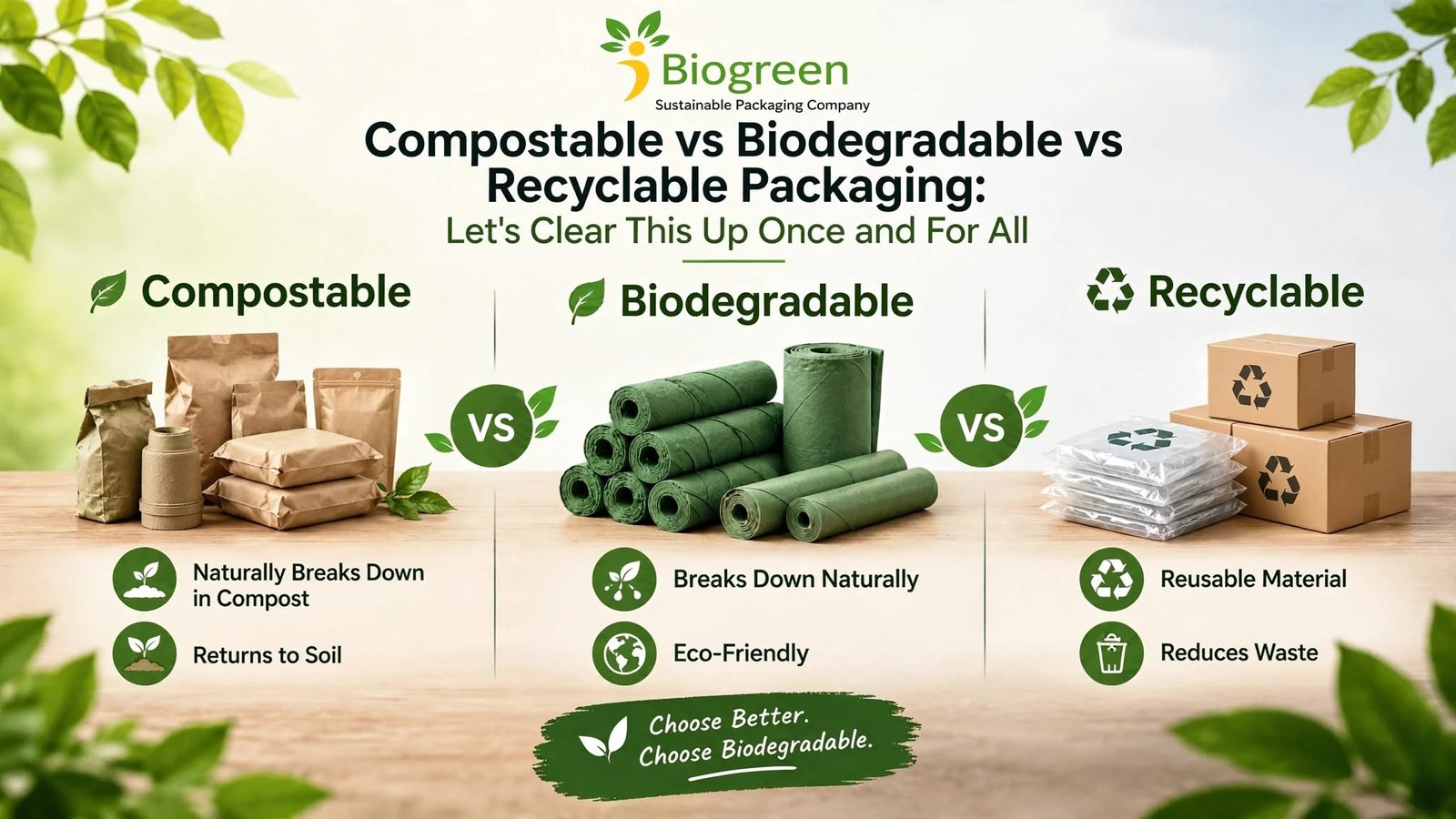
Walk into any packaging supplier’s showroom in India today, and you’ll be handed brochures with all three words on them, sometimes on the same product. “100% biodegradable bags.” “Fully recyclable.” “Certified compostable.” It feels like they should mean roughly the same thing, but they don’t. Not even close.
This confusion isn’t just a marketing problem. It costs businesses money, creates compliance headaches, and, if we’re being honest, contributes to the very environmental damage these labels are supposed to help prevent. A bag that’s technically biodegradable but takes 200 years to break down and leaves microplastic fragments behind isn’t helping anyone.
So let’s go through each term carefully. No jargon, no filler, just what these words actually mean and what they mean for the decisions you need to make.
Why This Confusion Exists (And Why It Costs Businesses Money)
The packaging industry didn’t accidentally end up with three overlapping terms. There’s a fair amount of deliberate vagueness baked in. “Biodegradable” in particular has no single legal definition in India or most countries, which means a manufacturer can technically print it on almost anything that will eventually break down, which, given enough time, is basically every material on earth.
This has made life difficult for buyers who genuinely want to make the right choice. You might pay a premium for “biodegradable” packaging only to discover later that it doesn’t qualify as a legal alternative under India’s plastic ban, or that it leaves toxic residue in soil when it does break down.
The financial cost of getting this wrong shows up in a few ways: regulatory penalties if your packaging isn’t actually compliant, wasted spend on certifications you didn’t need, and the cost of switching again when you realize the first switch was insufficient.
Understanding the real differences upfront saves all of that.
What Recyclable Packaging Actually Means
Recyclable packaging is material that can be collected, processed, and turned into new raw material or products. The most widely recycled packaging materials are certain types of plastic (PET, HDPE, PP), glass, aluminium, and paper.
In theory, recyclability sounds like the cleanest solution. Use the material, send it back into the system, use it again. No waste. In practice, there are serious limitations, especially in an Indian context.
What Can and Cannot Be Recycled in India
Not all plastics that say “recyclable” are actually recycled in India. The recycling symbol on packaging (the three-arrow triangle) indicates the material type, not that the product will actually be recycled. Multilayer packaging, which includes most flexible food pouches, chip packets, and sauce sachets, is technically recyclable but practically almost never is, because separating the layers is economically unviable at most Indian recycling facilities.
PET bottles have a reasonably functional recycling ecosystem in India. HDPE containers (like shampoo bottles and milk jugs) do too. But flexible plastic packaging, low-density film, and anything with mixed materials typically ends up in landfill or is incinerated regardless of what the label says.
The Recycling Infrastructure Problem
Even if the material is theoretically recyclable, recycling only works when there’s a proper collection and processing chain. In most Indian cities outside the tier-1 metros, that chain is weak. Informal waste pickers do collect recyclable plastic, but what gets processed is highly selective. Thin films, soft plastics, and contaminated packaging rarely make it into the formal recycling stream.
The practical takeaway: recyclable is the right choice for rigid plastics that have a functioning recycling ecosystem (PET bottles, HDPE containers), but it’s not the answer for flexible packaging bags, wraps, or thin films. For those categories, you need to look elsewhere.
What Biodegradable Packaging Actually Means
Here’s where things get complicated. “Biodegradable” literally means capable of being broken down by living organisms like bacteria and fungi. By that definition, almost everything biodegrades eventually. A plastic bottle will biodegrade. It’ll just take between 400 and 1,000 years to do so.
The word on a label, without any timeframe or condition attached, tells you very little.
The “Biodegradable” Label — Why It’s Often Misleading
Most “biodegradable” plastic products you see in the market fall into two categories. The first is oxo-degradable plastic, which is conventional plastic with chemical additives that cause it to fragment into smaller pieces when exposed to light and heat. The problem is that these fragments are microplastics, not actually broken-down organic matter. The material doesn’t disappear; it just becomes invisible to the naked eye while continuing to exist in soil and water.
The second type is genuinely bio-based or plant-derived plastic that does biodegrade under the right conditions. This category is legitimate, but the conditions matter enormously. Some of these materials only biodegrade properly in industrial composting facilities at specific temperatures and humidity levels. Put them in a landfill and they behave almost identically to conventional plastic.
India’s Ministry of Environment has explicitly prohibited oxo-degradable plastics. They’re not a legal alternative under the current regulatory framework. If a supplier offers you “biodegradable bags” at suspiciously low prices with no certification documentation, you’re likely looking at oxo-degradable products.
How Long Does Biodegradable Plastic Take to Break Down?
This depends entirely on the specific material and the conditions it breaks down in. Certified compostable plastics based on PBAT or PLA can break down to harmless biomass within 90 to 180 days under industrial composting conditions. Oxo-degradable plastic can take decades to fragment, and even then leaves microplastic residue. Standard LDPE plastic bags can take 20 to 1,000 years depending on environmental conditions.
The label alone doesn’t tell you which category you’re in. Certification does.
What Compostable Packaging Actually Means
Compostable packaging is a specific, defined category with concrete performance standards. To be certified compostable, a material must meet tests for biodegradation rate, disintegration, absence of harmful residues, and plant toxicity.
This is the category with the clearest standards, the most meaningful certifications, and the strongest alignment with India’s current regulatory requirements for packaging alternatives.
Industrial Compostable vs Home Compostable
This is a distinction that trips up a lot of buyers, so it’s worth spending a moment on.
Industrial compostable packaging breaks down in a professional composting facility that maintains specific temperature ranges (typically 55 to 60 degrees Celsius), controlled humidity, and regular aeration. These conditions accelerate breakdown dramatically. Most certified compostable carry bags, garbage bags, and packaging films fall into this category.
Home compostable packaging is designed to break down in a backyard compost pile, which operates at lower temperatures and less controlled conditions. Home compostable certification is harder to achieve and, as a result, more meaningful for certain applications. It’s particularly relevant for products that consumers handle directly, like kitchen waste bags.
For most business applications in India, industrial compostable certification under IS 17088 or EN 13432 is what you’re looking for. India currently has limited home composting infrastructure, so the practical difference matters less than it might in countries with widespread home composting programs.
What Certified Compostable Actually Guarantees
When a product carries a legitimate compostability certification (IS 17088, EN 13432, BPI, or DIN CERTCO), it has been independently tested to confirm that:
- At least 90% of the material biodegrades within a defined timeframe (typically 180 days under industrial composting conditions)
- The material disintegrates into pieces smaller than 2mm within 12 weeks
- The composted end product doesn’t contain heavy metals or other harmful substances above specified limits
- The resulting compost doesn’t negatively affect plant germination or growth
That last point matters more than people realize. Some materials marketed as compostable leave residues that are actually harmful to plants. Certification testing specifically screens for this.
Biogreen Bags’ compostable carry bags are made from certified compostable materials and meet recognized international standards. The same applies to their compostable garbage bags and other packaging lines.
Comparison Table: Compostable vs Biodegradable vs Recyclable
| Factor | Recyclable | Biodegradable | Certified Compostable |
| Defined legal standard in India | Partial (by material type) | No | Yes (IS 17088) |
| Timeframe to break down | N/A (reused, not broken down) | Highly variable (months to centuries) | 90 to 180 days in industrial composting |
| End product | New raw material | Variable (often microplastics) | Biomass and CO2 — no harmful residue |
| Works in Indian waste infrastructure | For rigid plastics only | Often not tested or verified | Requires industrial composting access |
| Legal under India’s plastic ban | Depends on material | Not without certification | Yes, with IS 17088 or equivalent |
| Risk of greenwashing | Medium | Very high | Lower (with certification) |
| Best suited for | Bottles, rigid containers | Limited legitimate use | Bags, films, flexible packaging |
Which Type Is Right for Your Business?
This depends on what you’re packaging and what your customers do with it after.
If you’re selling beverages, cleaning products, or anything in a rigid container that your customers are likely to throw into a bin that gets sorted, recyclable packaging in PET or HDPE is a reasonable choice. The recycling infrastructure exists, at least in major Indian cities.
If you’re running a food business, a retail store, a cloud kitchen, or an e-commerce brand, and your primary packaging items are bags, mailers, wraps, or pouches, certified compostable is almost always the better choice. The recycling ecosystem for these materials doesn’t function in India. Biodegradable without certification is legally risky and environmentally dubious. Certified compostable gives you documented environmental benefit and regulatory compliance.
If you’re in manufacturing or export, the picture is more nuanced. International buyers increasingly ask for specific certifications. EU buyers may require EN 13432. US retail buyers often prefer BPI certification. It’s worth knowing your export markets’ requirements before committing to a certification pathway.
One more thing worth saying: don’t let perfect be the enemy of good. Many businesses get stuck trying to find a solution that’s simultaneously recyclable, compostable, and biodegradable in all conditions. That product doesn’t really exist at commercial scale yet. The right move is to identify the most important environmental and compliance goal for your specific packaging application and choose accordingly.
For most Indian businesses dealing with flexible packaging, bags, and wraps, certified compostable under IS 17088 is the answer. For rigid containers in categories with functional recycling, recyclable is appropriate. For flexible packaging going to industrial composting facilities, compostable wins every time.
Conclusion
If someone asks you to explain all three in under a minute, here’s how to do it.
“Recyclable” means the material can be processed and turned into something new. It only works if there’s infrastructure to collect and process it. In India, that infrastructure exists for some rigid plastics but barely at all for flexible films and bags.
Biodegradable means it will eventually break down in nature. Without certification, that timeframe could be anywhere from months to centuries. The label alone means very little.
“Certified compostable” means the material has been independently tested to break down into harmless biomass within a defined timeframe under composting conditions. It has legal recognition under India’s plastic ban framework and provides the most reliable environmental outcome for flexible packaging applications.
When in doubt, ask for the certification document. If the supplier can’t produce one, that tells you everything you need to know.
FAQs
Is compostable packaging better for the environment than recyclable?
For flexible packaging like bags and films in India, certified compostable wins the recycling infrastructure for these materials barely functions here. For rigid containers like PET bottles, recyclable is the more practical environmental choice.
Can I throw compostable bags in the regular trash?
You can, but they won’t compost properly in a landfill they need the heat and microbial activity of a composting facility. The right disposal path is a wet waste stream that goes to composting.
What’s the difference between home compostable and industrially compostable?
Industrial compostable materials need a professional facility running at 55 to 60°C to break down properly. Home compostable materials work in a backyard compost pile at lower temperatures a more demanding certification to achieve.
Is all biodegradable plastic legal in India?
No oxo-degradable plastics are specifically prohibited under India’s plastic waste rules. To be a legal alternative to banned plastics, a product needs IS 17088 or equivalent certification; “biodegradable” on its own isn’t enough.
Can packaging be both compostable and recyclable?
Generally no the material properties required for each are different. Paper is an exception, but for plastic-type packaging you typically choose one: compostable for bags and films, recyclable for rigid containers.