Bengaluru, India · Dubai, UAE




Biodegradable Courier Bags for E-commerce: What to Know Before You Make the Switch

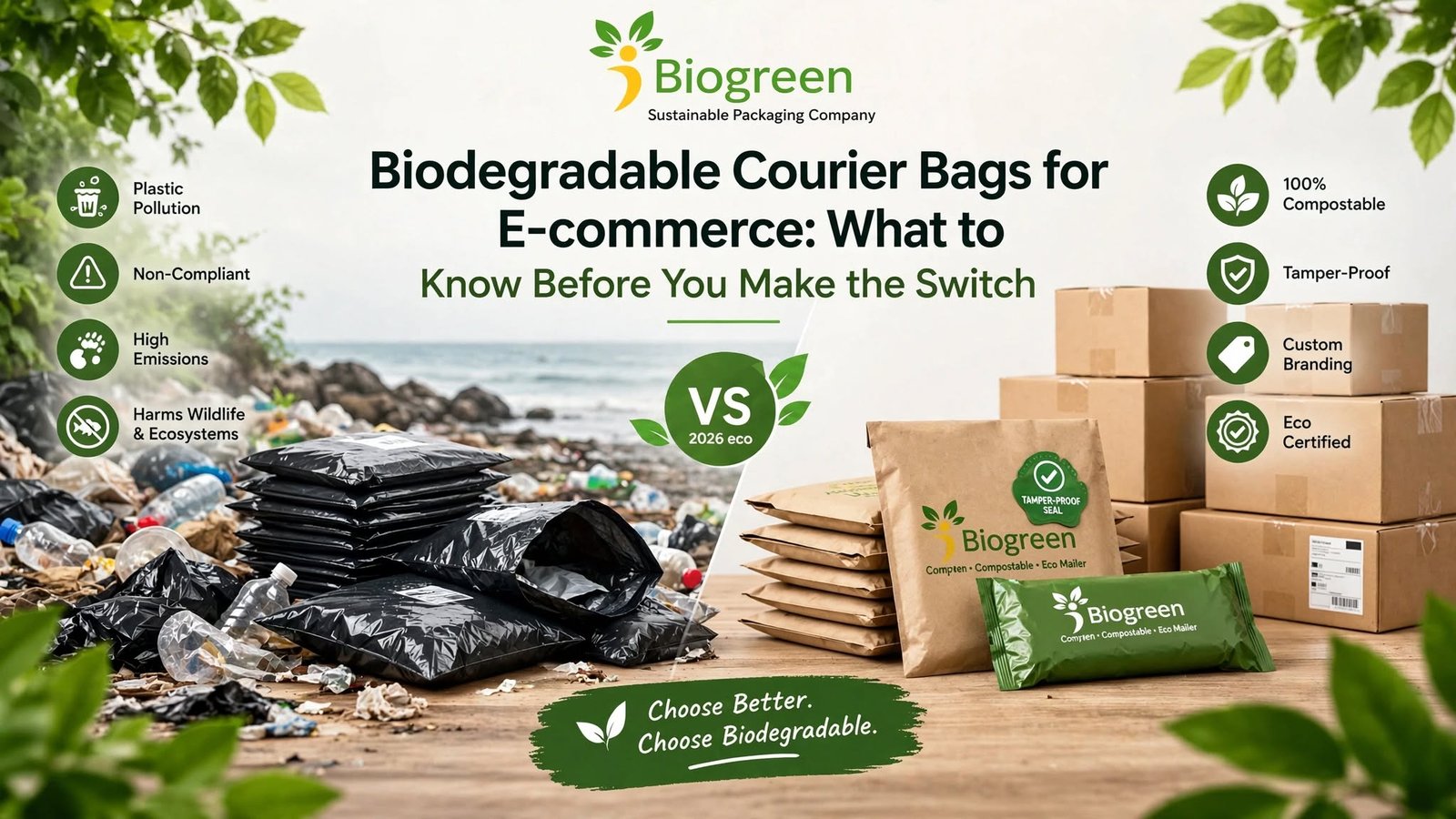
If you run an e-commerce business in India, your poly mailer bags are quietly becoming one of your bigger problems. Not operationally they work fine, they’re cheap, they protect your products during transit. The problem is what happens after your customer opens their order and tosses the bag in the bin. Standard poly mailers are made from LDPE plastic. They’re not recycled in any meaningful volume. Most end up in landfills or in some form of open waste dumping.
That’s been true for years. What’s changed is the regulatory pressure. India’s plastic ban now covers
below 120 microns, and many conventional poly mailers fall in that range. Ecommerce platforms are adding sustainability-related scoring to seller profiles. Consumers, particularly in urban markets, are starting to notice and comment on excessive plastic packaging.
So the question isn’t really whether to make the switch. It’s how to make it without compromising on protection, cost, or operational smoothness.
This guide is the honest answer to that question.
Why Ecommerce Brands Are Rethinking Their Packaging Right Now
The shift toward sustainable courier packaging in Indian e-commerce is being driven from several directions at once.
The regulatory side is the most immediate. Thin plastic mailers that fall below 120 microns are directly covered by India’s Plastic Waste Management Rules. Enforcement is tighter in 2026 than it was two years ago, particularly in major metro areas where state pollution control boards are more active.
Then there’s the marketplace pressure. Both Flipkart and Amazon India have been pushing their seller ecosystems toward more sustainable packaging practices. Sellers with better packaging scores may benefit from preferential placement or reduced logistics costs over time.
And then there’s something harder to quantify but genuinely real: customer perception. Unboxing content on social media means that your packaging is visible to more people than just your buyer. A biodegradable courier bag with a simple eco-certification mark is increasingly a positive signal. A bulging plastic mailer with no eco credentials can generate the kind of comment you’d rather not see under a product review.
What Are Biodegradable Courier Bags Made Of?
There are three main material types you’ll encounter when shopping for biodegradable or sustainable courier bags. They’re meaningfully different, and which one makes sense for your business depends on what you’re shipping and what your priorities are.
PBAT-Based Bags
PBAT (Polybutylene Adipate Terephthalate) is the most widely used material for certified compostable courier bags in India. It’s flexible, tear-resistant, and performs very similarly to conventional LDPE plastic in terms of how it handles and protects contents during transit. PBAT is typically blended with PLA (Polylactic Acid) to balance flexibility with stiffness.
These bags can carry IS 17088 or EN 13432 certification, which makes them legally compliant alternatives to standard plastic mailers under the current regulatory framework. They’re the go-to choice for most ecommerce brands making the switch because the performance difference from conventional poly mailers is minimal.
Biogreen Bags‘ biodegradable courier bags are PBAT-based and available in multiple sizes for ecommerce use.
PLA-Blended Bags
PLA on its own is more rigid and slightly less flexible than PBAT. When blended with PBAT, you get a material that’s stronger in some respects but needs to be handled a bit more carefully in cold conditions (pure PLA can become brittle at low temperatures). For most ecommerce shipping within India’s climate, PBAT–PLA blends perform excellently.
Ocean-Bound Recycled Plastic Mailers
This is a different category. Ocean-bound plastic mailers are not compostable they’re made from recycled plastic that was collected from coastal communities before it entered waterways. They’re a strong environmental choice for brands that want to use recycled content rather than compostable material.
These are particularly relevant for brands exporting to European or US markets, where recycled content in packaging is often more recognizable to consumers than compostability certifications. Biogreen carries recycled packaging options for brands with this requirement.
The right choice depends on your compliance priorities, your customer base, and your export market requirements. For domestic Indian ecommerce focused on regulatory compliance, certified compostable (PBAT-PLA) is the clearest path. For international-facing brands with sustainability storytelling around ocean plastic, the recycled option has its own strong value.
Key Features to Look For in an Ecommerce Mailer Bag
Switching materials is only worth it if the replacement actually performs in your operations. Here’s what to assess before committing to a bulk order.
Tear Resistance and Tamper Evidence
Your courier bag needs to survive the handling conditions of Indian logistics sorting facilities, multi-stop delivery chains, sometimes rough treatment at the last mile. Standard quality certified compostable mailer bags of 50 to 60 microns handle this well. Ask your supplier what tensile strength their bags are rated to, and request a sample to test with your actual product weight and dimensions.
Tamper evidence is equally important. A courier bag that can be reopened and resealed without visible sign is a security issue. Look for bags with a permanent adhesive peel strip and a visible tamper-evidence feature — typically a security void pattern or a perforated tear strip that shows if the bag has been opened.
Water Resistance and Product Safety
Certified compostable courier bags provide water resistance during normal transit conditions. They’re not waterproof indefinitely, but they’ll protect your product from rain, moisture, and condensation through the delivery process. If you’re shipping products that are highly sensitive to moisture (electronics components, certain food items, printed materials), you may want to consider an inner layer of protection in addition to the outer mailer.
Self-Sealing Mechanism
A good ecommerce mailer has a strong, reliable self-sealing adhesive strip that doesn’t require heat or additional tools. Most biodegradable courier bags on the market today use a peel-and-seal strip. Test that the adhesive holds firmly before accepting a bulk order — a bag that opens in transit is a far bigger problem than any material choice.
Custom Printing Options
If you want your brand’s logo, sustainability message, or visual identity on your courier bags, this is the right time to build it in. Most manufacturers who produce certified compostable courier bags offer custom printing. It’s worth the setup cost because your packaging is the first physical brand touchpoint your customer gets. A clean, well-printed bag with a “certified compostable” mark and your logo is doing marketing and compliance work simultaneously.
Size Guide: Which Courier Bag Size for Which Product Category?
Getting the sizing right is both a cost issue and an operational one. Bags that are too big use more material, cost more, and create a sloppy presentation. Bags that are too small require force to seal and are more likely to fail.
| Product Category | Typical Product Dimensions | Recommended Bag Size |
| Documents, books, A4 items | Up to 30 x 22 cm | Small: 25 x 35 cm |
| Folded clothing (t-shirts, shirts) | Up to 35 x 28 cm | Medium: 35 x 45 cm |
| Stacked clothing (2 to 3 garments) | Up to 40 x 32 cm | Medium-Large: 40 x 55 cm |
| Shoes (small to medium) | Up to 35 x 25 x 12 cm | Large: 45 x 60 cm |
| Multiple items, soft goods | Up to 45 x 35 cm | Extra Large: 50 x 65 cm |
| Bulky soft goods, bundled items | Larger than 45 x 35 cm | Jumbo: 60 x 75 cm and above |
A practical tip: measure your three most commonly shipped product configurations and make sure your standard bag size accommodates them all with a few centimeters to spare on each edge. Having one size that covers 80% of your orders simplifies warehouse operations considerably.
Comparing Biodegradable Mailers vs Regular Plastic Poly Mailers
Let’s be honest about the trade-offs, because pretending there are none doesn’t help you make a good decision.
| Factor | Standard Poly Mailer (LDPE) | Certified Compostable Mailer (PBAT-PLA) |
| Cost | Lower (baseline) | 15 to 30% higher at equivalent volume |
| Tear resistance | High | Comparable at 50 microns and above |
| Water resistance | Excellent | Good (comparable for normal transit) |
| Cold temperature performance | Excellent | Good (some stiffening in cold storage) |
| Regulatory compliance | Banned below 120 microns | Compliant (certified) |
| End-of-life | Landfill / microplastics | Industrial composting |
| Customer perception | Neutral to negative | Positive |
| Custom printing quality | High | High |
| Shelf life in storage | Very long | 12 to 24 months (store in cool, dry conditions) |
The cost premium is the most common hesitation. At small volumes (under 500 bags per month), it’s noticeable. At scale — 5,000 bags a month and above — the per-unit premium narrows significantly, and most brands that track the numbers find that the combined benefit of compliance, brand perception, and avoided regulatory risk justifies the cost.
How to Order in Bulk Without Getting Burned
This is where a lot of businesses make expensive mistakes. Here’s how to approach a bulk order intelligently.
What MOQ to Expect
Most certified compostable courier bag manufacturers in India have minimum order quantities in the range of 500 to 2,000 bags per size variant. Some will do smaller sample runs for a higher per-unit cost. If a supplier claims no MOQ at standard pricing, check the certification claim carefully.
How to Request Samples First
Any reputable manufacturer will send you physical samples before you commit to a bulk order. Use them in your actual packing operations. Pack your most common product type. Seal the bag. Drop it from waist height. Leave it sealed for a week and check the seal is still holding. Run it under water briefly and check the internal paper or product is dry.
Do this before you place any order larger than a trial run. The few hundred rupees you spend on a sample evaluation will save you from a large order you can’t use.
Also verify the certification documentation during the sample stage. Ask for a copy of the IS 17088 or EN 13432 certificate. A legitimate manufacturer will provide this without hesitation. If they can’t, keep looking.
Conclusion
Before you place your first bulk order of biodegradable courier bags, run through this list:
- Confirm certification (IS 17088 or EN 13432) with documentation from the supplier
- Request and test physical samples with your actual most-shipped products
- Verify the sealing mechanism holds under your typical packing conditions
- Check storage requirements and available shelf life for your order volume
- Confirm size range covers your product portfolio
- Ask about custom printing if needed, and get a quote with setup costs included
- Get bulk pricing tiers so you know the per-unit cost at your projected monthly volume
- Brief your packing team on any differences in handling
Ready to get started? Browse Biogreen Bags’ biodegradable courier bags and request a sample to test in your operations. For custom print enquiries or bulk pricing, contact their sales team directly.
You can also explore biodegradable bubble wrap for inner packaging protection, and zip lock bags for smaller item packaging within shipments.
FAQs
Are biodegradable courier bags as strong as regular poly mailers?
At the same thickness (50 microns), PBAT-PLA compostable bags perform comparably to LDPE poly mailers for tear resistance and handling. The performance difference is minimal for most shipping scenarios.
Can I get custom-printed biodegradable mailer bags?
Yes most manufacturers offer flexographic printing in 1 to 4 colours. Setup costs apply for new designs, but per-unit print cost is comparable to standard poly mailers.
How long do biodegradable courier bags take to break down?
In industrial composting conditions, 90 to 180 days. In cool, dry storage, they have a shelf life of 12 to 24 months they won’t start breaking down on your shelf.
What’s the minimum order quantity for bulk biodegradable courier bags?
MOQ varies by size and print specification. Contact Biogreen Bags’ sales team for current MOQ and bulk pricing tiers.
Are these bags approved for use under India’s plastic ban?
Yes, certified compostable courier bags meeting IS 17088 or EN 13432 are legally compliant alternatives to plastic poly mailers. Ask your supplier for the certification document to confirm.