Bengaluru, India · Dubai, UAE



How to Start a Compostable Product Manufacturing Business in India (2026 Guide)


Thinking about starting a compostable product manufacturing business? It is one of the few manufacturing ideas in India where demand is being pushed by both law and customers at the same time. Plastic carry bags below the permitted thickness are banned, cities are enforcing waste segregation, and brands want packaging that does not end up as microplastics.
But it is not as simple as buying a machine and switching it on. Compostable material behaves differently from plastic, and many new units lose money in the first year because nobody told them that. We have been making compostable products for over 15 years and have helped many entrepreneurs set up their units, so this guide covers what actually matters.
Why a compostable bag business makes sense now
- Steady demand: shops, supermarkets, hotels, hospitals, housing societies and online brands all need bags every single day.
- Repeat orders: bags are a consumable. A customer who likes your quality comes back every month.
- Room to grow: you can start with carry bags and add garbage bags, courier bags, garment bags and pouches using the same core setup.
- Government push: single-use plastic rules keep getting stricter, which keeps sending buyers towards compostable options.
Products you can make
Most units start with one or two products and expand later:
| Product | Main buyers |
| Carry bags (W-cut, D-cut, U-cut) | Retail shops, pharmacies, bakeries |
| Garbage bags | Homes, offices, hotels, municipal bodies |
| Grocery and vegetable bags | Supermarkets, vendors |
| Courier and garment bags | E-commerce and fashion brands |
| Food pouches | Hotels, tiffin services, takeaways |
| Nursery bags | Nurseries, farmers |
Carry bags and garbage bags are usually the easiest place to start because the demand is everywhere and the specs are simple.
Raw material: what compostable bags are made of

Compostable bags are made from compostable granules, a blend of biopolymers such as PBAT and PLA with plant-based starch and fillers. The blend decides how strong, stretchy and smooth your bag will be.
This is the most important decision in your business. Cheap or inconsistent granules cause holes in film, weak seals and bags that break down on the shelf. Our compostable carry bag granules are made for blown film and are used by bag makers across India. If you want to understand the base polymers, read our guide on PLA vs PBAT vs PBS, and see our PBAT biodegradable polymer page.
You may also need:
- Compostable filler to balance cost and strength
- Colour masterbatch for green, white or custom coloured bags
The manufacturing process, step by step
- Film blowing: granules are melted in a blown film extrusion machine and blown into a thin tube of film. Temperature and speed must be set for compostable material, which runs differently from polyethylene.
- Printing: if the customer wants a logo, the film roll goes through a flexographic printing machine.
- Cutting and sealing: a bag making machine cuts the film to size and seals the bottom or sides. For carry bags, a punching unit makes the W-cut, D-cut or U-cut handle.
- Quality check and packing: bags are checked for seal strength, size and thickness, then counted and packed.
Machines you need
- Blown film extrusion machine (the heart of the unit)
- Bag cutting and sealing machine
- Handle punching unit for carry bags
- Flexographic printing machine (optional at first; you can outsource printing)
- Weighing scale, thickness gauge and basic testing tools
Many existing plastic film machines can run compostable granules with the right settings and minor changes. Get advice before buying new equipment.
Costs to plan for
Your total investment depends on capacity, machine brand and location. Plan for these heads:
- Land or rented shed with proper power connection
- Machines and installation
- Raw material for the first few months
- Labour (machine operators, helpers, quality staff)
- Electricity, which is a big running cost for extrusion
- Business registrations and approvals
- Working capital, since many buyers pay on credit
Get two or three quotations for machines and a written raw material quote before you finalise your project report.
Common mistakes new units make
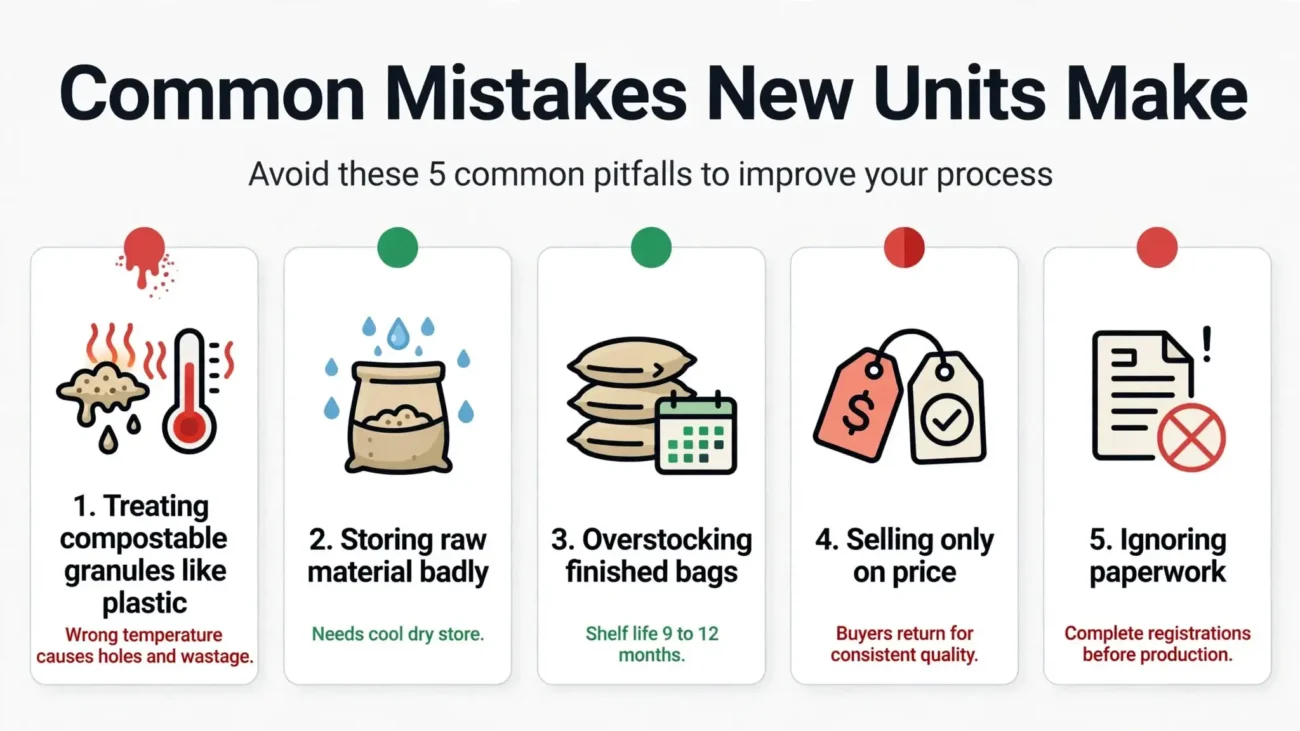
- Treating compostable granules like plastic. Wrong temperature settings cause holes and wastage.
- Storing raw material badly. Granules need a cool, dry store. Moisture ruins film quality.
- Overstocking finished bags. Compostable bags have a shelf life of around 9 to 12 months, so produce close to demand.
- Selling only on price. Buyers who come back are the ones who get consistent quality.
- Ignoring paperwork. Complete every registration and approval your state requires before production starts.
How Biogreen helps you start
Biogreen does more than sell granules. Through our manufacturing setup support, we help you plan your factory layout, choose and source the right machines, and set up production. Our R&D team helps fine-tune your film settings, and we provide ongoing technical support once you start.
In short, a compostable product manufacturing business works best when your raw material supplier is also your technical partner.
Frequently Asked Questions
What is the manufacturing cost of biodegradable bags?
The cost per kilo depends mainly on the raw material blend, electricity, labour and wastage. Raw material is usually the largest part. Using the right granules and machine settings keeps wastage low, which has a big effect on your final cost.
How much do biodegradable bags cost?
Compostable bags cost more than plastic bags because the raw material is more expensive. Prices vary by size, thickness, printing and order quantity. Buying in bulk directly from a manufacturer is the cheapest option for regular users.
Is bag business profitable?
Yes, it can be, because bags are bought again and again. Profit depends on steady customers, low wastage, good raw material and managing working capital well. Units that focus on consistent quality usually build repeat orders faster.
What are 100% compostable bags made of?
They are made from compostable granules, which are blends of biopolymers like PBAT and PLA with plant-based starch. These materials break down into water, carbon dioxide and compost in composting conditions.
Who are some manufacturers of biodegradable bag-making machines in India?
Several Indian companies make blown film and bag-making machines. Since compostable material runs differently from plastic, choose a machine maker that has run compostable granules before, and ask your raw material supplier which machines they recommend.
What is the cost of a plastic bag manufacturing plant?
It depends on capacity, machines and location. A compostable bag plant uses similar machines to a plastic bag plant, but the raw material costs more. Prepare a detailed project report with real quotations before investing.
Who are some manufacturers of biodegradable carry bags in India?
India has many manufacturers. Biogreen Biotech makes compostable carry bags and also supplies granules and setup support to other bag makers.