Bengaluru, India · Dubai, UAE




Compostable Bags for Restaurants: Which Bag Type Should You Use for Takeaway Orders?

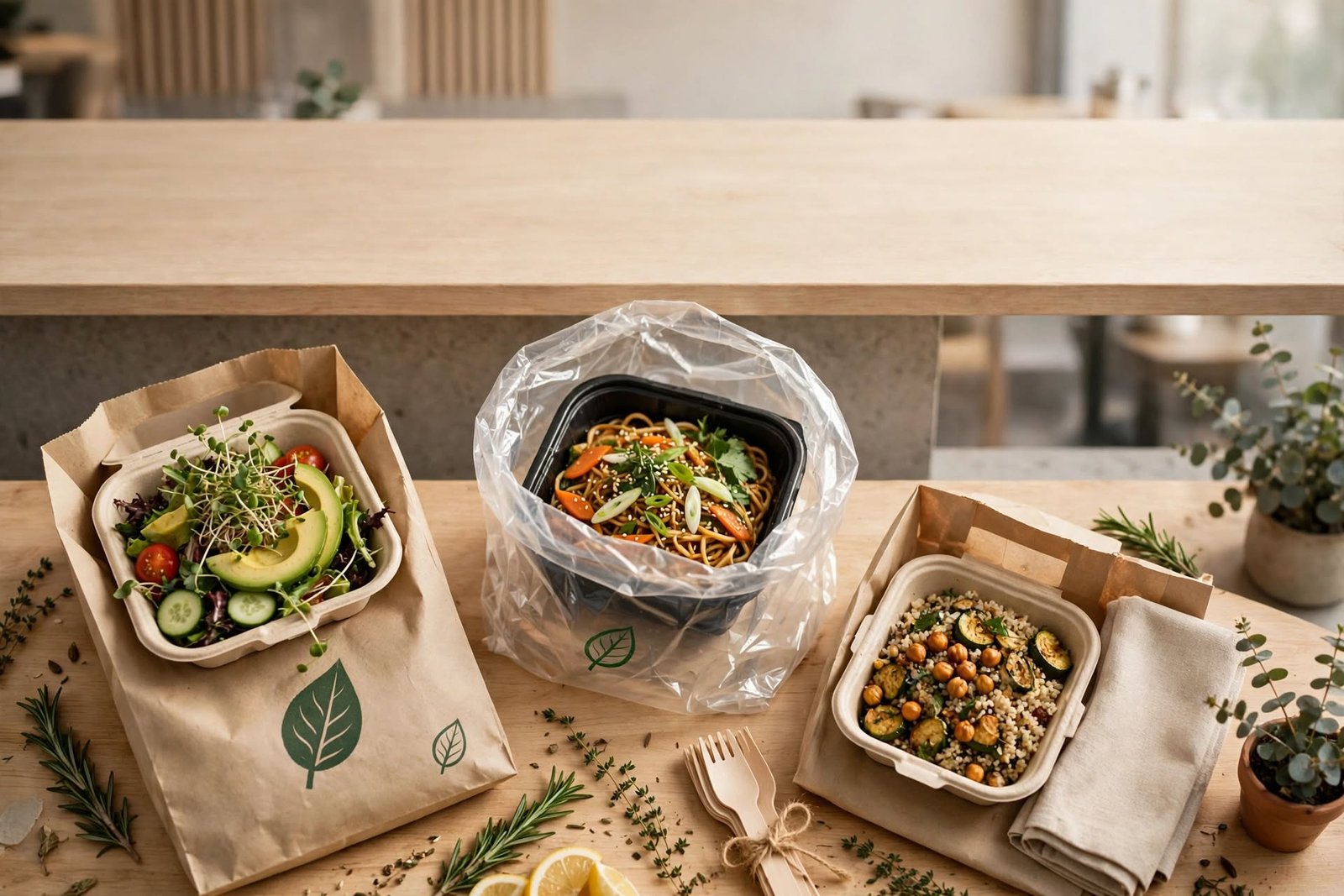
A takeaway order travels further than most restaurant owners imagine. It leaves the kitchen, sits on a counter, goes into a delivery bag, rides on a scooter for twenty minutes and finally lands on a customer’s dining table. Somewhere along that route, the bag either holds up or it does not. One torn handle or one leaking container, and the customer remembers your restaurant for the wrong reason.
If you are thinking of moving to compostable bags for restaurants, the first thing to understand is that there is no single bag that fits every order. Different foods need different formats. This guide helps you match the bag to the order, so your takeaway packaging works as well as your food does.
Why restaurants are moving away from plastic takeaway bags
There are practical reasons, not only environmental ones. Since 1 July 2022, a list of single-use plastic items has been banned in India, and plastic carry bags thinner than 120 microns are not permitted. Compostable plastic commodities are kept outside those prohibitions, provided the manufacturer holds a CPCB certificate. State and city rules add more restrictions on top, so restaurants that depend on thin plastic bags face a real risk of fines and stock seizures during inspections.
There is also a customer side. Younger diners, corporate buyers and cloud kitchens that sell on aggregator apps often get asked about packaging. Having certified compostable bags gives you something concrete to say.
The main compostable bag types for takeaway
1. Compostable carry bags (D-cut, W-cut and loop handle)
These are the everyday bags used at the billing counter. A W-cut bag has a thin handle shape cut into a flat film and is best for light items like sealed boxes, sweets and bakery goods. A D-cut bag has a sturdier punched handle and holds heavier orders. Loop-handle bags are more comfortable to carry and suit larger orders. Browse the range on the compostable carry bags page.
2. Compostable grocery and bulk bags
A grocery-style bag is wider and thicker, designed for several items at once. Restaurants that sell packaged food, bottled drinks, family-pack meals, or catering orders will find this format more useful than a small carry bag. See the compostable grocery bag for this style.
3. Stand-up pouches and pouches for liquids
For sauces, chutneys, sambar, soups and dips, a pouch with a good seal is safer than a loose bag. Biogreen lists sambar pouches in its range, and biodegradable stand-up pouches work well for dry snacks, spice mixes and ready-to-cook items.
4. Compostable containers, bowls, and meal trays
Here is a point many owners miss: a bag is only the outer carrier. The food itself should sit in a proper container. Gravy, biryani, dal and curries belong in a bowl or tray, and then the container goes into the bag. A compostable leak proof food bowl or a cornstarch meal tray gives you that inner layer without bringing back plastic or foam.
Match the bag to the order: a quick chart
Order type | Best option | What to watch |
|---|---|---|
Dry snacks, sweets, bakery | W-cut or D-cut carry bag | Check handle strength with a full load. |
Rice meals, biryani, thali | Compostable container or tray inside a grocery or D-cut bag | The container lid must close firmly. |
Gravy, curry, soup | Leak-proof bowl with lid, then a carry bag | Never pour hot gravy directly into a film bag. |
Sauces and dips | Compostable pouch with sealed top | Seal strength and heat tolerance |
Catering and bulk orders | Large grocery bag, thicker micron | Weight limit per bag |
Cold drinks and desserts | Carry bag with a tray or cup holder. | Condensation on cold items can weaken wet film. |
Hot food, oil and moisture: what compostable film can and cannot do
Compostable bags are made from biopolymers like PBAT and PLA, and these materials respond to heat differently from LDPE. PLA in particular softens at relatively low temperatures. A bag that carries a sealed, closed container is fine. A bag that is filled directly with hot, oily food may sag, sweat or fail at the seam.
So treat the compostable bag as a carrier and not as a food container, unless the manufacturer has specifically told you it is suitable for direct hot food and given you the heat range in writing. Ask also for food-contact suitability documents in line with the FSSAI packaging requirements, particularly if the film will touch food directly, like in a snack pouch.
Strength and size: how to choose without wasting money
- Weigh your typical order. A solo meal with two containers weighs about 700 g to 1 kg. A family order can cross 3 kg. Choose the bag by your heaviest common order, not your lightest.
- Pick two or three sizes. A small, a medium and a large cover almost every restaurant. More sizes increase your stock holding and your cost.
- Do a handle test. Fill a sample bag with the real containers, lift it by the handle and hold it for a minute. Then swing it gently. Handles tear at the joint, so check that point.
- Check width for container fit. Many bags fail not because they are weak, but because the container does not fit and gets squeezed.
Certification checks restaurants should not skip
A restaurant that buys uncertified bags marked “biodegradable” is taking a real risk. Here is what to ask the supplier:
- A valid CPCB certificate number for the manufacturer
- A test report under IS/ISO 17088 from a recognised laboratory
- The label “compostable only under industrial composting” on the product or pack
- A QR code or printed code that links to the manufacturer details
- A written statement on food-contact suitability, if the bag touches food
Manufacturers that are open about this will share it without delay. Biogreen, for instance, displays its CPCB and CIPET details on a public certifications page. A supplier who avoids sharing papers has told you something important.
What to tell your customers
Be careful with the words you print on your packaging and your menu. Because the rules specify industrial composting, avoid claims like “dissolves in 30 days” or “safe for home compost”. A line such as “Our takeaway bags are made from certified compostable material” is accurate and enough. If your city has a composting partner, you can add a short disposal tip.
A simple switch plan for a restaurant or cloud kitchen
- Note down the six most common order types you pack in a week.
- Match each to a bag and container from the chart above.
- Order samples of two bag sizes and one container type.
- Test during a busy dinner service with real food and real delivery partners.
- Collect feedback from your delivery riders. They notice handle and seal problems before anyone else.
- Order for one month, track tear and leak complaints, then scale.
Final thoughts
The right compostable takeaway packaging is a system: a carry bag for the outside, a proper container for the food, and a pouch for sauces. Choose each part for its job, test with real orders, and verify the paperwork. That way, your packaging protects the food, keeps you compliant and says something good about your restaurant.
Need a sample pack for your menu? Talk to the Biogreen team and share your order types, and they can suggest the right mix.
Frequently Asked Questions
Can I put hot food directly in a compostable carry bag?
It is not advised. Place hot food in a container with a lid and use the bag as the outer carrier, unless the manufacturer has confirmed direct hot food suitability in writing.
Are compostable carry bags allowed under the single-use plastic ban?
Compostable plastic commodities are kept outside the single-use plastic prohibition and the 120 micron rule, if the manufacturer holds a CPCB certificate. Also check your state or city rules.
Do compostable bags cost more than plastic bags?
Usually yes, because the raw material is more expensive. Compare the cost per usable bag, including tear losses and compliance risk, instead of price per kg.
Can I get my restaurant logo printed on the bags?
Most manufacturers offer printing on compostable film. Confirm the ink type and minimum order quantity before approving a design.
How long can I store compostable bags in my kitchen store?
Keep them in a cool, dry spot away from heat and moisture, and ask your supplier for a recommended storage period.