Bengaluru, India · Dubai, UAE




Compostable Courier Bags for E-commerce in India: Sizes, Strength, Cost & Certification Guide

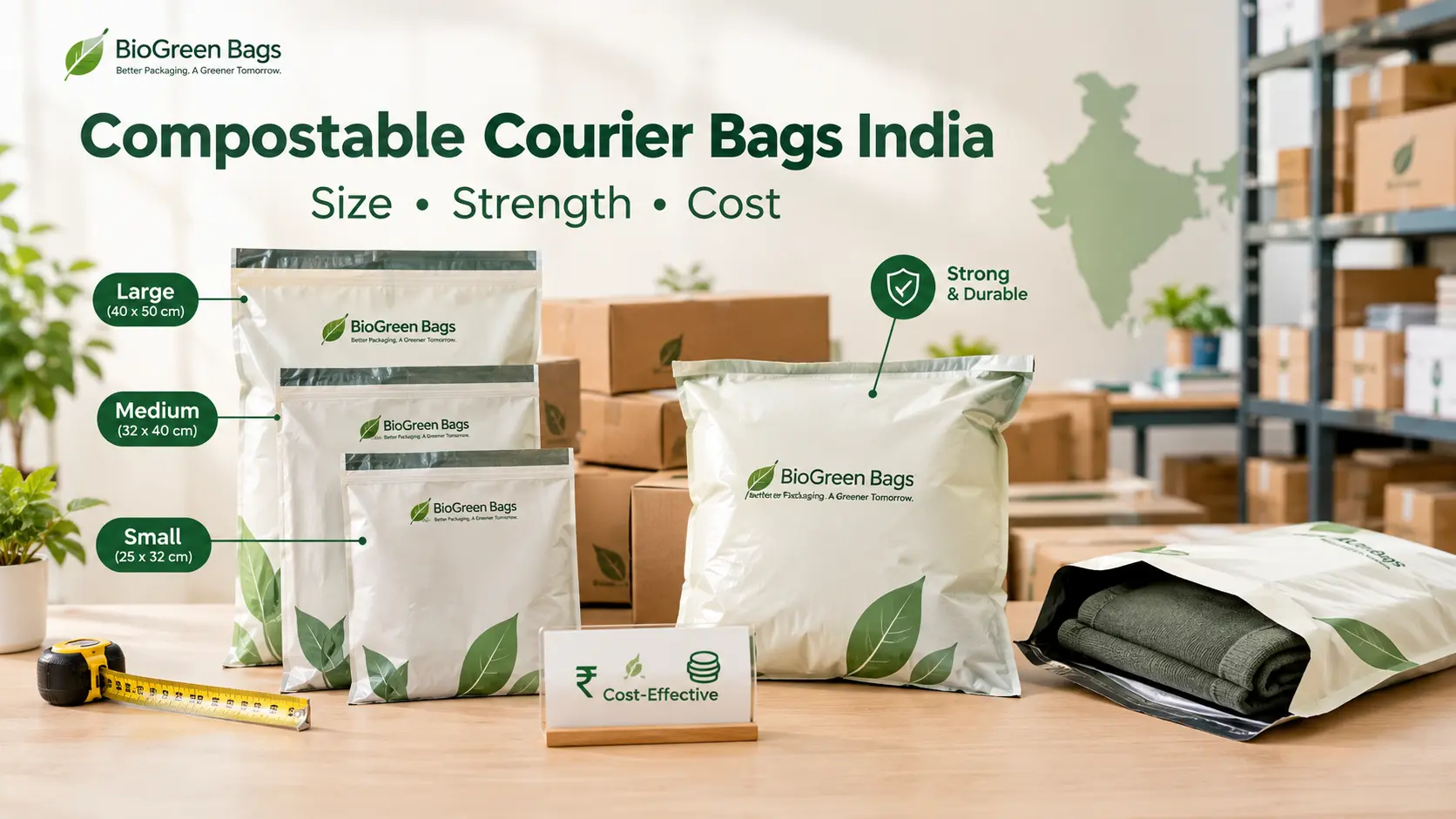
If you ship even 300 orders a month, the courier bag is probably the cheapest part of your packaging and the one customers touch first. It is also the part that ends up in the bin within a minute of delivery. That is why more Indian sellers are asking a simple question: can the bag itself be made from something that is meant to break down?
Compostable courier bags are the answer many sellers are trying. But the market is full of confusing claims, and a wrong purchase means torn bags, angry customers and a certificate you cannot show anyone. This guide explains sizes, strength, cost and certification in plain terms, so you can place your first order with confidence.
What are compostable courier bags?
A courier bag, also called a mailer or poly mailer, is the sealed, tamper-evident bag used to ship garments, accessories, books and other soft goods. A conventional one is made from LDPE or HDPE film. A compostable version replaces that film with a blend of biopolymers such as PBAT, PLA and starch-based fillers, so the bag can break down in a composting environment.
Two words get mixed up all the time, so it helps to separate them. “Biodegradable bags” is a loose term. Almost anything biodegrades if you wait long enough. Compostable is a tested claim: the material must disintegrate and biodegrade within a set time under composting conditions, and leave no harmful residue. In India, that test standard is IS/ISO 17088, and the 2024 amendment to the Plastic Waste Management Rules asks compostable plastic products to follow the 2021 version of it.
Biogreen makes its compostable film from PBAT-based material, and you can see the finished product on the biodegradable courier bag page.
Why Indian e-commerce sellers are making the switch
- Rules are tightening for ordinary plastic. Plastic carry bags below 120 microns are no longer allowed under the 2021 amendment, and identified single-use plastic items have been banned since 1 July 2022. Commodities made of compostable plastic are kept outside those prohibitions, as long as the maker holds a CPCB certificate.
- Marketplaces and buyers are asking questions. Larger brands and export buyers now ask for packaging declarations, and a certified compostable bag gives you a document to hand over.
- The unboxing matters. A customer who buys an eco-friendly product and receives it in a plain plastic bag notices the mismatch.
- EPR is a real obligation. If you are a brand owner, plastic packaging falls under Extended Producer Responsibility. Compostable packaging has its own place in that framework, so talk to your compliance advisor about how to report it.
Courier bag sizes: how to pick the right one
Courier bag sizes in India are quoted as length by width in inches, and most sellers add a flap of about 2 inches for the adhesive strip. Common ready sizes stocked by packaging suppliers are 6×8, 8×10, 10×12, 10×14, 12×16 and 14×18. Custom sizes are possible with most manufacturers once you cross a minimum order.
| Size (inches) | Typically suits |
|---|---|
| 6 x 8 | Jewellery, cosmetics, phone accessories, small gift items |
| 8 x 10 | Books, notebooks, small kids’ wear, wallets |
| 10 x 12 | Folded T-shirt, kurti top, small shoe accessories |
| 10 x 14 | Two folded garments, leggings, a small box |
| 12 x 16 | Jeans, hoodies, ethnic wear sets |
| 14 x 18 | Bulky clothing, bed linen, multi-item orders |
A simple rule: fold the product the way you ship it, measure its length and width, then add 1 inch on each dimension. A bag that is too tight stresses the seal. A bag that is too big wastes film and moves around in transit. If you ship garments, the compostable garment bag is a better fit for folded stacks or premium pieces that need a cleaner look.
Strength: understanding microns and what actually matters
Thickness is measured in microns. Plain courier bags sold to Indian sellers usually sit around 60 to 75 microns. Some compostable courier bags in the market are made at about 40 microns, and still work for light goods because PBAT film is stretchy and resists tearing. So a lower micron number does not automatically mean a weaker bag. The blend, the filler ratio and the sealing quality decide how it behaves.
Use the table below as a starting point only. Every order should be confirmed with a sample test, because film from two manufacturers at the same micron can behave very differently.
| Product weight | Starting micron range to ask for | Notes |
|---|---|---|
| Up to 500 g | 40 to 50 | T-shirts, accessories, light cosmetics |
| 500 g to 1.5 kg | 50 to 60 | Jeans, hoodies, multi-item orders |
| 1.5 kg to 3 kg | 60 to 80 | Heavy sets, items with corners or hard edges |
Five quick tests before you approve a sample
- Drop test. Pack a real order and drop it from about one metre, on a corner, three or four times.
- Seal pull test. Seal the bag and pull both sides apart. The adhesive strip should hold, and the film should tear before the seal opens.
- Edge test. Put a box corner or a hard hanger inside and press from outside. Watch for puncture.
- Splash test. Pour a little water on the outside and leave it for ten minutes. Compostable film resists splashes, but it is not meant to be a submerged container.
- Storage test. Keep a few bags in your warehouse for a few weeks, especially in a hot or humid city. Check whether they go brittle or the adhesive weakens.
Cost: what decides the price per bag
Sellers often compare compostable and plain bags by price per kg, which is misleading. What matters is the landed cost per usable bag. For reference, a plain 75 micron 10×12 courier bag with a 2 inch flap sells at around ₹508 for a pack of 100 on a leading logistics-packaging store, which works out to roughly ₹5 a bag. Compostable bags usually cost more than that, because the raw material is more expensive than virgin LDPE.
These are the factors that move the price:
- Micron thickness and film weight per bag
- Bag size and flap size
- Printing: number of colours, full-bleed or one-colour logo
- Adhesive type, tamper-evident or plain
- Order quantity and whether the size is custom
- Certified material versus uncertified blends
An illustration, not a quotation: suppose a plain bag costs ₹5 and a compostable one costs ₹8. At 5,000 shipments a month, the extra spend is ₹15,000. If a switch cuts even a small share of damage claims, wins a repeat customer or satisfies a brand buyer, that extra amount can be justified. If a lower micron compostable bag does the job, the gap shrinks further. The point is to calculate it, not guess it. For help on working out volumes, see our blog on how to calculate your monthly compostable bag requirement.
Certification: what to check before you pay
This is where most buyers get caught. Under the Plastic Waste Management Rules, manufacturers of compostable plastic carry bags and commodities must obtain a certificate from the Central Pollution Control Board before they market or sell. CPCB’s process requires a test report under IS/ISO 17088 from a recognised laboratory, covering disintegration during composting and ultimate aerobic biodegradation. Certified products carry a printed code, a certificate number and a QR code linked to the manufacturer’s details.
So before you place an order, ask for these five things:
- The CPCB certificate number and the plant address it was issued for
- The test report from a CPCB-recognised laboratory such as CIPET
- Confirmation that the certificate covers the exact product you are buying
- A bag printed with the code, certificate number and the label “compostable only under industrial composting”
- A working QR code that opens the manufacturer’s certification details
As an example of what good disclosure looks like, Biogreen publishes its CPCB certificate number, plant location, raw material and CIPET test figures on its certifications page. The CIPET report shows disintegration of 91.2 percent and biodegradation of 90.04 percent against a requirement of more than 90 percent. Whoever you buy from, ask for the same level of detail.
An honest note on disposal
Compostable does not mean the bag will vanish in a roadside heap or a home bin. Indian rules require the label “compostable only under industrial composting”, and industrial composting capacity is still limited in many cities. If you print “home compostable” or “disappears in 90 days” on your bag or website, you are making a claim the rules do not support, and it can hurt your brand.
A safer approach is to tell customers plainly: this bag is made from certified compostable material, and it is best handed to a facility that accepts it. If you sell in a city with a composting partner, mention it. Your customers will trust a clear statement more than a big green promise.
How to place your first order, step by step
- List your top five products by volume and note their folded dimensions and weight.
- Pick one or two bag sizes that cover most orders. Fewer sizes means better pricing.
- Ask for free samples and the certificate documents together.
- Run the five tests above with real orders, not empty bags.
- Place a pilot order of one month’s requirement, then move to bulk after a clean pilot.
If you ship fragile items, pair the bag with protective wrap. A biodegradable bubble wrap roll keeps the whole pack consistent, instead of a compostable bag wrapped around conventional plastic cushioning.
Final thoughts
A compostable courier bag is a small switch with a visible effect. Get the size right, test the strength with real products, confirm the CPCB paperwork, and be honest about disposal. Do these four things and you will avoid most of the mistakes sellers make in their first order.
Want to try before you buy? Visit the biodegradable courier bag page or contact the Biogreen team to request samples and certificate copies for your product
Frequently Asked Questions
Are compostable courier bags waterproof?
They are water resistant, which is enough for rain splashes and wet roads during delivery. They are not meant to hold liquids or sit in standing water for long.
Can I print my brand logo on compostable courier bags?
Yes, most manufacturers offer one-colour or multi-colour printing. Ask which inks they use and confirm they are suitable for compostable film, because ink can affect certification.
Do compostable courier bags have a shelf life?
Yes. Biopolymer film is sensitive to heat and humidity, so store the bags in a cool, dry place away from direct sunlight and ask your supplier for the recommended storage period.
Is a lower micron compostable bag always weaker?
No. PBAT-based film is flexible and tear resistant, so a 40 to 50 micron compostable bag can hold light garments. Always test with your real products before committing to a bulk order.
What is the minimum order for custom size courier bags?
It depends on the manufacturer. Many ask for a minimum by weight or by quantity. Share your size, micron and print requirement and ask for a written quote.