Blog
Sustainable Packaging for Cloud Kitchens: A Practical Starting Guide for 2026

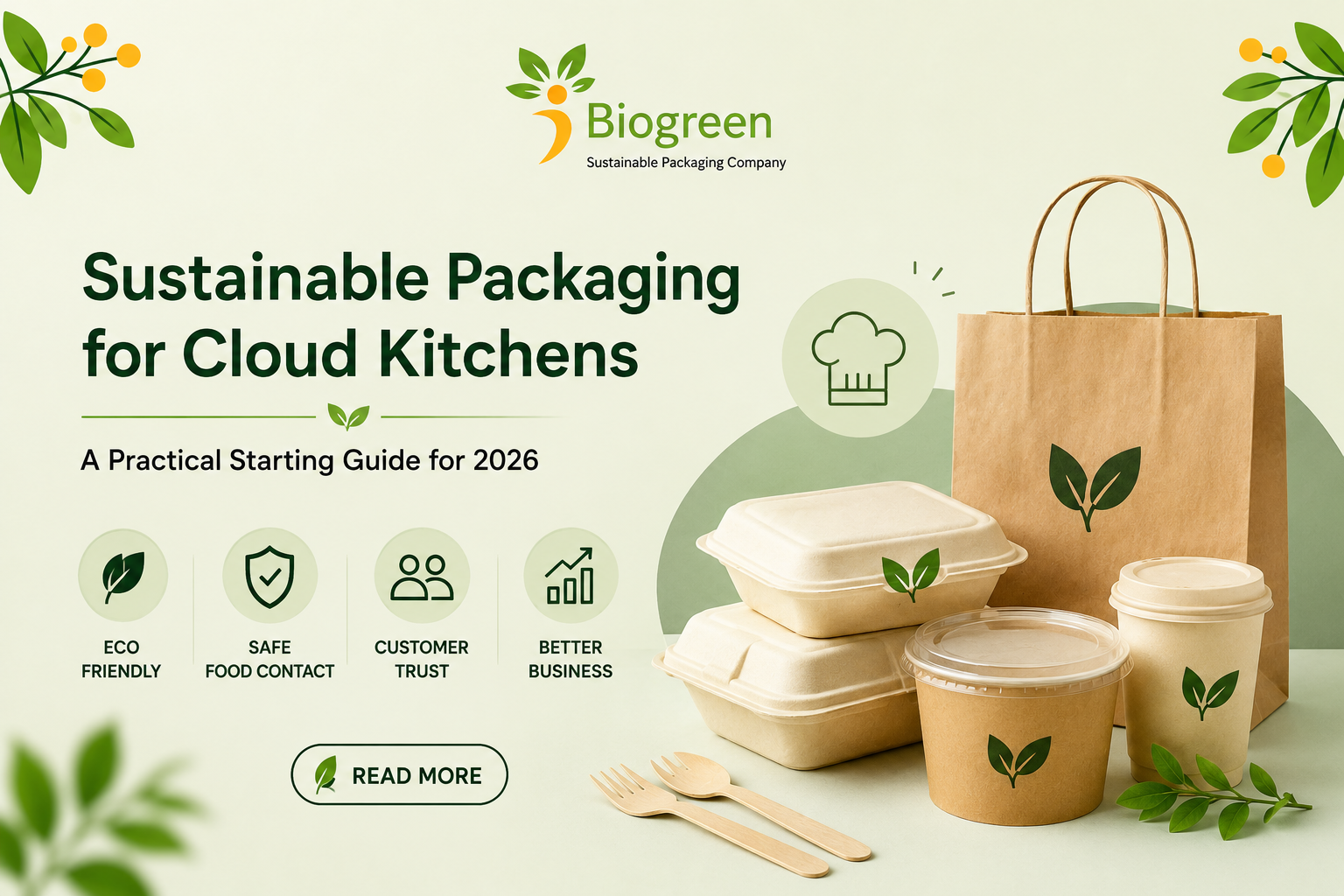
Running a cloud kitchen is already demanding. You’re managing food quality, delivery times, aggregator ratings, and kitchen staff, all while competing in one of India’s fastest-moving food businesses. Packaging is supposed to be the boring part — the thing that just works without you having to think about it too hard.
But packaging has become a problem that’s harder to ignore. The plastic ban is real, and it covers several items that cloud kitchens rely on every day. Zomato and Swiggy are increasingly vocal about sustainability in their partner messaging. And customers — especially in metro areas — are paying more attention to what their food arrives in than they were even two years ago.
The good news is that switching to sustainable packaging for a cloud kitchen is genuinely manageable. It doesn’t require a full operational overhaul. It doesn’t cost as much as most people assume. And in 2026, there are enough high-quality certified compostable and eco-friendly options in India that you’re not making any real compromises on functionality.
This guide walks through every core packaging item in a typical cloud kitchen and tells you the truth about what the best sustainable alternative is, what it costs, and what to watch out for.
Why Food Delivery Packaging Is One of the Biggest Plastic Problems in India Right Now
Let’s put a number on it. India’s food delivery market handled over 8 billion orders in 2024, and the number keeps climbing. Every single one of those orders involved at least one piece of packaging—a bag, a container, a set of cutlery, or a straw. Many involved five or six pieces.
Most of that packaging was plastic. And most of it was single-use. The journey of a standard cloud kitchen order goes from plastic container to delivery bag to customer’s bin to landfill (or, more accurately, to the nearest open pile of waste). The entire product lifespan is measured in hours.
India’s July 2022 plastic ban directly addressed this by prohibiting plastic cutlery, straws, stirrers, and thermocol packaging. But enforcement has been uneven, and many kitchens are still using banned items simply because they haven’t been checked yet. That’s a risk worth taking seriously in 2026.
Beyond the regulatory angle, there’s something worth acknowledging: customers who order food two or three times a week are generating a noticeable amount of packaging waste, and many of them are becoming more conscious of it. A kitchen that’s visibly doing something about this is building a type of trust that’s harder to fake than a good rating.
What Sustainable Packaging Actually Means for a Cloud Kitchen
Before getting into specifics, it’s worth being clear about what we mean by sustainable here, because the term gets stretched.
Sustainable packaging for a food business has three practical dimensions:
Regulatory compliance: Your packaging should not include items covered by India’s plastic ban. This is the floor, not the ceiling.
Environmental outcome: The packaging materials should have a genuinely better environmental footprint than conventional plastic alternatives. “Biodegradable” labels without certification don’t count. Look for IS 17088 or EN 13432 certified compostable materials or verified recycled content.
Functional adequacy: A bowl that leaks curry, a straw that collapses in a cold drink, or a bag that tears before the delivery reaches the customer is not a viable packaging solution, regardless of how eco-friendly it is. Every sustainable option discussed here passes a functional test for typical cloud kitchen use.
The Core Packaging Items Your Kitchen Needs — and the Best Eco Alternatives
Food Bowls and Containers
The container is usually the most important and most expensive packaging decision a kitchen makes. For cloud kitchens serving curries, biryanis, gravies, or anything with significant liquid content, the container needs to be leak-proof, heat-resistant, and sturdy enough to survive a delivery ride.
Best sustainable options:
Compostable plastic bowls and containers: made from CPLA or PBAT-PLA blends are probably the closest functional equivalent to conventional plastic containers. They handle heat well (up to about 90 degrees Celsius for most CPLA products), are genuinely leak-proof when sealed correctly, and are certified compostable under recognized standards. Biogreen’s compostable leak-proof food bowls are specifically designed for liquid-heavy Indian food dishes.
Bagasse containers: are made from the fibrous residue of sugarcane processing. They’re sturdy, handle moderate moisture well, and are home compostable. They tend to be slightly less liquid-tight over extended periods than compostable plastic containers, which is worth knowing if your dishes have significant gravy. For fried foods, rice dishes, or anything drier, bagasse containers perform very well and often feel more premium than plastic.
Avoid: conventional polystyrene (thermocol) containers entirely—they’re banned, non-recyclable, and a liability in any compliance audit. Also be cautious about containers labelled “biodegradable” without IS 17088 or similar certification.
Cling Wrap for Storage and Order Packaging
Cling wrap is used heavily in cloud kitchen operations—wrapping individual items within a container, sealing freshly prepped ingredients, and securing lids during delivery. Standard PVC cling wrap is problematic: it contains plasticisers, is difficult to recycle, and is facing increasing regulatory scrutiny.
Certified compostable cling wrap made from PBAT or plant-derived materials performs comparably to PVC wrap for most kitchen applications. It clings adequately, is food safe for direct contact, and breaks down properly in composting conditions. Biogreen’s biodegradable cling wrap is food-safe certified and available in commercial roll sizes suitable for cloud kitchen operations.
The main practical note: Compostable cling wrap typically has a slightly lower cling strength than PVC wrap in cold, dry environments. For most hot kitchen applications this isn’t noticeable. If your staff is cold-storing a lot of prepped items, test the wrap in your specific temperature conditions before fully switching.
Straws
Plastic straws are banned under the July 2022 notification. If your kitchen is still using them, this is the highest-priority switch on this list.
The sustainable alternatives that actually work:
Paper straws: are the most widely available and the most affordable. The main complaint is that they soften in cold drinks over time. For drinks consumed quickly, this isn’t an issue. For longer-duration beverages, the quality matters — cheap paper straws can get soggy quickly, while higher-quality versions hold up for 30 to 45 minutes.
CPLA straws: are made from crystallised PLA, a bioplastic. They perform almost identically to plastic straws — same rigidity, no softening, suitable for both hot and cold beverages. They’re more expensive than paper but a much better experience, particularly for thick beverages like milkshakes.
Bamboo and wheat straw straws: are natural, compostable, and work well. They do have a slightly different feel and are better suited to cold beverages than very hot ones.
Cutlery
Biogreen’s biodegradable straws cover the compostable option in formats suitable for both cold drinks and hot teas.
Plastic spoons, forks, and knives are banned. The functional replacements have improved substantially in the last two years.
CPLA cutlery is the most durable compostable option. These spoons and forks are stiff enough to handle Indian food dishes—thick dals, rice, and solid curries—without bending or breaking in the way that early versions of compostable cutlery used to. Biogreen’s biodegradable spoons are CPLA-based and rated for standard food service use.
Wooden and bamboo cutlery works well for many applications and carries a premium, artisan feel that some brands lean into deliberately. It’s food-safe, compostable, and reasonably priced in bulk quantities.
Avoid the very cheap “compostable” cutlery sets that arrive in bulk from unverified suppliers. Test any cutlery with your actual dishes before committing to a large order. A spoon that breaks under the pressure of a thick biryani is a customer service problem.
Carry Bags for Delivery
The bag that goes to the customer’s door is also a brand touchpoint. Standard thin plastic carry bags are banned under the 120-micron rule. Certified compostable carry bags made from PBAT-PLA or corn starch are the right replacement.
For food delivery specifically, the carry bag needs to be strong enough to hold a loaded order (often 1 to 3 kg with multiple containers), have handles that don’t cut into a delivery partner’s hands under weight, and ideally be wide enough at the base to keep containers upright and prevent spillage.
Biogreen’s compostable carry bags are available in sizes and handle configurations suitable for food delivery use. Order a sample and load it with your typical heaviest order before deciding on the right size and thickness.
Stand-Up Pouches for Sauces and Ready Meals
Cloud kitchens increasingly sell sauces, condiments, ready-to-eat meals, and meal kits as direct D2C offerings alongside their delivery menu. These products need packaging that’s sealed, food-safe, and has shelf presence.
What Zomato and Swiggy Are Expecting From Their Partner Restaurants
Both platforms have been vocal about sustainable packaging goals as part of their broader ESG commitments. In practical terms, for partner restaurants, this has translated into packaging audits in some cities, sustainability badges for restaurants that meet certain criteria, and promotional visibility for eco-certified kitchen partners on their apps.
The specific requirements evolve frequently, so it’s worth checking the current partner portal guidelines directly. But the general direction is clear: kitchens using certified compostable or verified eco-friendly packaging are better positioned for the sustainability programs these platforms are running.
One thing that matters for both platforms: packaging consistency. A kitchen that uses certified compostable containers but still hands out banned plastic cutlery is not compliant. The transition needs to cover all the single-use items in an order.
How Much Does Switching to Sustainable Packaging Cost?
This is the question most kitchen owners want answered first, so let’s be direct.
Certified compostable packaging typically costs 15 to 35% more than conventional plastic equivalents at comparable volumes. The exact premium depends on the item (containers have a larger premium than bags, for instance) and the volume you’re ordering.
For a cloud kitchen doing 100 orders per day, the packaging cost difference on a full sustainable switch might be in the range of Rs 1,500 to Rs 3,000 per month, depending on the specific items and your current packaging cost baseline.
That’s nothing, but it’s also not the budget-breaking figure many kitchen operators fear. For a kitchen running at decent volume, it’s the equivalent of optimising one or two items on the menu to reduce food cost by a similar amount.
There are a few ways to offset the cost. Some customers are willing to pay a small eco-packaging surcharge if it’s communicated clearly — not as a hidden fee but as a transparent sustainability choice. Volume ordering reduces per-unit cost significantly. And switching away from items you’re currently using illegally (banned plastic cutlery, thin carry bags) eliminates the penalty risk that comes with those items.
How to Make the Switch Without Disrupting Your Kitchen Operations
A full switch on day one creates operational chaos. A phased approach is far more sensible.
Week 1 to 2: Switch out the banned items first. Plastic cutlery, straws, and thin carry bags. These are your highest regulatory risk and the switches are straightforward.
Week 3 to 4: Switch containers for your highest-volume dish categories. Order samples in advance, test them with your actual dishes, and involve your kitchen team in the evaluation. A container switch that the kitchen team hasn’t tested will create complaints.
Month 2: Switch remaining container types and packaging films. By this point, your team is comfortable with the new materials and can handle any remaining edge cases.
Ongoing: Build a supplier relationship with a manufacturer who can scale with your volume, customise if needed, and provide consistent quality. Inconsistent bag seals or containers that vary in quality between orders cause real operational problems.
Conclusion
Cloud kitchen packaging can be sustainable, functional, and compliant without breaking your kitchen’s budget. The key switches are certified compostable containers (CPLA or PBAT-based), biodegradable cling wrap for food prep, CPLA or paper straws, certified compostable cutlery, and compostable carry bags.
Phase the transition, test everything with your actual dishes and delivery times, and build a relationship with a supplier who can scale with you.
FAQ
Ans: Yes—CPLA and PBAT-based bowls with sealed lids handle liquid-heavy Indian dishes well. Bagasse is better for drier dishes or shorter delivery windows. Always test with your actual menu items before bulk ordering.
Ans: Bagasse is a natural sugarcane fibre—home compostable, with a natural feel, best for drier dishes. Compostable plastic (CPLA, PBAT) looks and performs closer to conventional plastic and handles gravies and longer delivery times better.
Ans: Paper straws soften in thick shakes—CPL Straws are the better choice for thick beverages, holding their structure for 30 to 45 minutes. Paper works fine for water, juices, and soft drinks.
Ans: Switching to certified compostable packaging is typically a core requirement for both platforms’ sustainability programs. Check your specific platform’s partner portal for current criteria—the requirements are updated periodically.
Ans: MOQ varies by item. Contact Biogreen Bags’ sales team directly for current minimums and pricing tiers based on your volume.