


Blog
Biodegradable Bubble Wrap: Is It Actually as Good as the Regular Kind?

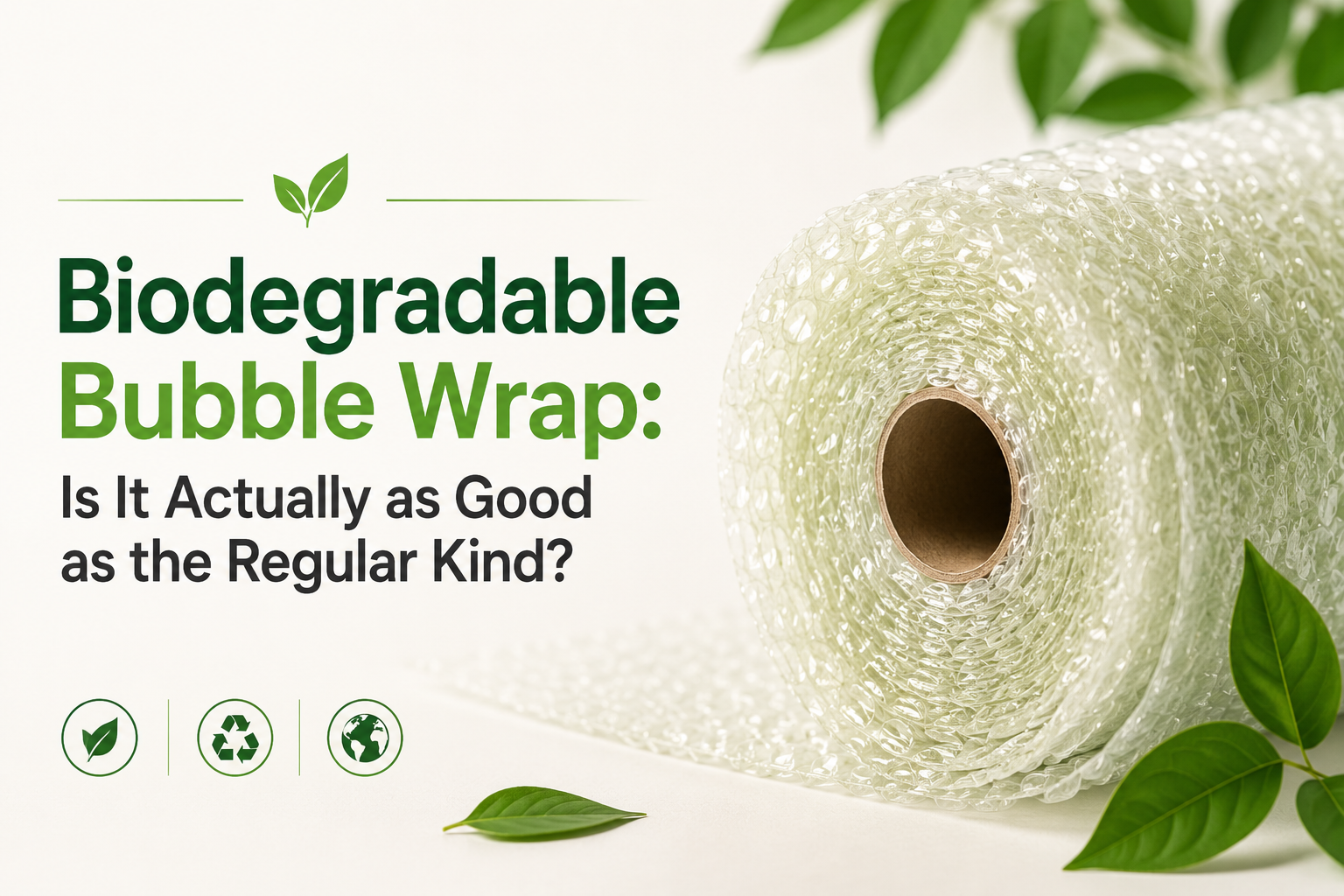
Most e-commerce sellers don’t think much about biodegradable bubble wrap. It’s just that roll of plastic sitting in the corner of the packing station—grab some, wrap the product, done. The thing is, that casual relationship with bubble wrap is generating an enormous amount of hard-to-deal-with plastic waste, and the industry is starting to take notice.
Standard bubble wrap is made from LDPE (low-density polyethylene). It’s lightweight, flexible, and reasonably good at protecting fragile products during transit. It’s also one of the more difficult plastics to recycle. Most municipal recycling programs don’t accept it. It ends up in a landfill, where it persists for hundreds of years, or it gets swept into drainage systems and waterways.
Biodegradable bubble wrap is the industry’s answer to this problem. But before you switch, it’s fair to ask the same question anyone would: Does it actually work as well? This guide gives you the honest, practical answer.
The Bubble Wrap Problem Nobody Talks About
Bubble wrap gets lumped in with general plastic packaging, but it’s worth understanding why it’s specifically problematic.
Unlike plastic bottles or rigid containers that have reasonably well-established recycling streams in India’s major cities, thin plastic films like bubble wrap and poly bags are a different story. They tangle in sorting machinery, contaminate other recyclable materials, and are generally rejected by formal recycling facilities. Even in cities with functional recycling infrastructure, thin plastic films rarely make it through the recycling process.
The result is that almost all bubble wrap that gets used ends up as waste with no productive end-of-life. For an e-commerce business that ships hundreds or thousands of orders per month, that adds up to a significant plastic footprint—one that’s increasingly difficult to justify to customers, regulators, and sustainability-conscious marketplaces.
What Is Biodegradable Bubble Wrap Made Of?
The term “biodegradable bubble wrap” covers a few different materials. Understanding the differences helps you choose the right product for your application.
PBAT-Based Biodegradable Bubble Wrap
The most common and most practically useful option. PBAT (Polybutylene Adipate Terephthalate) is a biodegradable polymer that behaves very similarly to conventional LDPE in terms of flexibility and cushioning performance. Bubble wrap made from PBAT-PLA blends provides good air retention in the bubbles, adequate cushioning for most fragile products, and certified compostability under industrial composting conditions.
This is the option closest in feel and performance to conventional bubble wrap, which makes it the easiest transition for most businesses.
PLA-Based Bubble Wrap
PLA (Polylactic Acid) is made from fermented plant starch, typically corn. PLA-based protective wraps tend to be slightly stiffer than PBAT, which can actually be an advantage for wrapping rigid, fragile items. The trade-off is that PLA can become brittle in cold environments, so it’s less suitable for businesses with cold storage operations or shipping to cold-climate destinations.
Paper-Based Bubble Wrap (Honeycomb Paper)
Technically not bubble wrap in the traditional sense, but worth mentioning as an alternative. Honeycomb kraft paper provides cushioning through its structure rather than through air pockets. It’s fully recyclable and compostable, performs well for a wide range of fragile products, and has become popular with brands that want a more premium, natural unboxing experience. The trade-off is that it’s slightly heavier than plastic bubble wrap per unit area, which can affect shipping costs at high volume.
Biogreen Bags’ biodegradable bubble wrap is made from certified biodegradable materials and available in roll formats suitable for commercial e-commerce operations.
How It Compares to Regular Bubble Wrap
This is the section most people skip to first, and fairly so. Here’s the honest comparison.
Protection Level — Side by Side
For most e-commerce shipping scenarios—ceramics, glassware, electronics, cosmetics, and home goods—certified biodegradable bubble wrap provides equivalent protection to standard LDPE bubble wrap at comparable thicknesses and bubble sizes. The air-filled bubble structure works the same way regardless of what the outer film is made from.
Where you might notice a difference is in very high-impact situations or extremely long transit times with rough handling. Standard LDPE has slightly better elasticity under repeated impacts. For most standard courier shipments within India, this difference is negligible. For very fragile or high-value items travelling through multiple handling points, testing with your specific product is advisable before fully committing.
Weight and Shipping Cost Impact
Biodegradable bubble wrap made from PBAT or PLA blends is marginally heavier per square meter than standard LDPE bubble wrap—typically 5 to 10% heavier. For most shipments, this difference doesn’t cross a weight threshold that would affect shipping costs. For businesses shipping very high volumes of lightweight items where every gram counts, this is worth factoring into your calculation.
Shelf Life Before Use
This is a genuine practical difference. Standard LDPE bubble wrap has essentially unlimited shelf life in normal storage conditions. Certified compostable bubble wrap, being an organic material, has a shelf life of typically 12 to 18 months when stored properly—cool, dry, and in its original sealed packaging.
For businesses that order packaging in very large quantities and store it for extended periods, this matters. The solution is straightforward: order quantities you’ll use within your storage window rather than buying an entire year’s supply at once.
How It Breaks Down After Disposal
This is where the real difference lies. Standard bubble wrap persists in landfill for centuries. Certified compostable bubble wrap, when it reaches an industrial composting facility, breaks down into water, CO₂, and organic biomass within 90 to 180 days — leaving no microplastic residue.
The catch is that this breakdown only happens under composting conditions. If it ends up in regular landfill, it breaks down more slowly than in a composting environment (though still significantly faster than conventional plastic). Pairing a switch to biodegradable bubble wrap with communication to customers about correct disposal maximises the environmental benefit.
Which Products Is It Best For?
Biodegradable bubble wrap is a strong fit for most standard e-commerce product categories. Here’s how it maps to common use cases:
Ceramics and glassware — Excellent fit. The cushioning properties of PBAT-based bubble wrap handle these products well, and the fragility of the product class means customers are already paying attention to packaging quality.
Electronics and gadgets—a good fit for outer protection. For very sensitive components, pairing with anti-static inner wrapping is advisable (as it is with any bubble wrap for electronics).
Cosmetics and beauty products—Very good fit. Glass bottles and fragile product containers benefit from the cushioning, and beauty customers are among the most sustainability-conscious demographics in Indian e-commerce.
Books and printed materials — Bubble wrap is often overkill for books. Honeycomb paper or kraft wrap is usually sufficient and more cost-effective.
Clothing and soft goods—Bubble wrap isn’t the right tool here, regardless of material. Biodegradable courier bags are the appropriate solution for soft goods.
Jewelry and small accessories—a good fit when combined with a rigid inner box. Use small-bubble biodegradable wrap for this category.
Sustainable Packaging as a Brand Signal — What Customers Actually Notice
There’s a practical business case beyond compliance and environmental responsibility. Customers who open a package and find biodegradable bubble wrap—especially if it’s labeled or if the outer packaging mentions it—respond positively in a way that standard bubble wrap simply doesn’t generate.
This matters more as unboxing culture grows. Customers photograph, video, and share their unboxing experiences. A package that visibly demonstrates sustainable choices contributes to positive brand associations in a way that compounds over time. For D2C brands in particular, this is a meaningful brand-building moment at zero additional cost if you were already planning to switch.
The effect is stronger when brands communicate the change proactively — a small card inside the package explaining that the wrap is certified compostable and what to do with it, or a simple line on the outer bag. It doesn’t need to be elaborate. It just needs to acknowledge that the choice was deliberate.
How to Source Biodegradable Bubble Wrap in Bulk in India
A few practical points for businesses looking to make the switch at a commercial scale.
Verify certification before ordering: Ask for IS 17088, EN 13432, or equivalent certification documentation. If the supplier cannot provide this, the “biodegradable” claim is unverified. Legitimate manufacturers will have paperwork.
Order a sample roll first: Test it with your actual products. Wrap your most fragile standard product. Drop it from waist height onto a hard surface. Leave a wrapped item in your packing station for a week and check that the wrap hasn’t degraded. This process takes two days and will save you from a costly bulk order mistake.
Check roll dimensions match your existing equipment: If you use a bubble wrap dispensing machine, verify the roll core diameter and width are compatible before ordering. Most biodegradable bubble wrap is available in standard roll formats, but it’s worth confirming.
Factor storage conditions into your order quantity: Given the 12 to 18-month shelf life, order quantities that align with your usage timeline. A three-month supply at a time is a sensible starting point for most businesses.
Compare per-meter cost, not per-roll cost: Rolls vary in length and bubble density. Calculate the cost per square meter to compare fairly across suppliers.
Conclusion
The honest answer to the question this blog started with—is biodegradable bubble wrap actually as good as regular bubble wrap? —is yes for the vast majority of e-commerce applications. The protection is comparable. The handling is similar. The main practical differences are a shorter shelf life in storage and a marginally higher per-unit cost, both of which are manageable with sensible ordering practices.
What you get in return is a packaging material that doesn’t contribute to permanent plastic waste, that signals sustainability to increasingly aware customers, and that positions your business ahead of the regulatory direction that the packaging industry is clearly moving toward.
For any e-commerce business already thinking about sustainable packaging, bubble wrap is one of the simpler switches to make — and one of the more visible ones to customers.
FAQ
Ans: Yes—PBAT-based biodegradable bubble wrap provides comparable cushioning to standard LDPE bubble wrap for most e-commerce shipping scenarios. Test with your specific products before bulk ordering.
Ans: In proper storage conditions (cool, dry, and sealed), it stays stable for 12 to 18 months. Breakdown only begins when exposed to composting conditions — it won’t degrade on your shelf.
Ans: Most certified biodegradable bubble wrap is industrially compostable, meaning it requires a professional composting facility. Check whether the specific product carries home compostable certification if that’s important for your customers.
Ans: Biodegradable bubble wrap is available in standard roll widths and lengths comparable to conventional bubble wrap. Contact Biogreen Bags for current size options and commercial roll formats.
Ans: Yes—typically 15 to 25% higher per square meter. At higher order volumes, this premium narrows, and most businesses find it manageable when weighed against compliance and brand benefits.