Blog
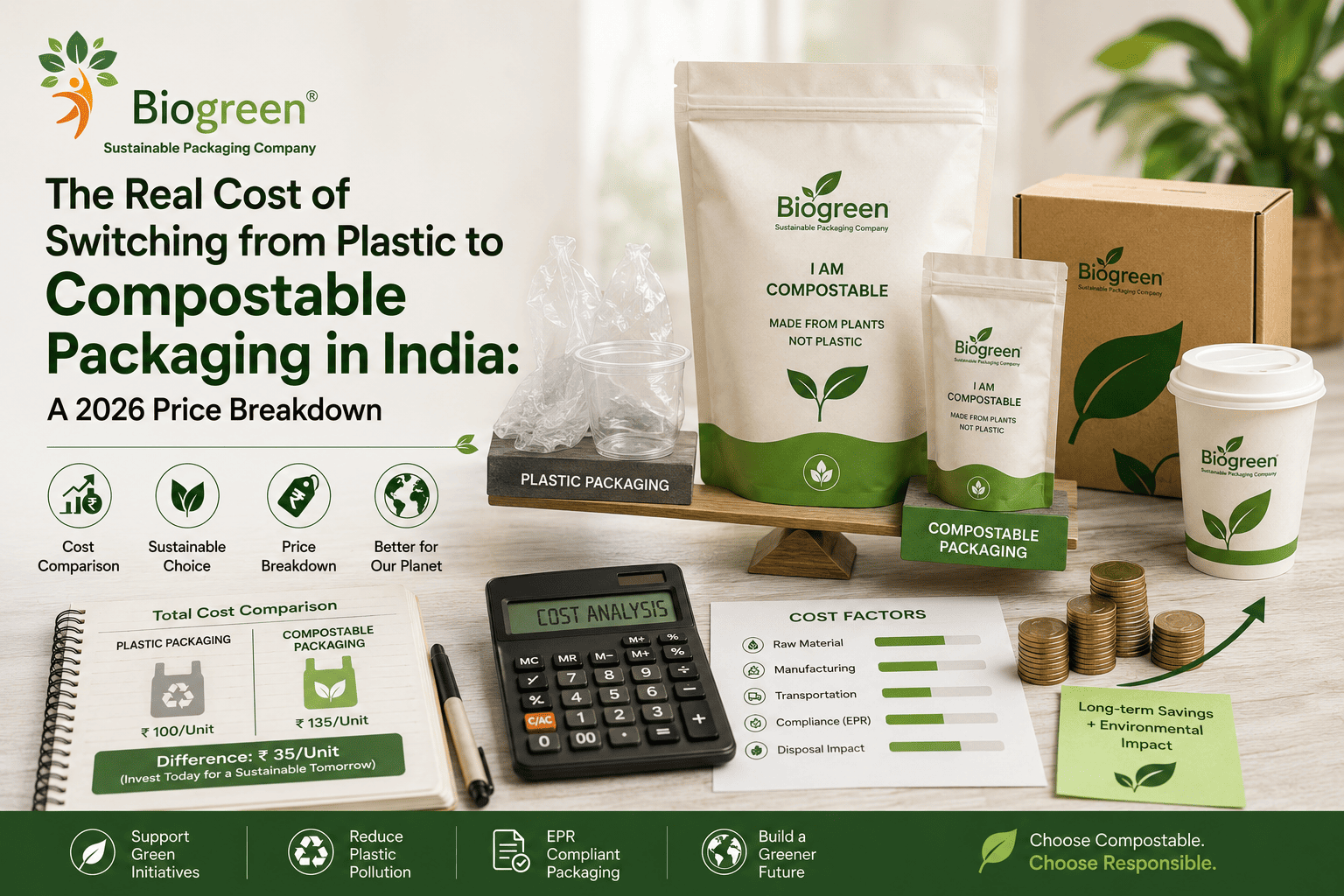
The Real Cost of Switching from Plastic to Compostable Packaging in India: A 2026 Price Breakdown

The number one reason businesses delay switching to compostable packaging is cost. And that concern is not unfounded. Compostable packaging does cost more per unit than conventional plastic in India.
But the full cost picture, once you factor in EPR compliance obligations, penalty exposure, and the narrowing price gap at commercial volumes, looks quite different from the per-unit comparison most businesses start with.
This is an honest 2026 breakdown of what switching from plastic to certified compostable packaging actually costs, with real price ranges across product types and order volumes, a worked example for a D2C brand, and the numbers most suppliers do not mention upfront.
Why the Price Gap Exists
Compostable bags are made from PBAT (polybutylene adipate terephthalate) and PLA (polylactic acid), derived from renewable sources like corn starch and sugarcane. The raw material supply chain is smaller than petroleum-based LDPE, which means higher input costs at every stage.
IS 17088 certification also requires rigorous third-party testing and periodic retesting, adding to the cost base. Suppliers offering IS 17088 certified bags at or below conventional plastic prices are almost always selling uncertified material.
2026 Price Comparison: Compostable vs Conventional Plastic
Compostable Carry Bags (12×16 to 16×20 Inches)
| Order Volume | Compostable (Rs/bag) | LDPE Plastic (Rs/bag) | Premium |
| Under 5,000 units | Rs 8 to Rs 14 | Rs 1.50 to Rs 3 | 4x to 5x |
| 5,000 to 50,000 units | Rs 5 to Rs 9 | Rs 1.50 to Rs 3 | 2x to 3x |
| 50,000+ units | Rs 3.50 to Rs 6 | Rs 1.50 to Rs 3 | 1.5x to 2x |
Compostable Courier / Mailer Bags (A4 to A3)
| Order Volume | Compostable (Rs/bag) | Poly Mailer (Rs/bag) | Premium |
| Under 2,000 units | Rs 14 to Rs 22 | Rs 3 to Rs 5 | 3x to 4x |
| 2,000 to 10,000 units | Rs 9 to Rs 14 | Rs 4 to Rs 7 | 2x to 2.5x |
| 10,000 to 50,000 units | Rs 6 to Rs 10 | Rs 3 to Rs 6 | 1.5x to 2x |
| 50,000+ units | Rs 4.50 to Rs 7 | Rs 3 to Rs 6 | 1.2x to 1.5x |
Compostable Garbage Bags (15L to 60L)
| Order Volume | Compostable (Rs/bag) | Conventional (Rs/bag) | Premium |
| Under 5,000 units | Rs 10 to Rs 18 | Rs 2 to Rs 5 | 3x to 4x |
| 5,000 to 20,000 units | Rs 6 to Rs 12 | Rs 2 to Rs 5 | 2x to 2.5x |
| 20,000+ units | Rs 4 to Rs 7 | Rs 2 to Rs 5 | 1.5x to 2x |
Add Rs 1 to Rs 2.50 per bag for one- to two-color custom printing at medium volumes. Add Rs 15,000 to Rs 50,000 for a one-time tooling charge if you need custom non-standard dimensions.
The Compliance Cost That Plastic Now Carries
Conventional plastic packaging (Category II under EPR) now carries costs that were not there two years ago. Businesses must meet annual recycling targets or purchase EPR credits from CPCB-registered recyclers.
| Compliance Cost Item | Conventional Plastic | IS 17088 compostable? |
| EPR credit purchase (if targets missed) | Rs 8 to Rs 25 per kg | Not required (Category IV) |
| Recycled content requirement | Required (rising targets) | Exempt |
| Annual CPCB reporting burden | Complex recycling chain | Simple composting doc |
| Penalty exposure | Rs 10K to Rs 15 lakh per violation | Low if compliant |
For a business using 5 tonnes of flexible plastic packaging per year, EPR credit purchases alone can add Rs 40,000 to Rs 1.25 lakh annually before factoring in registration and reporting overhead.
A Worked Calculation: D2C Brand at 8,000 Orders Per Month
| Cost Item | Poly Mailer (Plastic) | Compostable Courier Bag |
| Cost per bag | Rs 5 | Rs 9 |
| Monthly bags (8,000 orders) | Rs 40,000 | Rs 72,000 |
| EPR compliance cost (monthly est.) | Rs 6,000 to Rs 8,000 | Rs 0 |
| Penalty risk provision | Rs 2,000 to Rs 5,000 | Rs 0 |
| Total real monthly cost | Rs 48,000 to Rs 53,000 | Rs 72,000 |
| Effective monthly premium | Rs 19,000 to Rs 24,000 |
For a brand doing Rs 32 lakh per month in revenue at Rs 400 AOV, that premium is under 0.75% of revenue. At 20,000 orders per month (compostable rate drops to ~Rs 7/bag), the effective premium falls to under 0.3% of revenue. Most brands find this manageable when the compliance and brand value are factored in.
What Drives Cost Down at Volume
Order volume is the biggest lever: The per-unit cost difference between a 1,000-unit order and a 50,000-unit order can be 60% for the same bag. Commit to larger runs.
Standard sizes save tooling costs: Custom dimensions add Rs 15,000 to Rs 50,000 per size in tooling charges. Align your needs to the supplier’s standard range where possible.
Fewer print colors: One-color printing costs Rs 1 to Rs 1.50 per bag at medium volumes. Four-color printing can add Rs 2.50 to Rs 4. Minimize colors unless brand guidelines require it.
Annual contracts beat spot orders: Commit to quarterly or annual volumes in exchange for a fixed rate card. Most certified suppliers will negotiate 10% to 20% better rates for committed volumes.
The Bottom Line
Compostable packaging costs more per unit than conventional plastic, and anyone who tells you otherwise is not being straight with you. But the cost difference is smaller than most businesses assume; it shrinks significantly at volume, and the compliance cost of conventional plastic is no longer zero.
When you run the full calculation, including EPR credits, penalty exposure, export compliance risk, and brand perception value, switching to certified compostable packaging makes financial sense for most businesses operating at any meaningful scale in India today.
Check out – Biogreen bags
Frequently Asked Questions
Yes, on a per-unit basis. At medium volumes, compostable carry bags cost Rs 5 to Rs 9 per bag compared to Rs 1.50 to Rs 3 for LDPE plastic. However, once EPR compliance costs (Rs 8 to Rs 25 per kg for plastic), penalty risk, and volume discounts are factored in, the real-world cost gap is considerably smaller than the raw per-unit comparison suggests.
Most certified Indian suppliers require a minimum of 1,000 to 5,000 units for plain (unprinted) bags and 3,000 to 5,000 units for custom-printed bags. Some suppliers offer trial quantities of 500 units for first-time buyers. Larger consolidated orders per SKU are the fastest way to bring per-unit cost down.
PBAT and PLA raw materials, derived from corn starch and sugarcane, have a smaller supply chain than petroleum-based LDPE. IS 17088 certification also requires rigorous third-party testing and periodic renewal that adds to the cost base. Suppliers quoting compostable bags at or below plastic prices are almost always selling uncertified material.
EPR compliance costs for conventional flexible plastic (Category II) include annual recycled content requirements and recycling targets. Businesses that miss targets must purchase EPR credits from registered recyclers at Rs 8 to Rs 25 per kilogram of plastic. For a business using 5 tonnes of plastic packaging annually, this adds Rs 40,000 to Rs 1.25 lakh per year in compliance costs before registration and reporting overhead.
The crossover point depends on the product type. For carry bags and courier bags, at volumes above 20,000 units per month, the per-unit compostable rate drops to within 1.5x of conventional plastic when EPR compliance savings are included. For garbage bags, the gap narrows meaningfully above 5,000 units per month. At these volumes, the full cost picture makes switching financially viable for most businesses.