



Blog
EPR Registration for Compostable Packaging in India: Step-by-Step CPCB Guide (2026)

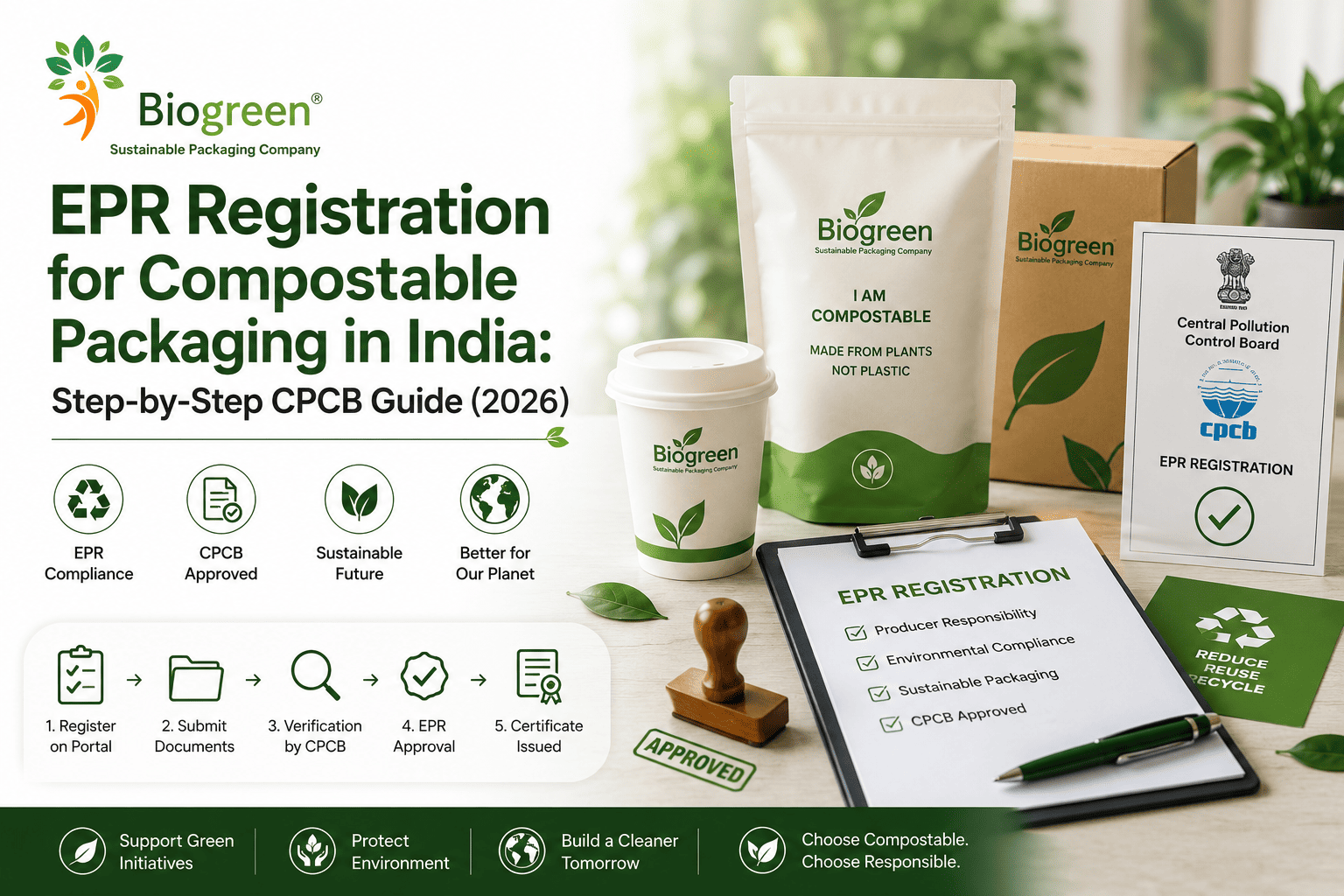
India’s Extended Producer Responsibility rules are no longer something you can plan for next quarter. They are live, the penalties are active, and if your business uses plastic packaging in any form, you are already within scope.
The good news is that switching to certified compostable packaging is one of the simplest ways to reduce your EPR compliance burden. You avoid recycled content targets, skip the complex recycling traceability requirements, and fulfill your EPR obligation through a composting pathway that is far easier to document and manage.
But to make that switch work for compliance purposes, you first need to understand what EPR requires, which category your packaging falls under, and exactly how IS 17088 certified compostable bags change your obligations. This step-by-step guide covers all of it.
What Is EPR for Plastic Packaging in India?
EPR stands for Extended Producer Responsibility. Under India’s Plastic Waste Management Rules, businesses that manufacture, import, or sell products in plastic packaging must take responsibility for collecting and processing that plastic waste after use.
The Central Pollution Control Board (CPCB) oversees the EPR program. If your business qualifies as a producer, importer, or brand owner (collectively called PIBOs), you must register on the CPCB EPR portal, declare your packaging volumes, and meet annual targets. As of April 2026, EPR compliance is mandatory and enforceable. Penalties range from Rs 10,000 to Rs 15 lakh per violation, with Rs 10,000 per day for continuing defaults.
Who Needs to Register?
●Manufacturers whose products are sold in plastic packaging
●Importers of goods packaged in plastic
●Brand owners whose products reach consumers in plastic packaging
●E-commerce entities shipping orders in plastic mailers, poly bags, or plastic-heavy outer packaging
This covers FMCG companies, food manufacturers, apparel brands, D2C startups, cloud kitchens, and marketplace sellers above a certain threshold. If you are unsure whether you qualify, the safer assumption is that you do.
The Four EPR Packaging Categories Explained
| Category | Packaging Type | Recycling Target (FY2028) | Compostable exempt? |
| Category I | Rigid plastic (bottles, jars, containers) | 80% | No |
| Category II | Flexible plastic (poly bags, mailers, pouches) | 60% | No |
| Category III | Multi-layer plastic packaging | 60% | No |
| Category IV | Certified compostable plastic (IS 17088) | Composting pathway | YES |
Why Compostable Packaging Is the Easier Compliance Path
No recycled content targets: Categories I through III carry mandatory recycled content requirements (5% to 40% for FY2026-27). Category IV compostable packaging is exempt entirely.
No recycling traceability: Categories I through III require tracking how waste moves through registered recyclers. Certified compostable packaging enters organic waste streams, which is far simpler to document.
Composting fulfills your obligation: A tie-up with a registered composting facility, plus annual composting tonnage documentation, is all you need to close your Category IV EPR obligation for the year.
Lower penalty risk: The IS 17088 compliance pathway is explicitly defined in the rules. There is no ambiguity about what fulfills it, unlike the more complex recycling chain for conventional plastics.
Step-by-Step: CPCB EPR Registration
Step 1: Determine Your Entity Type
Go to and classify your business as a producer, importer, brand owner, or e-commerce entity. If you manufacture and sell under your own brand, register as both producer and brand owner.
Step 2: Gather Your Documents
●GST registration certificate
●PAN card of the company
●Certificate of Incorporation or Partnership Deed
● Authorised signatory details and identity proof
●Declaration of plastic packaging volumes by type and category
●IS 17088 or EN 13432 certification from your compostable bag supplier
Step 3: Submit Your Annual Declaration
Declare the total quantity of each packaging category your business introduces into the market per financial year. For Category IV, the portal calculates your composting target. This declaration forms your EPR obligation for the year.
Step 4: Set Up a Composting Partnership
To fulfill your Category IV obligation, tie up with a registered composting facility. Your compostable bag supplier can typically connect you with their partner composters. The facility issues composting certificates for the tonnage received, which you submit to CPCB to close your annual obligation.
Step 5: File Your Annual Report
Each financial year, report your actual packaging volumes versus composting achievements. Fully compostable businesses that cover their declared quantity through a composting partner will have a clean compliance record.
Mandatory QR Code on Every Bag (From July 2025)
All plastic packaging sold in India must now display the company name, CPCB EPR registration number, and traceability information on the bag, via QR code, barcode, or unique identifier. This applies to compostable bags too. Confirm with your supplier that they can print your registration number and IS 17088 mark before your first bulk order.
Common Mistakes to Avoid
Delaying registration: Penalties are live. If you have been using plastic packaging without registering, the compliance clock is already running.
Mislabeling your packaging category: Flexible pouches are Category II, not Category I. Oxo-degradable bags are not Category IV: Only IS 17088-certified bags qualify.
Buying biodegradable without certification is problematic: Biodegradable does not equal compostable under Indian law. Without IS 17088 or equivalent, your bags are Category II.
Not retaining supplier documentation: CPCB can request certification verification at any time. Keep all certificates, invoices, and composting documentation on file.
What to Ask Your Compostable Bag Supplier
●Do you hold a current IS 17088 certificate from a BIS-recognized lab?
● Can you print our EPR registration number and IS 17088 mark on the bags?
●Do you have a registered composting facility tie-up for EPR fulfillment certificates?
●Can you provide batch-level documentation for CPCB audit purposes?
Non-Compliance Penalties at a Glance
| Violation | Penalty Range |
| Initial violation | Rs 10,000 to Rs 15 lakh |
| Continuing violation (per day) | Rs 10,000 additional per day |
| Repeat non-compliance | License suspension |
| Public disclosure | CPCB defaulter registry listing |
The Bottom Line
EPR compliance does not have to be complicated. Switching from conventional plastic to IS 17088 certified compostable bags moves you from Category II (recycling obligations) to Category IV (composting, no recycled content targets). The documentation trail is clean, the compliance pathway is clear, and the reputational benefit of genuine certification is a bonus on top.
If you want to know which compostable bag options qualify for Category IV and which composting partners we work with, get in touch and we will walk you through the specifics for your business.
Frequently Asked Questions
EPR (Extended Producer Responsibility) requires businesses that manufacture, import, or sell products packaged in plastic to manage the resulting packaging waste. If your business is a producer, importer, or brand owner using plastic packaging, you are within scope. This includes FMCG companies, D2C brands, food manufacturers, cloud kitchens, and marketplace sellers. EPR registration on the CPCB portal has been mandatory since April 2026.
Are IS 17088 or EN 13432 certified compostable bags category IV under India’s EPR rules? This category has no recycled content targets, no complex recycling traceability requirements, and is fulfilled through a simple composting tie-up. Businesses in Category IV just document composting tonnage annually, instead of managing a multi-step recycling chain.
Penalties range from Rs 10,000 to Rs 15 lakh per violation, with Rs 10,000 per day for continuing defaults. Repeat non-compliant businesses can face license suspension and public listing on the CPCB defaulter registry. For brand-conscious businesses, the reputational consequence of a public listing can far exceed the cost of compliance.
Yes. EN 13432 (the European compostability standard, certified by bodies like TUV Rheinland or DIN Certco) is recognized as equivalent to IS 17088 for India’s EPR Category IV classification. Bags certified under EN 13432 qualify for the composting-based compliance pathway.
Category II covers conventional flexible plastic packaging such as poly bags, mailers, and pouches. It carries annual recycling targets (rising to 60% by FY2028) and recycled content requirements. Category IV covers certified compostable plastic packaging. It has no recycling targets and is fulfilled through composting. Switching from Category II to Category IV significantly reduces compliance burden and cost.
No. “Biodegradable” is a marketing term, not a legal classification under India’s EPR rules. Only packaging certified under IS 17088, EN 13432, or ASTM D6400 qualifies as Category IV. Bags labelled as biodegradable, eco-friendly, or green without one of these certifications are treated as Category II for EPR purposes.