Bengaluru, India · Dubai, UAE



From Poly Mailers to Compostable Bags: A Complete Switching Guide for Indian D2C Brands (2026)

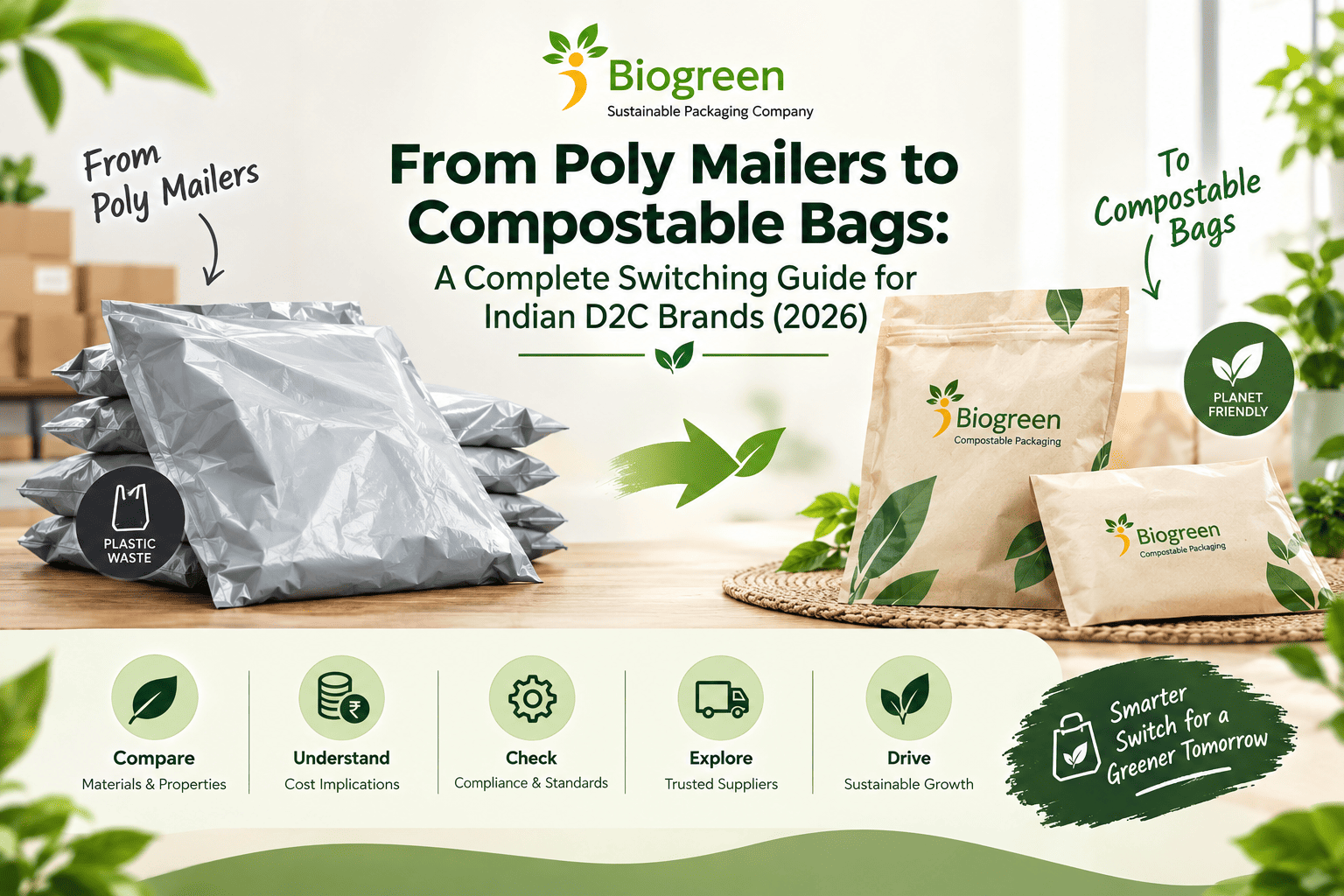
If you run a D2C brand in India, poly mailers are probably your default shipping choice. They are light, cheap, and waterproof. They also attract EPR compliance obligations from April 2026 and land in the bin after one use.
The good news is that switching from poly mailers to compostable courier bags is one of the most straightforward packaging changes a D2C brand can make. The products exist at scale in India, the supply chain has matured, and the cost gap has narrowed enough that the switch is realistic at almost any order volume.
This guide covers everything you need to make the switch: sizing, printing specs, per-unit costs, EPR compliance, a week-by-week transition plan, and the brand story you get to tell once you are through it.
Why D2C Brands Are Switching Now
Regulation. Poly mailers are Category II under India’s EPR rules (flexible plastic packaging). From April 2026, brands using poly mailers at meaningful volumes must register on the CPCB portal and meet recycling targets. IS 17088-certified compostable bags qualify as Category IV, a composting-based pathway with no recycling obligations.
Platform ranking. Amazon India, Flipkart, and Meesho now factor sustainability credentials into seller visibility scores. Brands using certified compostable packaging appear in eco-filtered search results, which are increasingly prominent in platform interfaces.
Customer expectations. In 2025 surveys of Indian online shoppers, 67% said they prefer brands using sustainable packaging, and 41% said they actively avoid brands known for excessive plastic use. For fashion, beauty, and wellness brands, packaging is a brand experience touchpoint.
What Makes Compostable Courier Bags Different
Compostable courier bags look nearly identical to poly mailers: same self-seal adhesive strip, similar puncture resistance, same print quality. The difference is the material.
Instead of LDPE (low-density polyethylene), IS 17088 certified PBAT bags are made from PBAT blended with corn starch or PLA. Under industrial composting conditions (55 to 60 degrees Celsius), they break down completely within 180 days without leaving microplastics or toxic residues.
Sizing Guide for D2C Products
| Product Type | Recommended Bag Size | Min. Thickness |
| T-shirts, light apparel | 12×16 inch | 25 micron |
| Folded shirts, jeans, kurtas | 14×18 or 16×20 inch | 25 micron |
| Multiple clothing items | 18×24 inch | 25 micron |
| Shoes (single pair) | 12×18 inch (gusset recommended) | 25 micron |
| Books, skincare sets, gift kits | 10×14 inch | 25 micron |
| Large or bulky items | 18×24 or 20×28 inch | 30 micron |
| Small accessories, jewellery | 6×9 or 8×12 inch | 20 micron |
Most D2C brands can cover their full product range with two to four standard sizes. Consolidating SKUs means higher volume per size and better per-unit pricing.
Printing Specs for Compostable Courier Bags
Flexographic printing works well on PBAT compostable bags clean results across up to six colours.
| Spec | Details |
| Print method | Flexographic (same as conventional poly mailers) |
| Colours | Up to 4 to 6 colours; 1 to 2 colours for lowest cost |
| Min. print order | 3,000 to 5,000 units per design per size |
| First-order lead time | 14 to 21 days |
| Repeat-order lead time | 7 to 10 days |
| Artwork format | Vector: AI, EPS, or PDF |
Mandatory print elements under CPCB 2026 rules: company name, CPCB EPR registration number, IS 17088 certification mark, and the words Certified Compostable. A good designer can integrate these into your brand layout without making the bag look like a regulatory document.
Per-Unit Costs at D2C Volumes
| Order Volume | Compostable (Rs/bag) | Poly Mailer (Rs/bag) | Effective Gap |
| 500 to 2,000 units | Rs 14 to Rs 22 | Rs 3 to Rs 5 | 4x to 5x |
| 2,000 to 10,000 units | Rs 9 to Rs 14 | Rs 4 to Rs 7 | 2x to 2.5x |
| 10,000 to 50,000 units | Rs 6 to Rs 10 | Rs 3 to Rs 6 | 1.5x to 2x |
| 50,000+ units | Rs 4.50 to Rs 7 | Rs 3 to Rs 6 | 1.2x to 1.5x |
For a brand shipping 3,000 orders per month at Rs 9 per compostable bag (vs Rs 5 poly mailer), the monthly premium is Rs 12,000. At Rs 800 average order value, that is 0.5% of monthly revenue. After EPR compliance savings, the effective premium is closer to 0.3%.
EPR Compliance Benefit
Poly mailers (Category II) require annual recycling targets and recycled content compliance. IS 17088 certified compostable bags (Category IV) replace all of this with a composting tie-up and annual documentation. Ask your supplier: ‘Do you have a registered composting facility that can issue EPR Category IV fulfillment certificates?’ If yes, your compliance pathway is clean.
What to Watch Out For
Biodegradable is not compostable. Only bags with IS 17088, EN 13432, or ASTM D6400 certification qualify for Category IV. Vague eco labels do not.
Minimum thickness for transit. Use 25 to 30 microns for safe shipping of most products. Go to 30 micron for books, shoeboxes, or items with hard edges.
Self-seal strip performance. Test the adhesive strip under load and slight moisture before placing a bulk order. Request 20 to 50 samples first.
Lead times are longer. Plain bags: 10 to 15 days. Custom print: 20 to 25 days. Do not let stock run to zero before ordering.
5-Week Transition Plan
| Week | Action |
| Week 1 to 2 | Request samples from 2 to 3 suppliers. Test your top 3 bag sizes with live shipments. |
| Week 3 | Place trial bulk order (500 to 1,000 units per size). Monitor for transit failures. |
| Week 4 to 5 | Place first full bulk order. Run down remaining poly mailer stock in parallel. |
| Month 2 | Register on CPCB EPR portal. Declare Category IV. Confirm composting tie-up. |
| Month 3 onward | Update website, platform listings, and social media with the switch announcement. |
The Brand Story You Can Now Tell
Once you switch, you can say something specific and verifiable: your packaging is certified compostable under IS 17088, and it breaks down completely in industrial compost within 180 days, without microplastics.
That is not a vague green claim. It is a certified outcome tied to a specific Indian standard that customers can look up. In a market where sustainability scepticism is growing, the ability to point to a real certification is worth considerably more than a generic eco-friendly label.
Frequently Asked Questions
Are compostable courier bags as strong as poly mailers?
At 25 to 30 micron thickness, IS 17088 certified PBAT compostable bags offer transit strength comparable to conventional poly mailers for most D2C products. They have similar puncture resistance and the same self-seal adhesive strip. For heavy or sharp-edged products, specify 30 micron or above and always test with samples before bulk ordering.
Can I print my brand on compostable courier bags?
Yes. Flexographic printing works well on PBAT compostable bags, achieving clean results across one to six colours. Minimum print orders are typically 3,000 to 5,000 units per design per size, with 14 to 21 day lead times for first orders. Under 2026 CPCB rules, the EPR registration number and IS 17088 certification mark must also be printed on the bag.
Do compostable courier bags qualify for EPR Category IV in India?
Yes, provided they carry IS 17088, EN 13432, or ASTM D6400 certification. Switching your courier bags from conventional poly mailers (Category II) to certified compostable alternatives (Category IV) removes recycling targets and recycled content requirements, replacing them with a simpler composting-based compliance pathway.
How long do compostable courier bags take to break down?
IS 17088 certified bags break down completely within 180 days under industrial composting conditions (55 to 60 degrees Celsius). In landfill or normal soil conditions, breakdown will be slower. The bag delivers its full environmental benefit only when it reaches an industrial composting facility — which your supplier’s EPR composting tie-up can support.
What is the minimum order for compostable courier bags in India?
Most certified manufacturers offer plain compostable courier bags from 500 to 1,000 units for trial orders and 2,000 to 5,000 units for standard orders. Custom printed bags typically require 3,000 to 5,000 units minimum per design. Request 20 to 50 free or at-cost samples before any bulk commitment.
Will switching to compostable bags improve my Amazon or Flipkart listing?
Yes. Amazon India, Flipkart, and Meesho are incorporating sustainability credentials into seller visibility scores and search filters. Brands using IS 17088 certified compostable packaging qualify for eco-packaging badges, which improve placement in sustainability-filtered search results. This is a direct ranking benefit, not just a brand communication advantage.