Bengaluru, India · Dubai, UAE

PLA vs PBAT vs PBS: Which Bioplastic Is Best for Packaging?

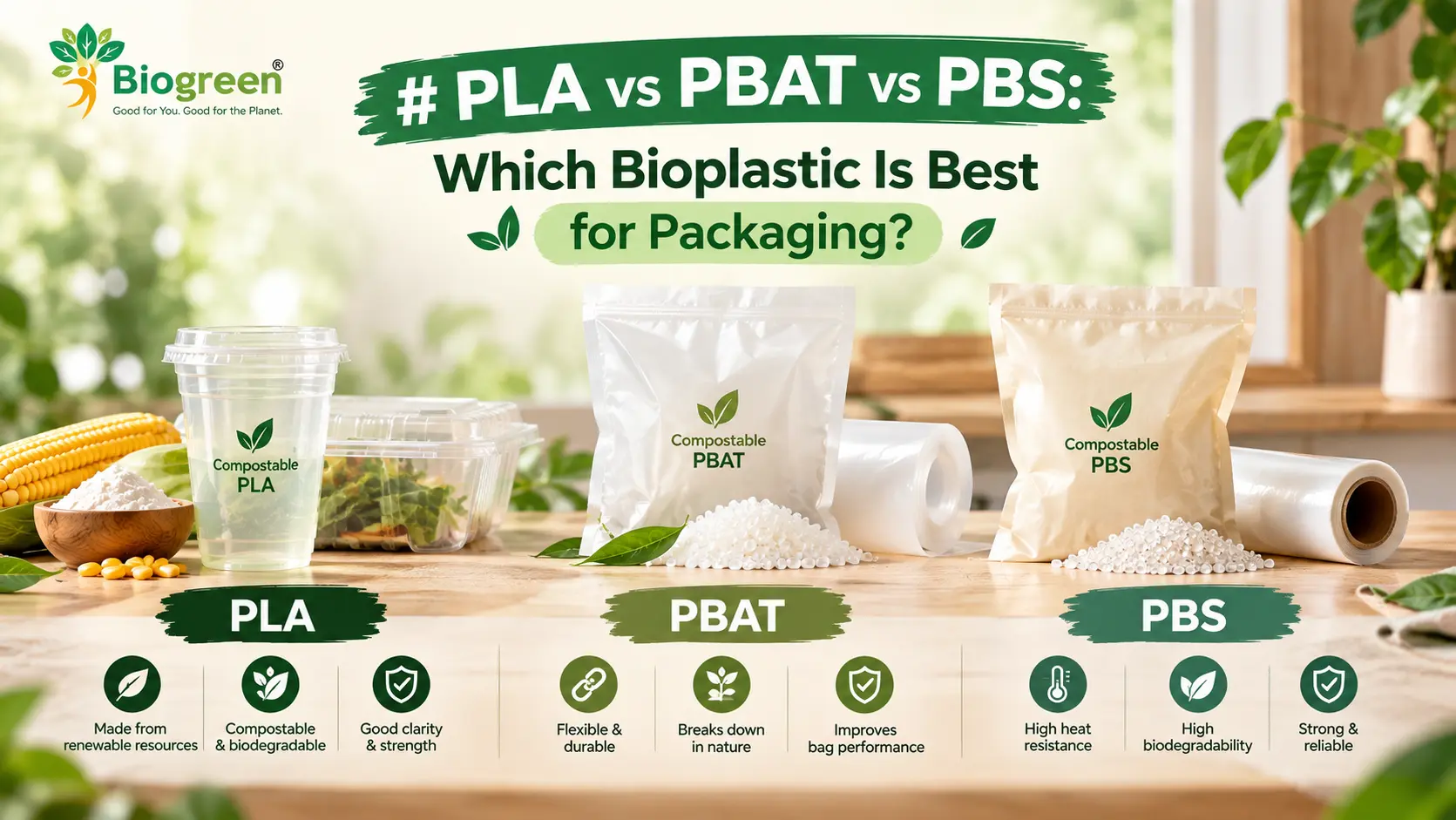
Walk down any supermarket aisle today, and you’ll notice something different about the packaging on shelves. More brands are printing words like “compostable,” “biodegradable,” and “plant-based” on their bags, containers, and wraps. This isn’t just a marketing trend. It reflects a real, urgent shift happening across the entire packaging industry.
Businesses are under pressure from two directions. Customers want greener packaging, and governments are banning or taxing conventional plastic. Caught in the middle, manufacturers are trying to figure out which material actually works for their products.
This is where bioplastics come in, and where the confusion usually starts.
Most people have heard the word “bioplastic,” but few know there are different types, each built differently, behaving differently, and suited to a completely different packaging job. PLA, PBAT, and PBS are three of the most widely used bioplastics in packaging today. If you’re deciding which one makes sense for your business, this guide covers everything you need to know in plain language.
What Is PLA (Polylactic Acid)?
Think of the clear plastic containers you see at salad bars or bakeries, sturdy, clean looking, and good at showing off the product inside. There’s a good chance those are made from PLA.
PLA, or Polylactic Acid, is made by fermenting natural plant sugars from sources like corn starch or sugarcane. The result is a plastic resin that looks and behaves much like conventional plastic but comes entirely from renewable crops rather than fossil fuels.
This is what makes PLA such an attractive starting point for brands going green. It doesn’t require businesses to sacrifice appearance or functionality. It’s rigid, crystal clear, and has a polished finish that works well for retail packaging.
On the sustainability side, PLA is certified compostable. Sent to an industrial composting facility, it breaks down within 60 to 90 days, impressive compared to conventional plastic, which sits in landfills for centuries. The one caveat: PLA needs the right composting environment to break down properly. Left in a regular bin or a home compost pile, it will take much longer.
Where PLA works best:
- Clear rigid food containers for salads, fruits, and baked goods
- Cold drink cups, lids, and takeaway packaging
- Disposable spoons, forks, and knives
- Transparent retail packaging where product visibility matters
- Short life cycle packaging destined for industrial compost
If you’re in food service or retail and need packaging that looks premium and performs well for cold food products, PLA is worth serious consideration.
BioGreen supplies certified PLA powder to manufacturers across India, building plant-based packaging lines. For businesses comparing rigid packaging options, our Compostable Thermoforming Granules are also worth a look.
What Is PBAT (Polybutylene Adipate Terephthalate)?
Now forget everything rigid and transparent. PBAT is a completely different material.
Pick up a compostable carry bag at a grocery store and stretch it between your hands. That soft, elastic quality that lets it stretch without tearing is almost certainly PBAT. It’s the material that gave the compostable bag industry its practicality. Before PBAT became widely available, making a bag that was both flexible and biodegradable was genuinely difficult.
PBAT is made from fossil-based chemicals but is specifically engineered to biodegrade, which sets it apart from regular plastic. It’s soft, stretchy, and tough enough to carry heavy loads without breaking. It also bonds extremely well with other bioplastics, especially PLA, which is why most compostable bags today are actually a blend of the two.
The PLA and PBAT combination is genuinely clever. PLA brings transparency and structure, and PBAT brings flexibility and toughness. Together they produce a bag that’s compostable, reasonably clear, and strong enough for everyday use.
PBAT breaks down under industrial composting conditions within 90 to 180 days and carries certified compostability status under major international standards.
Where PBAT works best:
- Compostable carry bags and grocery bags
- Biodegradable garbage bags and bin liners
- Flexible food wraps and packaging films
- Courier bags and e-commerce mailers
- Agricultural mulch films
If flexible packaging is your core requirement and you need something that genuinely composts after use, PBAT is your material.
BioGreen manufactures compostable carry bags for packaging manufacturers and converters across multiple industries. If you need finished products rather than raw granules, check out our biodegradable courier bags.
What Is PBS (Polybutylene Succinate)?
PBS is the quieter one of the three, but don’t underestimate it. It solves problems that PLA and PBAT simply can’t handle as well.
PBS, or polybutylene succinate, sits somewhere between PLA and PBAT in terms of flexibility. Not as stiff as PLA, not as stretchy as PBAT, but tougher and more heat-resistant than both. That heat resistance is what really makes PBS stand out. PLA starts to soften around 55 to 60 degrees Celsius, while PBS handles heat significantly better, opening it up to applications PLA can’t touch, like warm food trays, hot food contact packaging, and materials used in outdoor or agricultural settings.
PBS also biodegrades differently. PLA needs an industrial compost facility to break down properly, but PBS is more versatile. It can biodegrade in soil and water environments over time, making it a natural fit for agricultural films and packaging that ends up in open environments.
Researchers are also making good progress on fully bio-based versions of PBS using succinic acid from sugarcane and corn, which will eventually strengthen its sustainability credentials even further.
Where PBS works best:
- Semi-rigid trays for warm or hot food contact
- Agricultural mulch films that need to break down in the field
- Specialty industrial wraps requiring higher durability
- Packaging with a longer functional life before disposal
BioGreen offers
as part of its expanding range of biodegradable biopolymers for manufacturers who need heat tolerant, durable sustainable materials.
Key Differences Between PLA, PBAT, and PBS
| Property | PLA | PBAT | PBS |
|---|---|---|---|
| Raw Material | Plant-based | Fossil-based, biodegradable | Fossil or bio-based |
| Flexibility | Rigid | Highly flexible | Moderately flexible |
| Heat Resistance | Low (55 to 60°C) | Low to moderate | Moderate to good |
| Transparency | Very high | Low | Moderate |
| Biodegradation | Industrial compost | Industrial compost | Compost, soil, water |
| Best Application | Cups, trays, cutlery | Bags, films, wraps | Trays, agricultural films |
| Breakdown Time | 60 to 90 days | 90 to 180 days | Varies by environment |
Best Use Cases for Each Bioplastic
Knowing the science is helpful. Knowing which material fits your actual packaging situation is what matters in practice.
PLA when your product needs to look good on the shelf, stays cold or at room temperature, and will be disposed of at an industrial composting facility. It’s the go-to for food service packaging with high visual standards.
PBAT when flexibility is non-negotiable. Carry bags, bin liners, courier mailers, food wraps, and agricultural films all need the stretch and toughness that only PBAT consistently delivers.
PBS when your packaging has to handle warmth, needs to last longer in use, or will end up in an agricultural or outdoor setting where soil biodegradation is the expected end of life.
When none of the three alone quite fits the brief, consider a blend. PLA and PBAT blended together deliver transparency and flexibility in one compostable material. Adding PBS into a blend brings extra durability and heat tolerance. Manufacturers do this regularly to hit specific performance targets.
Conclusion
PLA, PBAT, and PBS aren’t competing materials. They’re complementary ones. Each fills a role the others can’t quite cover, and together they form a genuinely strong foundation for building plastic-free packaging.
If you take away one thing from this blog, let it be this: there’s no single “best” bioplastic. There’s only the right bioplastic for your specific packaging format, temperature requirements, end-of-life disposal options, and budget.
Getting that match right is the difference between packaging that works brilliantly and packaging that disappoints. That’s why working with an experienced manufacturer who understands all three materials and their blends matters so much.
BioGreen is one of India’s leading producers of compostable and biodegradable packaging materials, biopolymers, and granules. From raw material supply to finished packaging products, BioGreen supports businesses at every stage of their switch to sustainable packaging. Explore the complete product range at BioGreen Sustainable Packaging.
FAQs
What is the main difference between PLA, PBAT, and PBS?
PLA is rigid and plant-based, PBAT is soft and flexible for bags and films, and PBS is tougher with better heat resistance and broader biodegradability in soil and water.
Which bioplastic is fully biodegradable?
All three biodegrade, but PBAT and PBS break down in more environments, including soil and water, while PLA needs industrial composting conditions to degrade properly.
Is PLA suitable for food packaging?
Yes, PLA is food-safe and widely used for cold food packaging like salad boxes, fruit containers, and cold drink cups.
Which bioplastic is the most flexible?
PBAT is the most flexible of the three and is specifically used for carry bags, bin liners, films, and flexible wraps.
Are PLA, PBAT, and PBS compostable at home?
PLA needs industrial composting to work efficiently. PBAT and PBS can biodegrade in soil and water over time but all three give the best results in industrial composting conditions.