Bengaluru, India · Dubai, UAE




7 Mistakes Businesses Make When Buying Compostable Bags in Bulk

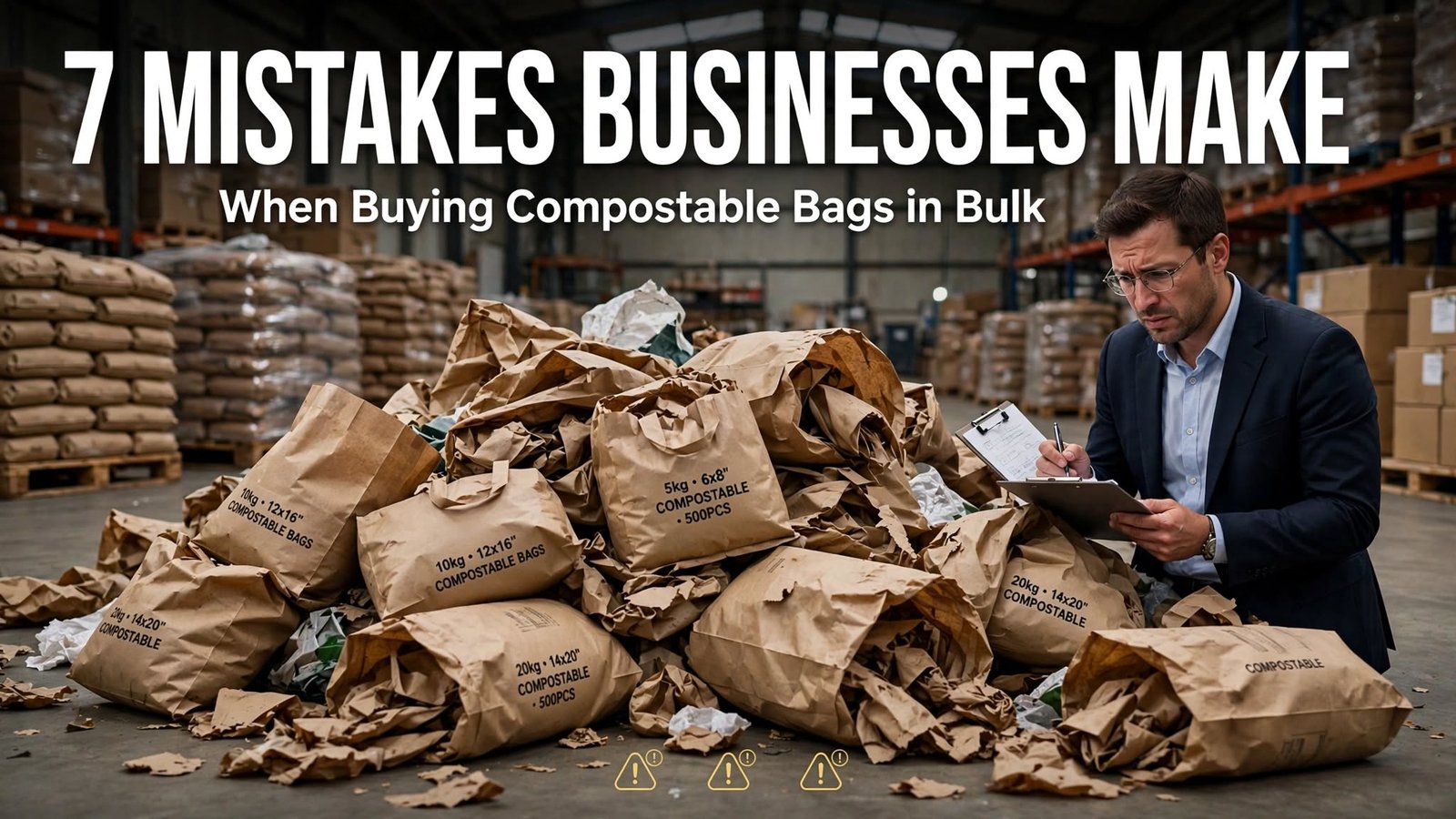
A bulk order of compostable bags is a big commitment. You pay in advance, the cartons arrive weeks later, and by the time you find a problem, thousands of bags are already in your storeroom. Some of the problems are small, like a size that is slightly off. Others are expensive: bags that tear under load, a certificate that does not match the product, or stock that has gone stiff in a hot warehouse.
After looking at how Indian buyers source these products and what the rules require, a clear pattern shows up. The same seven mistakes come up again and again. This guide lists them, explains why they hurt and shows what to do instead, so your bulk compostable bag purchase goes right the first time.
Mistake 1: Trusting the word “biodegradable” without a certificate
This is the most common and the most costly error. The market has plenty of bags sold as “biodegradable”, “eco-friendly” or “degradable” with nothing behind the claim. Some are ordinary plastic with an additive. They break into small pieces, and that leaves microplastics behind rather than solving the problem.
In India, manufacturers of compostable plastic carry bags and commodities must obtain a certificate from the Central Pollution Control Board before they market or sell. The product should follow IS/ISO 17088, and the 2024 amendment calls for the label “compostable only under industrial composting”. CPCB’s process also adds a printed code, a certificate number and a QR code.
What to do instead: ask for the CPCB certificate number, the test report from a recognised lab, and a sample that carries the label, code and QR. Open the QR code and see what it shows. Biogreen’s public certifications page is an example of how a manufacturer can show this openly.
Mistake 2: Assuming the certificate covers whatever you are buying
A real certificate is not enough if it was issued for a different product, a different raw material or a different plant. CPCB certificates are tied to the manufacturer, the plant location and the raw material. A trader who shows a certificate may be reselling goods made elsewhere.
What to do instead: match three things on the document: the manufacturer’s name, the plant address and the raw material. Then ask in writing: “Does this certificate cover the exact bag I am ordering?” A genuine manufacturer answers directly.
Mistake 3: Comparing price per kg instead of price per bag
Many quotations come in rupees per kg. A supplier quoting a low per kg price may be selling a heavier, thicker bag, or one with more filler, so you get fewer bags for your kilo. Another may quote a higher rate for a lighter, stronger bag and still work out cheaper.
What to do instead: weigh ten sample bags, divide by ten and get the weight of one bag. Convert the kg quote into a price per piece, and then compare. For a clear way to work out your volume, read our guide on how to calculate your monthly compostable bag requirement.
Mistake 4: Ordering in bulk without testing a sample
A catalogue picture and a clean sample bag tell you very little. What matters is how the bag behaves with your product, in your climate, with your staff. Many buyers discover problems only after the main order: weak handles, seals that open, bags too small for the container, or film that sweats with hot food.
What to do instead: ask for samples, then run a real trial. Pack actual orders, carry them, drop them, store a few in your warehouse for two or three weeks. For restaurants, test during peak service. For e-commerce, test with delivery partners. Only then move to the bulk order, and begin with a pilot quantity.
Mistake 5: Getting the micron and size wrong
Two opposite errors happen here. Some buyers choose too thin a bag to save money, and see tears and complaints. Others over-specify, paying for film the product never needed. Size mistakes are just as common: a bag that is 1 inch too narrow for your container can fail at the seam or squeeze the contents.
Also remember that compostable film does not behave like LDPE at the same thickness. PBAT-based film is stretchy and tear resistant, so a lower micron can work for light goods, while heavy loads or sharp edges need more.
What to do instead: measure your products as packed, add a small allowance, choose a few sizes only and test one micron above and one below your first guess. Ask the supplier to show the tolerance on thickness, since a bag marked 50 micron that actually measures 38 is a quality problem.
Mistake 6: Ignoring storage, shelf life and heat
Compostable film is designed to break down, which means it is more sensitive to heat, humidity and time than ordinary plastic. Buyers who store thousands of bags in a hot godown, a rooftop store or a damp basement may find the film brittle or sticky when they open the carton months later.
What to do instead: ask the supplier for the recommended storage conditions and shelf life. Keep cartons off the floor, away from sun and kitchen heat, and use the oldest stock first. Do not order six months of stock if your store room cannot protect it. Order in smaller lots more often.
Mistake 7: Making false or loose environmental claims
Even a good purchase can turn into a problem when it is marketed badly. Printing “100% eco-friendly”, “dissolves in 90 days” or “home compostable” on your bag or website goes beyond what the rules support. Indian rules call for the label “compostable only under industrial composting”, and industrial composting capacity is limited in many cities.
What to do instead: keep your claims plain and provable. “Made from certified compostable material” is accurate. Add a short note on disposal, and if your city has a composting partner, mention it. Honest messaging builds more trust than big green slogans and protects you from complaints or regulatory attention.
Bonus: a few smaller errors worth avoiding
- Skipping the supplier visit or video call. A manufacturer should be happy to show its facility. Look at the manufacturing page to see what a manufacturer can share, and ask any supplier for equivalent detail.
- No written specification. Put size, micron, colour, print, quantity, packing and delivery date in the purchase order.
- Forgetting lead time. Custom and printed orders take longer. Place reorders before you reach your last carton.
- Ignoring print and ink. Ask which inks are used and whether they suit compostable film.
- Not planning disposal. If nobody can take the used bags, the benefit of compostable material is lost.
A quick pre-order checklist
Question | The right answer looks like |
|---|---|
Is there a CPCB certificate? | Certificate number, plant address and raw material match the supplier. |
Is there a test report? | IS/ISO 17088 report from a recognised laboratory |
Is the product labelled correctly? | Compostable label, printed code and working QR code |
Did I test a sample? | Real orders packed, carried, dropped and stored |
Is price compared per bag? | Weight of one bag known and quote converted |
Is storage planned? | Cool, dry space with first-in, first-out use |
Are my claims accurate? | Wording matches the certificate and the rules |
Final thoughts
Most of these mistakes can be avoided with a few hours of homework and a sample test. Verify the certificate, compare by price per bag, test with real use, store carefully and keep your claims honest. A supplier who welcomes these questions is usually one worth working with.
Learn more about Biogreen on the about us page, or send your requirements to request samples and certificate copies before you place an order.
Frequently Asked Questions
How do I know a compostable bag is not just plastic with an additive?
Ask for the CPCB certificate and IS/ISO 17088 test report, and check the QR code on the bag. Oxo-degradable or additive plastics do not meet the compostable standard.
Should I buy directly from the manufacturer or through a trader?
Buying from the manufacturer usually makes it easier to verify certificates, customise sizes and resolve quality issues. If you use a trader, ask to see the manufacturer’s certificate and plant details.
How big should my first bulk order be?
Start with a pilot of one month’s usage after a successful sample test, then scale as you confirm quality and storage behaviour.
Can I negotiate price on compostable bags?
Yes, especially on volume, standard sizes and fewer colours. Custom sizes and heavy printing raise the price.
What should I do if the delivered bags differ from the sample?
Compare against your written specification and sample, document the difference with photos and measurements, and raise it with the supplier immediately. This is why a clear purchase order matters.