
Blog
How to Tell If a Compostable Bag Is Genuinely Certified or Just Greenwashing

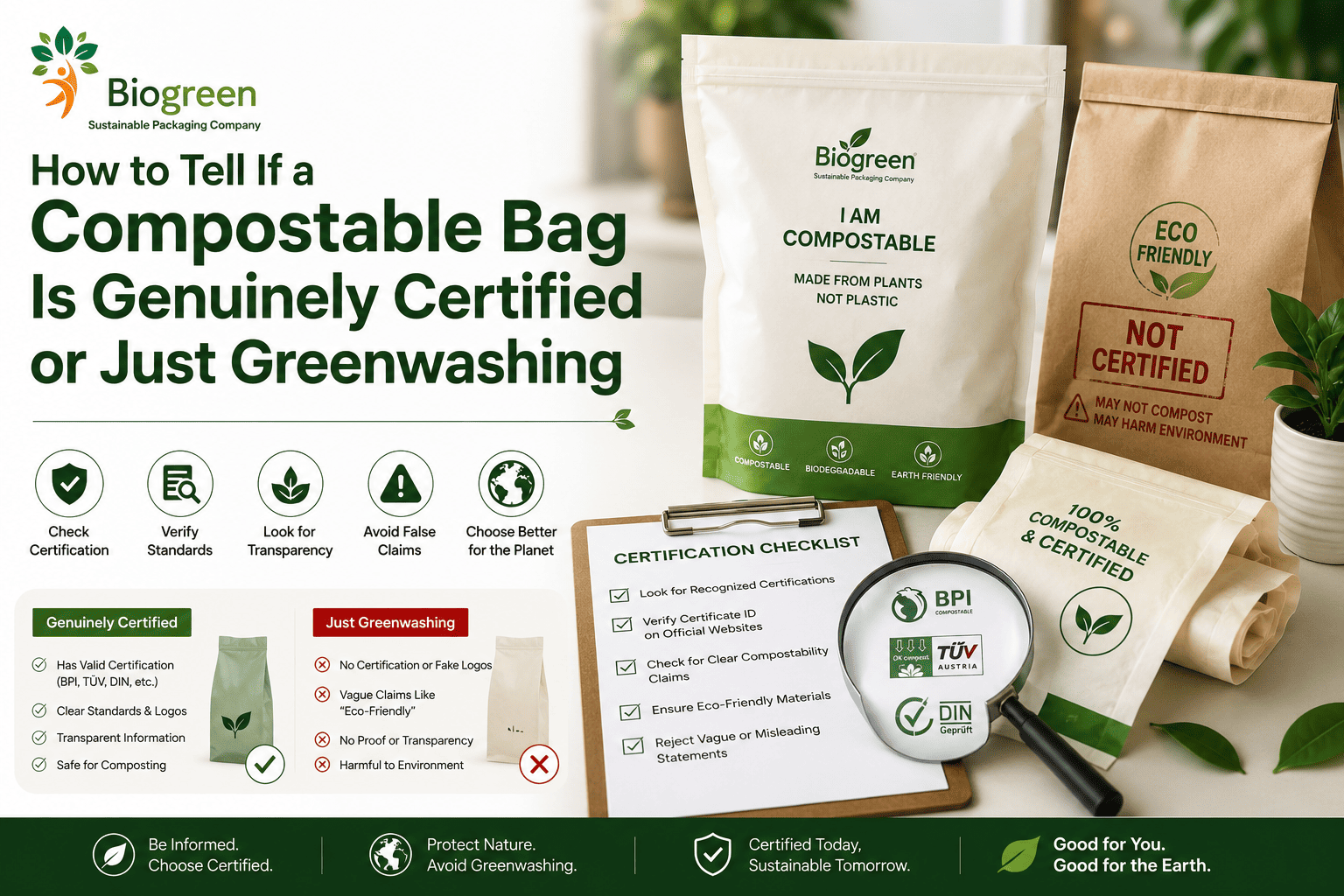
India’s compostable packaging market has a greenwashing problem. Walk through any wholesale packaging market, and you will find bags labeled “biodegradable bags,” “eco-friendly,” “green,” and sometimes “compostable,” none of which necessarily mean what they imply.
Some of these bags are conventional LDPE plastic with an additive that causes fragmentation into microplastics. Some are partially plant-based but untested against any compostability standard. And if you buy them believing they qualify for EPR Category IV, you are sitting on a compliance gap that CPCB can flag at any time.
This guide gives you a practical, step-by-step verification process to use before placing any order, so you know exactly what you are buying, what it does, and whether it actually supports your compliance position.
Why Getting This Wrong Has Consequences
If you buy uncertified bags thinking they are EPR Category IV compostable, you may register incorrectly on the CPCB portal and fail to meet your actual Category II recycling obligations. When CPCB asks for certification documentation, which they can do at any time, you have nothing to show.
Beyond compliance, oxo-degradable bags sold as biodegradable actively fragment into microplastics when exposed to heat or UV light. They are worse for the environment than regular plastic. Buying them while believing you are making a responsible choice is exactly the outcome greenwashing produces.
The Three Certifications That Actually Count
| Certification | Issuing Body | Recognized in India for EPR? |
| IS 17088 | Bureau of Indian Standards (BIS) | Yes, the primary standard for Category IV |
| EN 13432 | TUV Rheinland, DIN Certco, TUV Austria | Yes, equivalent to IS 17088 |
| ASTM D6400 | Biodegradable Products Institute (BPI) | Yes—the BPI database is searchable at bpiworld.org |
Any genuinely compostable bag will carry one of these three certifications. If a supplier cannot point you to one of them in document form, the product is not certified.
Labels That Should Make You Pause
Biodegradable: No legal definition in Indian packaging rules. Everything biodegrades eventually, including LDPE plastic over hundreds of years. A bag labelled only as biodegradable tells you almost nothing.
Eco-friendly or Green Packaging: Marketing language. Not a standard. Not a certification. Not verifiable by any third party.
Oxo-degradable or OXO Plastic: Contains a pro-oxidant additive that causes conventional plastic to fragment into microplastics. Banned or restricted in the EU. Explicitly excluded from India’s compostable packaging category. These are worse than regular plastic.
Made from Natural Materials or Plant-Based: Partially true in some cases. PLA is plant-based, but without IS 17088 certification, plant-based origin does not equal compostable performance. PLA alone can take years to break down in soil.
How to Verify a Supplier’s Certification: 5 Steps
Step 1: Request the Certificate as a PDF
Ask the supplier for their IS 17088 (or EN 13432 or ASTM D6400) certificate as a PDF document. A genuine certificate will show: the name and accreditation details of the testing laboratory, the standard tested against, the specific product specification (material, thickness, dimensions), the issue date and expiry date, and a unique certificate number. Do not accept a logo, brochure, website screenshot, or photo as a substitute.
Step 2: Cross-Check the Issuing Laboratory
For IS 17088: verify the testing lab against the BIS approved lab list at bis.gov.in. For EN 13432: the certifying body should be TUV Rheinland, DIN Certco, TUV Austria, or an equivalent accredited European body. For ASTM D6400: search the BPI public database at bpiworld.org directly.
Step 3: Confirm the Certificate Covers Your Product
This is the step most buyers skip, and it is where suppliers most commonly mislead. A certificate is issued for specific products at specific specifications. A 40-micron bag that is certified does not mean a 20-micron bag of the same material is certified. Ask explicitly: is this certificate for the exact product I am ordering, at the thickness and size I need?
Step 4: Check the Expiry Date
IS 17088 certifications are typically valid for one to three years. A certificate that expired more than a year ago means either the supplier has not re-tested, or they failed re-certification. Do not accept expired certificates. Ask when the next re-testing is scheduled.
Step 5: Ask About the Composting Pathway
Ask: ‘Do you have a tie-up with a registered composting facility that can issue EPR Category IV fulfillment certificates?’ This question tells you whether the supplier understands the end-of-life system their product operates in, and whether they can support your CPCB compliance documentation with an actual composting chain.
Red Flags in Supplier Conversations
| Red Flag | What It Likely Means |
| Cannot produce certificate PDF on request | Certification may not exist or has lapsed |
| Certificate covers a different product spec | Product you are buying has not been tested |
| Cannot name the testing laboratory | Certification is almost certainly not genuine |
| Pricing at or below conventional plastic | Certified PBAT cannot be produced at those costs |
| Claims bag composts in backyard or soil | IS 17088 requires industrial composting at 55-60C |
| Says certification is confidential | There is no confidentiality around a product certificate |
What to Do If You Cannot Verify
If a supplier cannot produce adequate documentation after you ask clearly, do not buy on the assumption it is probably fine. You have two options.
First, request samples and arrange independent testing at a BIS-approved lab. Testing typically costs Rs 15,000 to Rs 40,000 per product depending on scope. For large repeat orders, this is worth doing.
Second, move to a different supplier. The number of legitimate IS 17088 certified manufacturers in India has grown significantly. There is no shortage of alternatives. The time you spend verifying a questionable supplier is better spent finding a credible one.
Your Pre-Order Verification Checklist
| Done | Verification Step |
| [ ] | Certificate document received as PDF (not a logo, claim, or website link) |
| [ ] | Issuing laboratory verified against BIS approved lab list or relevant international body |
| [ ] | Certificate covers the exact product: material, thickness, and dimensions you are ordering |
| [ ] | Certificate is within its current validity period (not expired) |
| [ ] | Supplier can name their composting facility partner for EPR Category IV fulfillment |
| [ ] | Supplier pricing is in a realistic range for genuine IS 17088 certified PBAT material |
Six checks. Thirty minutes before any order. That is all it takes to protect your compliance position, your sustainability claims, and the actual environmental outcome of your packaging decision.
The Market Is Maturing: Use It to Your Advantage
The compostable packaging market in India is considerably better than it was two years ago. More manufacturers hold legitimate IS 17088 certifications. Testing lab capacity has expanded. CPCB enforcement has made the cost of non-compliance real enough that serious suppliers have invested in proper certification.
You have genuine, well-certified choices available at competitive prices. The goal of this guide is not to make you distrust the whole market, but to give you the six questions and verification steps that separate the suppliers doing it properly from those selling a label without the product to back it up. Ask the questions. Check the documents. The right supplier will have no problem with either.
Frequently Asked Questions
IS 17088 is India’s Bureau of Indian Standards (BIS) certification for compostable packaging. It confirms a bag breaks down completely within 180 days under industrial composting conditions (55 to 60 degrees Celsius) without leaving microplastics or toxic residues. For EPR compliance in India, IS 17088 is the primary standard that qualifies packaging as Category IV compostable. Without it, a bag labeled compostable does not legally qualify.
“Biodegradable” has no legal definition in Indian packaging rules and means only that the material will eventually break down under some conditions — which could take decades. “Compostable,” when certified under IS 17088, means the bag breaks down completely within 180 days”Compostable,” under industrial composting conditions, leaving no microplastics. Only certified compostable bags qualify for EPR Category IV. Biodegradable bags without certification are treated as Category II conventional plastic.
Oxo-degradable bags contain a pro-oxidant additive that causes conventional LDPE plastic to fragment into microplastics when exposed to heat or UV light. They do not compost, do not qualify under IS 17088, and are explicitly excluded from EPR Category IV. They are banned or restricted in the EU and are considered worse than conventional plastic by environmental scientists. Avoid them entirely, regardless of how they are labelled.
Request the full certificate PDF from the supplier. Verify the issuing laboratory against the BIS-approved lab list at bis.gov.in. Confirm the certificate covers your exact product specification (material, thickness, dimensions). Check the expiry date. A genuine certificate will show the lab name, standard tested, product specification, issue date, and a unique certificate number. If the supplier sends you a logo or marketing material instead of the document, that is a red flag.
Yes. IS 17088-certified bags are tested for industrial composting conditions at 55 to 60 degrees Celsius. Most home compost heaps do not reach these temperatures. The bag will not break down efficiently in a backyard compost pile. A supplier claiming their IS 17088 bag composts at home does not understand their product, or is being misleading. For home compostable claims, a separate certification specific to lower-temperature composting conditions is required.
Do not buy the product. If a supplier has genuine IS 17088 certification, there is no legitimate reason to withhold the certificate document. Treat refusal as a clear signal that certification does not exist or has lapsed. Request samples for independent testing at a BIS-approved lab (Rs 15,000 to Rs 40,000 per product) or move to a supplier who can provide documentation without hesitation.