Bengaluru, India · Dubai, UAE




How to Build a Compostable Packaging Procurement Checklist for Your Business

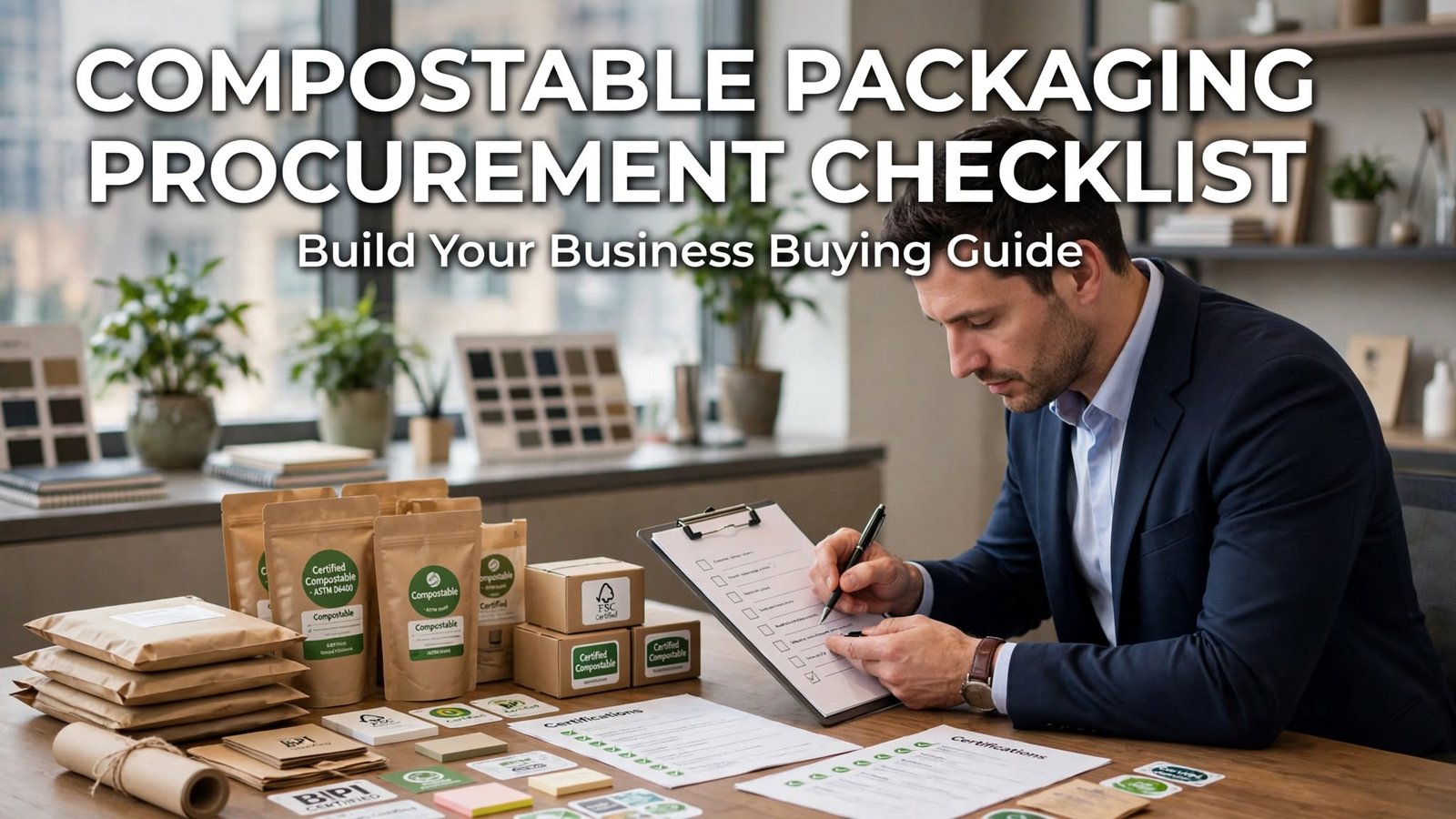
Ask five different teams in a company who is responsible for packaging, and you may get five different answers. Operations buys the bags. Marketing approves the design. Finance questions the price. Compliance worries about the rules. Sustainability wants better materials. Without a shared document, every purchase becomes a fresh debate, and every supplier gets a slightly different brief.
A written compostable packaging procurement checklist fixes this. It turns a vague wish to “go green” into a repeatable process that anyone in your company can follow. This guide shows how to build one, section by section, with a table at the end that you can copy into your own document.
Why a checklist is better than good intentions
- It protects you from mislabelled products. A checklist forces the certificate question every single time.
- It keeps purchases consistent. The same specification goes to every supplier, so quotes can be compared fairly.
- It saves time. New team members do not have to rediscover what was learned last year.
- It creates an audit trail. If a customer, auditor or inspector asks for proof, you have the documents ready.
- It reduces waste. Better planning means fewer unused cartons and fewer emergency orders.
Step 1: Define the need before you contact any supplier
Start with a one-page internal brief. Write down:
- The items you need to replace: carry bags, courier bags, liners, pouches, wraps, containers
- Where each will be used and what it will carry, with weight and moisture level
- Monthly volume per item and per size (see our guide to calculating monthly bag requirements)
- Special needs: printing, handles, tamper-proof strips, food contact, colour
- Budget range per bag and annual budget
- The person who owns the decision and the person who approves it
Step 2: Write a clear technical specification
A specification is the exact description of what you want to buy. Put it in writing, and attach it to every enquiry.
Specification item | What to record |
|---|---|
Product type | Carry bag, courier bag, liner, pouch, film, container |
Material | Compostable plastic (PBAT, PLA, starch blends) or cornstarch-moulded |
Size | Length x width x gusset or flap, in inches or mm, with tolerance |
Thickness | Micron, with acceptable tolerance |
Load capacity | Maximum weight to be carried |
Printing | Number of colours, artwork file, ink requirement |
Closure or handle | D-cut, W-cut, loop handle, adhesive strip, zip |
Colour | Natural, white, green or custom |
Food contact | Yes or no. If yes, suitability documents are required |
Packing | Pieces per bundle, bundles per carton, carton weight |
Step 3: Set your compliance requirements
This is the part that cannot be left to chance. Under the Plastic Waste Management Rules, manufacturers of compostable plastic carry bags and commodities need a certificate from the Central Pollution Control Board before marketing or selling. The 2024 amendment also calls for conformity with IS/ISO 17088:2021 and the label “compostable only under industrial composting”. CPCB certification involves a test report from a recognised laboratory and a printed code, certificate number and QR code on the product.
Turn this into a pass or fail gate in your checklist:
- Valid CPCB certificate, with certificate number noted
- Plant address and raw material on the certificate match the supplier and the product
- Test report covering disintegration and biodegradation under IS/ISO 17088
- Product label, printed code and working QR code
- Written confirmation that the certificate covers the exact item being supplied
Any supplier that fails one of these points is out until they correct it. A supplier like Biogreen publishes this information on its certifications page, which makes the first check quick.
If you are a brand owner, also record your Extended Producer Responsibility position with your compliance advisor, so packaging purchases and EPR reporting stay in step.
Step 4: Evaluate suppliers on more than price
Criterion | Questions to ask |
|---|---|
Manufacturing capability | Do you manufacture or trade? Where is the plant? What is the monthly capacity? |
Quality control | How do you check thickness, seal strength and print quality in each batch? |
Research and testing | Do you have in-house development and third-party test reports? |
Delivery | What is the lead time for standard and custom orders? Can you deliver in lots? |
Minimum order | What is the MOQ per size and per print design? |
References | Can you share customers in a similar industry? |
Support | Who handles complaints, and how fast? |
Documents | Will you share certificates, test reports, safety data and food-contact papers? |
Look at what the supplier shows about itself. Biogreen’s manufacturing and R & D pages are examples of the type of information worth asking any supplier to provide, and the about us page gives background on the company.
Step 5: Sample, test and approve
Never skip this stage. Make it formal:
- Request samples in your actual sizes and microns.
- Test with real products: drop test, seal test, edge puncture test, water splash test, storage test.
- Record results in a simple sheet: date, tester, pass or fail, notes and photos.
- Have operations, quality and the end user sign off.
- Freeze the approved sample as a reference. Keep a sealed copy for later comparison with bulk deliveries.
Step 6: Compare quotes the right way
Ask each supplier to quote on the same specification, and capture the following:
- Price per piece, and price per kg with the weight of one bag
- Tax, freight, printing plates or setup charges
- Price at three volume slabs, for example 5,000, 10,000 and 25,000 pieces
- Payment terms and advance requirement
- Lead time, and penalty or remedy for late delivery
- Replacement policy for defective lots
Then calculate the cost per usable bag, including a wastage allowance of a few percent. The cheapest quote on paper is not always the cheapest bag in practice.
Step 7: Plan storage and inventory
- Ask the supplier for the recommended shelf life and storage conditions
- Store cartons in a cool, dry area, off the floor and away from sun and heat
- Use first-in-first-out and label cartons with the date of receipt
- Set a reorder level equal to supplier lead time plus a safety margin
- Check stock every month and adjust the next order
Step 8: Decide how you will communicate and dispose.
Procurement does not end when the cartons arrive. Decide in advance:
- The exact wording you will use for customers. Stick to certified facts, such as “made from certified compostable material”. Avoid “home compostable” and quick-dissolve claims.
- Where used bags will go: an on-site composter, a private composting partner or a municipal programme.
- Who trains staff to use the right bins and bags.
India’s industrial composting capacity is still limited in many cities, so a clear disposal plan is part of making the purchase worthwhile.
Step 9: Review every quarter
Put a short review in the calendar. Check bags used against forecast, defects, customer feedback, price changes and new rules. Regulations on plastic and compostable products have been revised several times in recent years, so someone in your company should check for changes at least twice a year.
The complete checklist, ready to copy
Stage | Checklist item | Done |
|---|---|---|
Need | Items, uses, volumes by size and budget written down | [ ] |
Spec | Size, micron, load, print, handle, food contact and packing documented | [ ] |
Compliance | CPCB certificate number, plant and raw material verified | [ ] |
Compliance | IS/ISO 17088 test report from recognised lab received | [ ] |
Compliance | Label, printed code and working QR code confirmed on sample | [ ] |
Compliance | Certificate confirmed to cover the exact product | [ ] |
Supplier | Manufacturer or trader status, capacity and references checked | [ ] |
Testing | Drop, seal, puncture, splash and storage tests completed | [ ] |
Testing | Sample approved by operations, quality and user team | [ ] |
Commercial | Quotes compared per bag at three volume slabs | [ ] |
Commercial | Payment terms, lead time and replacement policy agreed | [ ] |
Order | Written purchase order with full specification | [ ] |
Receiving | Delivered lot checked against approved sample | [ ] |
Storage | Cool, dry storage, FIFO and reorder level set | [ ] |
Use | Staff trained, bins and bags matched | [ ] |
Disposal | Composting or collection route confirmed | [ ] |
Claims | Marketing wording checked against certificate and rules | [ ] |
Review | Quarterly review scheduled | [ ] |
Final thoughts
A checklist is not paperwork for its own sake. It makes sure that the compostable packaging you buy is genuine, fits the job and arrives when you need it. Build it once, share it with every team and improve it after each purchase.
If you would like to compare your checklist with a manufacturer’s documents, contact Biogreen to request certificates, samples and a quotation for your specification.
Frequently Asked Questions
Who should own the packaging procurement checklist in a company?
Usually procurement or operations owns it, with quality, compliance and marketing contributing. One named owner keeps it updated.
How often should we update the checklist?
Review it every quarter and whenever rules or suppliers change.
Do small businesses need such a detailed checklist?
A shorter version works well. Keep the compliance gate, the sample test and the price per bag comparison, even if you skip the rest.
What documents should we keep on file for each supplier?
Keep the CPCB certificate, test report, specification sheet, approved sample record, purchase orders and any correspondence about quality issues.
Can one checklist cover carry bags, courier bags, and liners?
Yes, as a base. Add product-specific lines in the specification step for each type.