Bengaluru, India · Dubai, UAE




Compostable Bags for Hospitals: Where They Can Be Used and What to Check Before Buying

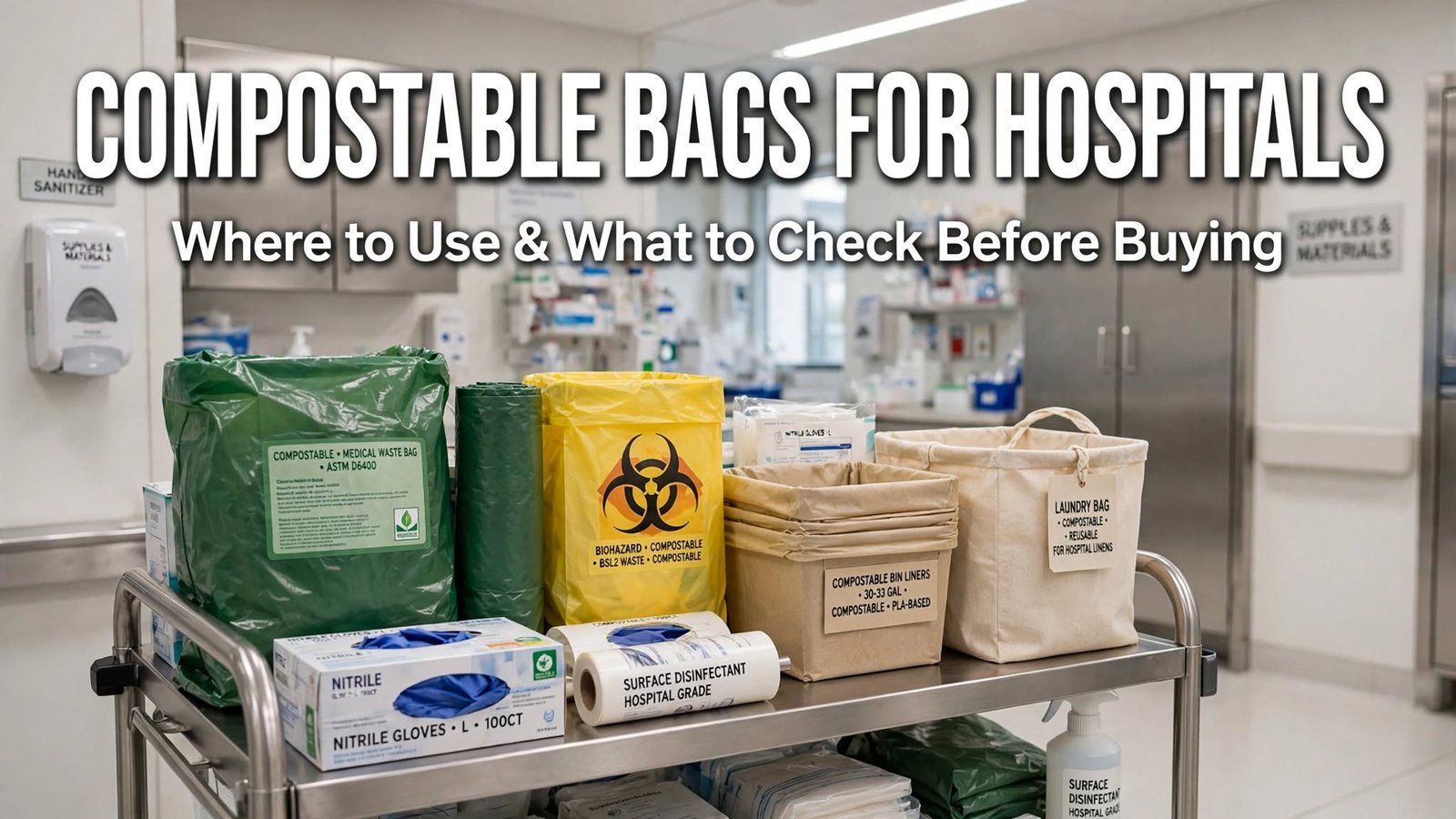
Hospital waste is not like office waste. A single ward produces food scraps, packaging, used gloves, soiled dressings, glass ampoules and sharps within the same hour, and each of them has a different legal route. Because of that, a hospital purchase manager asking about compostable bags is asking a more careful question than most buyers: not “is it eco-friendly?” but “where is it allowed?”
This guide answers that question honestly. It explains where compostable bags for hospitals make sense, where they do not replace prescribed bags and what to verify before you buy. It is general information, and your biomedical waste officer, infection control team and common treatment facility remain the final authority for your hospital.
First, understand the two waste streams in a hospital.
Indian hospitals work with two broad streams, and the bag you choose depends on which stream you are handling.
- Biomedical waste. Anything generated during diagnosis, treatment or immunisation that is infectious, anatomical, sharp or contaminated. This is governed by the Bio-Medical Waste Management Rules, 2016 and its amendments.
- General (non-hazardous) waste. Food waste, packaging, paper, garden waste, office waste and clean non-infectious material. This is handled like municipal solid waste under the Solid Waste Management Rules.
A commonly quoted estimate is that most hospital waste is non-hazardous and a smaller share is infectious. The risk comes from mixing the two. Under the biomedical waste rules, mixing of biomedical waste with general waste is not allowed, and segregation has to happen at the point of generation.
What the biomedical waste rules say about bags
The 2016 Rules prescribe a colour-coded system, with yellow, red, white and blue categories, each with its own container or bag type. Yellow and red categories use non-chlorinated plastic bags. The Rules also required hospitals to phase out chlorinated plastic bags, gloves and blood bags, to avoid dioxin and furan emissions when waste is incinerated, and introduced a barcode system for bags and containers sent for treatment.
What does this mean for compostable bags? It means that for biomedical waste categories, the bag has to meet the specifications in the Rules and be acceptable to your common biomedical waste treatment facility (CBWTF). A compostable bag is not automatically a replacement. Do not switch biomedical waste bags on your own. Get written confirmation from your pollution control board or CBWTF operator first.
Where compostable bags can be used in a hospital
Compostable bags suit the general, non-hazardous side of hospital life. These are the typical areas:
Area | Use | Why it suits |
|---|---|---|
Canteen and kitchen | Wet food waste liners | Food waste can go to composting or biogas. |
Patient attendants’ areas and waiting halls | General bin liners | Low risk, high volume |
Administration and offices | Dry waste liners | Same as any office |
Garden and landscaping | Leaf and garden waste bags | Plant waste can be composted. |
Pharmacy and retail counters | Carry bags for customers. | Customer-facing and visible |
Cafeteria and takeaway | Food carry bags and containers | Reduces single-use plastic |
Housekeeping | Mop and cleaning waste liners for non-infectious areas | Depends on your waste plan |
Biogreen’s biodegradable liner bag and compostable garbage bag pages show bin-liner formats suitable for the general waste side.
Where compostable bags should not be used without confirmation
- Infectious and soiled waste that falls under the yellow and red biomedical categories.
- Sharps and glassware, which need puncture-proof containers anyway.
- Cytotoxic and chemical waste, which have specific packaging rules.
- Any waste going to an autoclave, microwave or incinerator unless your treatment facility has confirmed that the bag type is accepted.
- Radioactive waste, which follows its own regulatory route.
Biogreen lists bio hazard bags under its industrial packaging range. If your hospital is considering them, ask for the full specification, applicable certificates and written confirmation that the product meets the Bio-Medical Waste Management Rules for the category you plan to use it in. Do the same with any supplier.
Seven checks before a hospital buys compostable bags
- Confirm the waste stream. Write down which bins will use compostable bags, and confirm that none of them hold biomedical waste.
- Check CPCB certification. Manufacturers of compostable plastic carry bags and commodities need a CPCB certificate before marketing or selling. Ask for the certificate number and verify the QR code on the product.
- Ask for the IS/ISO 17088 test report from a recognised laboratory, and for confirmation that it covers the exact product.
- Look for the label. Indian rules call for the words “compostable only under industrial composting” on compostable plastic products.
- Test strength with real waste. Wet kitchen waste and bulky packaging stress a bag more than people expect. Run a one-week test in a single area.
- Confirm the disposal route. Know where the filled bags go: an on-site composter, biogas plant, private composting vendor or municipal programme. If nobody accepts them, the compostable claim does not help.
- Get it in writing. Keep a file with the certificates, the test report, the supplier’s letter and your own approval note. Auditors and inspectors like paperwork.
Biogreen shares its CPCB certificate details and CIPET test results on a public certifications page. It is a useful reference when you compare suppliers.
Infection control and handling
Hospitals care about hygiene before sustainability, and rightly so. When you introduce a new bag type, involve the infection control team. Brief housekeeping staff so they know which bins carry which bag. Make sure colour coding stays consistent and that no compostable-lined bin is mistaken for a biomedical bin. Display clear signs at each bin point and include the change in your training sessions.
Also remember that compostable film is sensitive to heat and moisture over time. Store stock in a clean, cool, dry room and use older stock first.
A simple pilot plan
- Choose one non-clinical area, such as the canteen or the administration block.
- Order samples in two or three bin sizes.
- Run the trial for two to four weeks and note tears, leaks and complaints.
- Confirm with your waste vendor that they accept the filled bags.
- Write a short internal note and extend to more areas only after approval.
Final thoughts
For a hospital, the right question is not whether compostable bags are good, but where they are allowed and useful. Use them in non-hazardous areas, keep biomedical waste on prescribed bags unless your authority confirms otherwise, verify every certificate and make sure the filled bags have somewhere to go.
If you would like samples for a canteen or general waste pilot, contact Biogreen and share your bin sizes and expected monthly usage.
Frequently Asked Questions
Can compostable bags be used for biomedical waste?
Not as an automatic replacement. Biomedical waste has prescribed bag categories, colour codes and treatment routes. Get written confirmation from your pollution control board or treatment facility before using any other bag type for it.
Are compostable bags allowed for hospital canteen waste?
They are well suited to canteen wet waste, as that waste is non-hazardous, provided the filled bags go to a facility or route that handles them properly.
Why are chlorinated bags a concern in hospitals?
Burning chlorinated plastics can release dioxins and furans. For this reason the Bio-Medical Waste Management Rules, 2016 required hospitals to phase them out.
How do I verify that a compostable bag is genuine?
Check for the CPCB certificate number, the IS/ISO 17088 test report, the compostable label and a QR code that opens the manufacturer’s details.
Can we use compostable carry bags at the hospital pharmacy?
Yes. Pharmacy and retail counters are customer-facing areas where certified compostable carry bags fit well. Check size and strength for your usual orders.