Bengaluru, India · Dubai, UAE




How to Calculate Your Monthly Compostable Bag Requirement Before Buying in Bulk

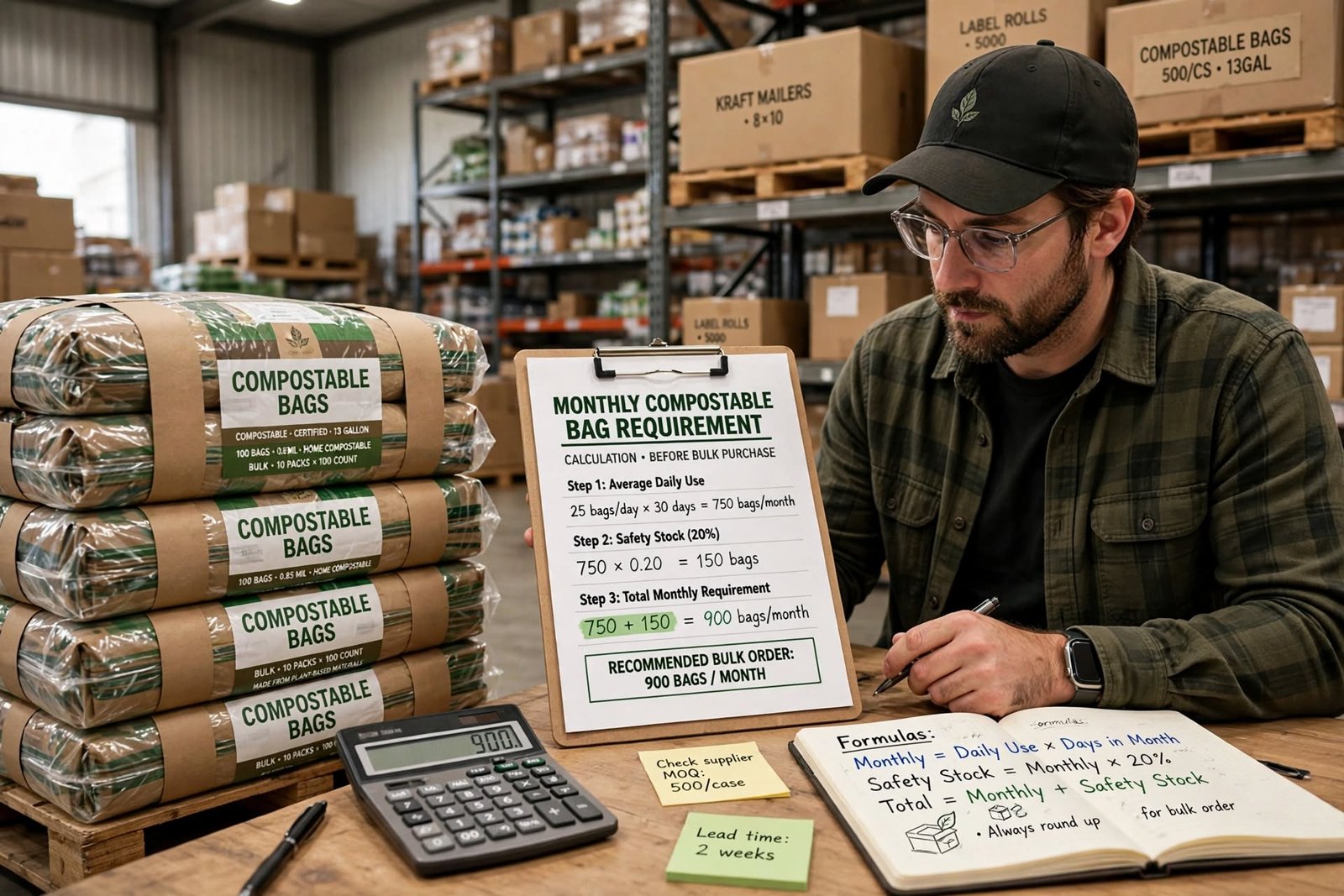
Most bulk packaging mistakes are not about quality. They are about quantity. Order too little and you run out in the second week, then pay for rush delivery or fall back on plastic. Order too much and you are left with cartons of bags ageing in a warm store room, with cash locked up that your business could have used elsewhere.
Compostable bags make the quantity question more important than usual, because biopolymer film does not like heat, humidity or long storage. So before you place a big order, it pays to work out your compostable bag requirement properly. This guide gives you a simple formula, three worked examples and a few habits that keep your stock right-sized.
Why quantity planning matters more for compostable bags
- Shelf life is limited. Compostable film is designed to break down, and that means it is more sensitive to heat, moisture and time than ordinary plastic. Ask your supplier how long the bags can be stored and under what conditions.
- Cash flow is tighter. Compostable bags usually cost more per piece, so over-ordering ties up more money.
- Custom orders take time. If you use printed bags or a custom size, a reorder can take weeks. Running out is expensive.
- Sizes do not mix. A leftover carton of the wrong size is useless to you.
The basic formula
Here is the calculation in plain words:
Monthly bag requirement = (Daily usage x working days) + wastage + safety stock
Let us break down each part.
Step 1: Find your daily usage
Do not guess. Use real data from one of these sources:
- Your billing or order system: number of orders per day
- Your delivery or dispatch log, if you ship
- A manual count for one week at the counter, if you run a shop or restaurant
Then work out how many bags go out per order. A restaurant might use 1.3 bags per order. An online seller shipping one product per order uses one bag. A grocery store may use two or three bags per customer.
Daily usage = orders per day x bags per order
Step 2: Count your real working days
A restaurant open seven days a week uses 30 days. A warehouse closed on Sundays uses 26. Festival months, sale seasons and weekends can change this, so use your actual calendar and not a flat 30.
Step 3: Split by bag size and type
Never calculate one big number. Do it per size. If your restaurant uses small, medium and large carry bags in a 50:30:20 ratio, calculate each separately. Order planning by size avoids the leftover problem.
Step 4: Add wastage
Some bags will tear while opening, get dirty, fail a seal or be rejected by staff. A reasonable allowance is 3 to 5 percent for busy counters and new staff, and a little less for controlled packing lines. Track your actual wastage for a month and refine the number.
Step 5: Add safety stock
Safety stock covers sudden spikes and delivery delays. A common approach is to hold stock for the supplier lead time plus a few extra days. If your supplier needs 15 days to deliver and your daily usage is 200 bags, you need at least 3,000 bags in hand to avoid a stock-out, before even counting wastage.
Worked example 1: a restaurant with takeaway and delivery
Item | Number |
|---|---|
Takeaway and delivery orders per day | 120 |
Bags per order (carry bag) | 1.2 |
Daily usage | 144 bags |
Working days in the month | 30 |
Base requirement | 4,320 bags |
Wastage at 4 percent | 173 bags |
Safety stock for 7 days | 1,008 bags |
Total to hold per month cycle | about 5,500 bags |
Split it by size: if 50 percent are small, 30 percent medium and 20 percent large, you need about 2,750 small, 1,650 medium and 1,100 large. Check the options on the compostable carry bags page and match them with your container sizes.
Worked example 2: an online seller using courier bags
Item | Number |
|---|---|
Orders per month | 4,000 |
Bags per order | 1 |
Base requirement | 4,000 bags |
Wastage at 3 percent | 120 bags |
Safety stock for 10 days | 1,333 bags |
Total | about 5,450 bags |
Now apply your size mix. If 60 percent of your orders fit a 10×12 bag, 30 percent need 12×16 and 10 percent need 8×10, the order splits into about 3,270, 1,635 and 545 pieces. For sizing help, read the compostable courier bag guide on our blog.
Worked example 3: garbage and liner bags for an office or hotel
Here you count bins and not orders. Suppose you have 60 bins, each emptied once a day, and 20 larger bins emptied twice a day. That is 60 + 40 = 100 bags a day. Over 30 days, that is 3,000 bags, plus 4 percent wastage (120 bags) and a 10-day safety stock (1,000 bags), giving about 4,100 bags. Match bin sizes carefully and look at the compostable garbage bag options.
Converting bags to kilograms: handle with care
Some manufacturers quote minimum orders in kilograms. To convert, you need the weight of a single bag. A rough formula for a flat bag is:
Weight (g) = length (cm) x width (cm) x 2 x thickness (microns) x density (g/cm3) / 10,000
Compostable PBAT-based film has a density in the region of 1.25 to 1.3 g/cm3, but this varies with the filler, so ask your supplier for the actual figure. Handles, gussets and printing change the final weight. The only safe number is the weight of a real sample bag on a kitchen scale. Weigh ten bags, divide by ten, and use that value to convert a kg quote into pieces. Then compare price per piece, not price per kg.
Choosing the order size: pilot, monthly or quarterly
Order type | When it makes sense | Risk |
|---|---|---|
Pilot order (one month) | First purchase, new supplier or new bag size | Higher price per bag |
Monthly order | Stable usage, limited storage space | More frequent ordering work |
Quarterly order | Steady demand, a bag that is not printed or customised | Storage and shelf life risk |
For most buyers, a pilot followed by monthly or six-weekly orders is the safest route. Move to larger orders only after you have seen how the bags age in your own storage.
Storage habits that protect your stock
- Keep cartons off the floor, away from walls and direct sunlight
- Avoid hot rooms, rooftop godowns and places near cooking heat
- Keep them dry. Humidity is a bigger problem than most buyers expect
- Use the oldest stock first (first in, first out)
- Keep a simple stock sheet with the date received, quantity and size
A simple monthly review routine
Spend ten minutes at the end of each month to check four numbers: bags used, bags left, bags wasted and the number of days of stock remaining. If days of stock regularly fall below your supplier lead time, raise your safety stock. If they stay above 45 days, trim the next order. After three months, you will have a reliable pattern.
Final thoughts
Calculating your requirement takes less than an hour and saves months of trouble. Use real data, split by size, add wastage and safety stock, and review every month. When you are ready for a quote, you can browse the Biogreen shop or send your numbers to the team for a bulk estimate.
Frequently Asked Questions
How many compostable bags should I order for the first time?
Order one month of actual usage plus 10 to 15 percent as a buffer, split by size. Treat it as a pilot, then adjust.
How long can compostable bags be stored?
It depends on the material and the storage conditions. Ask your supplier for a recommended storage period and keep stock cool and dry.
Is it better to order by weight or by quantity?
Quantity is easier to plan. If the supplier quotes by weight, weigh a sample bag and convert to pieces before comparing prices.
Should I order different sizes in one lot?
Yes, if the supplier allows it. Splitting by size reduces leftover stock and helps you test which sizes you really need.
What if my usage changes during festivals?
Plan a separate seasonal order based on last year’s peak, and place it early so that lead time does not catch you short.