Bengaluru, India · Dubai, UAE




Compostable Bags vs Paper Bags: Cost, Strength, Water Resistance & Sustainability Compared

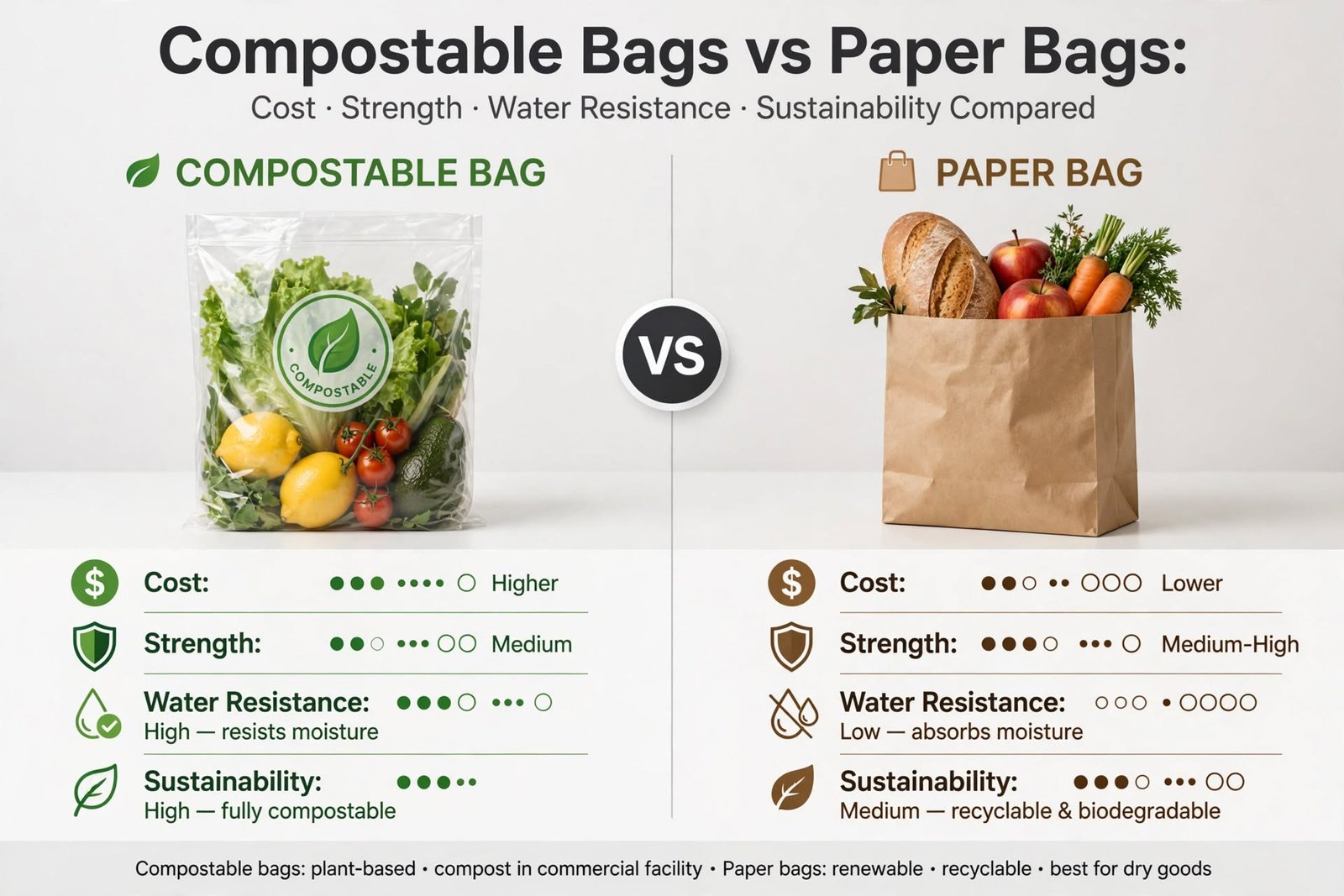
When plastic carry bags became a problem for shops, the first alternative most people reached for was paper. It looks natural, it feels familiar and everyone understands it. Then the monsoon arrived, a wet paper bag split at the bottom and a customer’s groceries landed on the road. That is usually the moment a business owner starts searching for something else.
Both paper and compostable bags are real options, and neither is perfect. This guide compares compostable bags vs paper bags on the things that decide a purchase: cost, strength, water resistance, storage, branding and environmental impact. By the end, you should know which one suits which job in your business.
The two bags in one minute
Paper bags are made from wood pulp, usually kraft paper, in weights measured in GSM (grams per square metre). Common carry bags run from about 70 GSM for light items to 120 GSM or more for heavier ones, often with twisted paper or flat handles.
Compostable bags are made from a film of biopolymers such as PBAT, PLA and starch-based materials. They look and feel like a plastic bag, but are made to break down under industrial composting conditions and are certified in India through CPCB under the IS/ISO 17088 standard.
Quick comparison table
Factor | Paper bags | Compostable bags |
|---|---|---|
Water resistance | Poor unless coated; coating can limit recycling. | Good. Resists splashes and dampness |
Wet strength | Drops sharply when soaked | Holds up well in rain and with moist items |
Tear and puncture | Tears at folds and corners; punctures easily | Stretchy film resists tearing; sharp edges can puncture thin film. |
Space and weight | Bulky to store, heavier to ship | Thin, light, folds flat; stores compactly |
Cost | Often cheaper in small sizes, rises quickly for strong, large or printed bags | Higher than conventional plastic; compares better with strong paper bags |
Printing and branding | Excellent for rich colour and texture | Good for one to few colours; finish is plastic-like. |
Reuse | Limited, weakens with each use | Reasonable for a few uses |
End of life | Recyclable if clean and uncoated; compostable in many cases | Compostable under industrial conditions only |
Rules in India | No plastic-specific rules | Exempt from single-use plastic ban and thickness rule when CPCB certified |
Cost: where each one wins
A basic small paper bag with no handles can be cheaper than a compostable bag, and for dry, light items like sweets or garments, that saving is real. The picture changes when you need strength. A paper bag that must carry 4 to 5 kg needs heavier paper, reinforced handles and a stronger bottom, and its price climbs steeply with GSM and size. A compostable carry bag at the right micron can carry a similar load at a comparable or lower price per bag.
Cost also includes things not on the invoice:
- Storage space. Paper bags are bulky. A year’s supply takes real shelf area, while compostable bags pack far tighter.
- Transport. Heavier, bulkier cartons cost more to move and store.
- Wastage. Paper bags damaged by humidity or rain have to be thrown away. Check how much of your last order was lost this way.
- Replacement cost. A bag that fails at the customer’s door costs more than the bag itself.
So compare cost per usable bag at your real load, not the list price of the cheapest sample. Ask for quotes on both options at the same size and carrying capacity.
Strength: it depends on the load and the weather
Paper has a stiff, structured feel, and dry paper is strong in compression. The weakness is that it loses strength when it gets wet or when the base is overloaded. In humid coastal cities or during the monsoon, uncoated paper bags absorb moisture and tear at the base and the handle joint.
Compostable film behaves differently. PBAT-based film is flexible and tear resistant. It stretches before it breaks, so it forgives rough handling. Its weaker points are sharp edges and heat, so a bag carrying hard corners or hot containers needs the right thickness. Browse the compostable carry bags to compare handle styles and loads, and look at the compostable grocery bag for heavier use.
A two-minute strength test you can do yourself
- Fill each sample bag with your typical load.
- Lift by the handles and hold for 60 seconds.
- Swing gently ten times, as a person walking would.
- Repeat after spraying a little water on the bottom and the sides.
- Note which bag changes shape, stretches badly or starts to tear.
Water resistance: the biggest practical difference
This is where the two bags separate. Paper soaks water. To make it water resistant, manufacturers laminate it with polyethylene or apply a coating, and then you have a paper-plastic combination that is harder to recycle and may not be accepted in paper recycling. If a paper bag is advertised as “waterproof”, ask what the coating is.
A compostable film bag resists splashes, light rain and damp food packaging without any added coating. It is not a liquid container, and standing water will eventually affect any biopolymer, but for day to day carrying it holds up far better. For businesses selling frozen items, fresh produce, wet garments or food in damp weather, this alone often decides the matter.
Sustainability: be fair to both
Environmental claims are where marketing runs ahead of facts, so let us be careful.
Paper
- Made from a renewable resource, but production uses wood, water and a good deal of energy.
- Recyclable when clean and uncoated, and it can compost naturally in many conditions.
- Heavier, so transport emissions are higher per bag.
- Coated or laminated paper loses much of the recycling advantage.
Compostable bags
- Made from biopolymers, partly from renewable sources such as starch, with PBAT currently produced from fossil feedstock in many cases.
- Lighter, so it needs less material and less transport energy.
- Designed to break down in industrial composting, and Indian rules require the label “compostable only under industrial composting”.
- Benefit depends on the bag reaching a composting facility. If it goes to a landfill, it does not behave as a compost product.
Neither bag is a free pass. The best environmental choice is the one that is used fully, reused where possible and disposed of properly. A paper bag that fails and is thrown away in a wet pile is worse than a compostable bag that carries goods safely and reaches a composter.
Certification and compliance
Paper bags do not have a CPCB certificate requirement, but compostable bags do. Manufacturers of compostable plastic carry bags and commodities must obtain a certificate from CPCB before marketing, and the product should carry the compostable label, a printed code and a QR code. When you buy a compostable bag, ask for the certificate number, the IS/ISO 17088 test report and confirmation that it covers your exact product. Biogreen shows its CPCB certificate and CIPET test results on a public certifications page as a reference for what to expect.
So which one should you use?
Your situation | Better fit |
|---|---|
Boutique, gifting, dry items, premium look | Paper, with a good GSM and reinforced handle |
Grocery, vegetables, wet or damp items | Compostable film |
Takeaway food orders (outer carrier) | Compostable film, with sealed containers inside |
Rainy or humid city | Compostable film |
Heavy loads over 3 kg | Strong compostable bag or thick, reinforced paper, tested on both |
Limited storage space | Compostable film |
Brand wants rich colour print. | Paper, or a compostable bag with simple print |
Many businesses use both: paper for the premium counter and gifting range, compostable film for everyday carry and delivery. That is a sensible approach, and it spreads your risk.
Final thoughts
There is no universal winner between paper and compostable bags. Paper wins on look and feel for dry, premium goods. Compostable film wins on water resistance, wet strength, storage and often on cost at higher strengths. Choose by the load, the weather and the way your customers use the bag, and keep your marketing claims accurate.
To test compostable bags against your current paper bags, browse the Biogreen shop and request samples for a side-by-side trial.
Frequently Asked Questions
Are compostable bags stronger than paper bags?
For wet conditions and tear resistance, usually yes. For stiffness and dry compression, paper can feel firmer. Test both with your real load.
Are compostable bags more expensive than paper bags?
Small, light paper bags can cost less. For strong, large or printed paper bags, the gap closes or reverses. Compare cost per usable bag.
Can compostable bags be recycled with plastic?
No. They should not go in the plastic recycling stream. They are meant for composting facilities that accept certified compostable material.
Are paper bags with plastic lining recyclable?
Often not in normal paper recycling, because the plastic layer has to be separated first. Ask the supplier what the coating is.
Do I need a certificate to buy compostable bags?
Yes, you should ask for it. Manufacturers must hold a CPCB certificate before selling compostable carry bags and commodities, and you should verify it.