


競馬予想 無料 的中情報 | Blog ランサムウェア カシオ ヨット アノニマス・フォックス
限定ボーナス 最新キャンペーン | PBAT: The Biodegradable Polymer That’s Quietly Replacing Plastic in India’s Packaging Industry

There’s a good chance that if you’ve purchased or researched certified compostable carry bags in India, you’ve come across the term “PBAT.” It appears on product specifications, certification documents, and packaging material supplier brochures. But explanations of what PBAT actually is, how it works, and why it matters tend to stay at the technical level, which isn’t helpful if you’re a packaging buyer, a manufacturer, or a brand owner trying to make an informed decision.
This guide explains PBAT in plain language. What it is, how it’s made, what products it’s used in, how it compares to other biodegradable materials, and what to look for when sourcing it in India.
What Exactly Is PBAT?
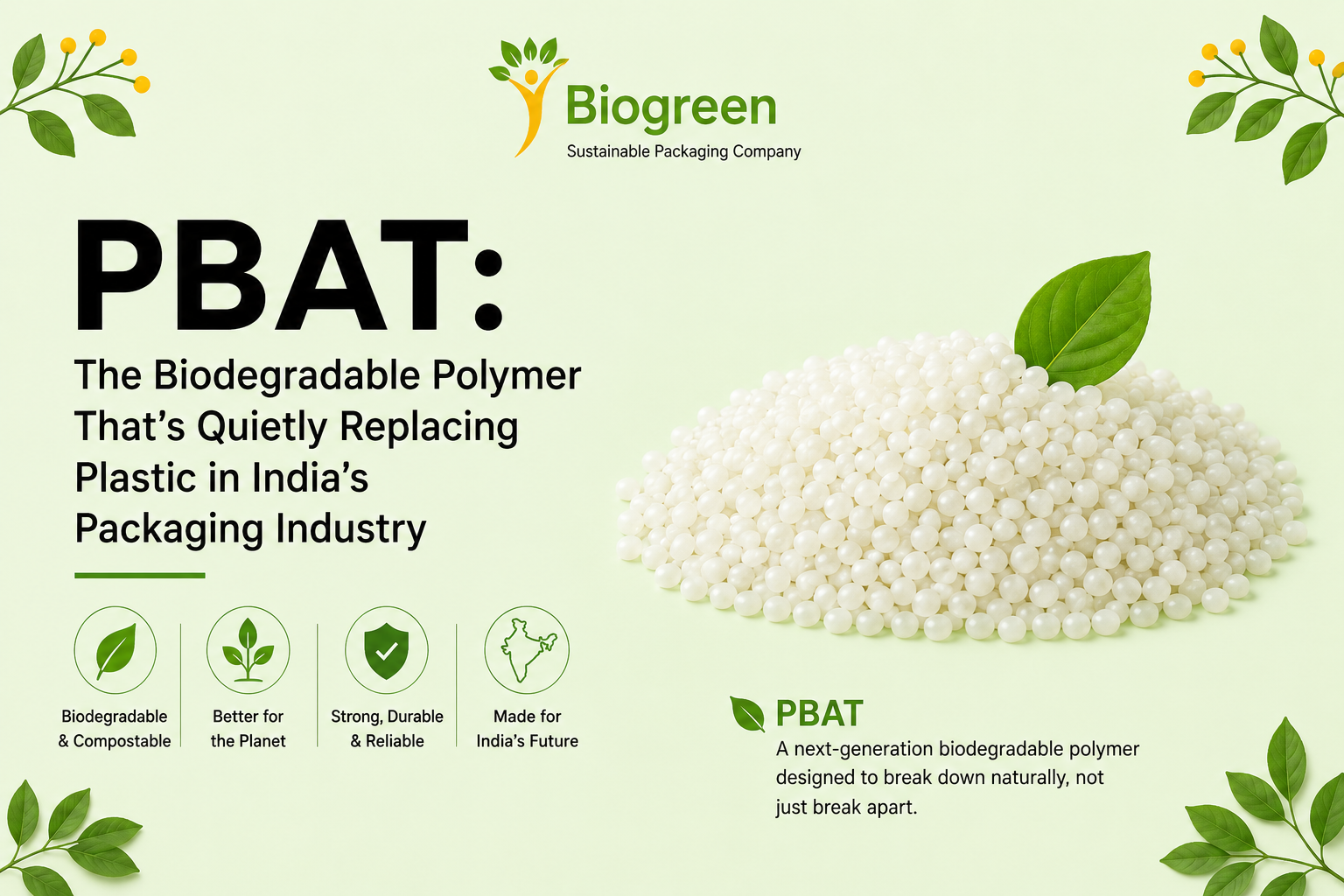
PBAT stands for Polybutylene Adipate Terephthalate. The name is a mouthful, but the concept is more accessible: PBAT is a biodegradable polymer—a type of plastic—made from components that are designed to break down through microbial activity under composting conditions.
Chemical Composition in Plain Language
PBAT is a copolymer, meaning it’s made by combining two or more different types of monomers (the chemical building blocks of polymers) into a single material. Specifically, PBAT combines the following:
- Butanediol (a compound derived from petroleum or bio-based sources)
- Adipic acid (a compound also used in nylon production)
- Terephthalic acid (a compound used in PET plastic production)
The combination produces a polymer that has the flexibility and toughness of conventional LDPE plastic while being genuinely biodegradable under composting conditions. This is the key property that makes PBAT commercially valuable: it behaves like plastic during use but doesn’t persist in the environment after disposal the way conventional plastic does.
Where Does PBAT Come From?
Currently, most PBAT produced globally uses petroleum-derived raw materials as feedstocks, though bio-based versions (using plant-derived adipic acid and bio-butanediol) are in development. This is a nuance worth understanding: PBAT is petroleum-derived in most commercial formulations, but its defining characteristic is its biodegradability — it breaks down into CO₂, water, and organic matter under composting conditions, unlike conventional petroleum plastics that persist for centuries.
Some manufacturers and buyers are confused by this — assuming “biodegradable” means “made from plants.” The two properties (bio-based origin and biodegradability) are related but not identical. PBAT can be largely petroleum-derived and still be genuinely compostable. What matters for environmental impact is the end-of-life behaviour, not just the feedstock origin.
How PBAT Is Different from PLA and PBS
The three most common certified compostable biopolymers you’ll encounter in the packaging industry are PBAT, PLA, and PBS. Understanding how they differ helps you choose the right material for your application.
PLA (Polylactic Acid): is made from fermented plant starch, most commonly corn or sugarcane. It’s bio-based, transparent, and has good stiffness — useful for rigid compostable containers, cutlery, and straws. Its limitation is brittleness: pure PLA can crack or shatter under mechanical stress, and it becomes soft at temperatures above around 60°C, limiting its use in hot-fill food applications.
PBS (Polybutylene Succinate): is another biodegradable polymer with properties somewhere between PLA and PBAT. It has better heat resistance than PLA and better stiffness than PBAT, making it useful for applications where both properties matter. It’s less widely available commercially than PBAT or PLA.
PBAT: is the most flexible of the three. Its molecular structure gives it excellent elongation at break — meaning it can stretch significantly before tearing, much like LDPE plastic. This makes it ideal for thin film applications: carry bags, garbage bags, cling wrap, agricultural films, and mailer bags. Its relative weakness is that it has lower tensile strength than PLA when used alone, which is why it’s almost always blended with PLA in commercial applications.
The PBAT-PLA blend is the industry standard for most certified compostable flexible packaging. PBAT provides the flexibility and toughness; PLA provides the strength and stiffness. Together, they produce a material that performs comparably to LDPE in most packaging applications.
What Products Are Made from PBAT?
PBAT and PBAT-PLA blends are the base material for a wide range of certified compostable packaging products.
Carry Bags and Grocery Bags
The largest single application for PBAT in India is certified compostable carry bags. Compostable carry bags made from PBAT-PLA blends are the legally compliant replacement for conventional plastic carry bags under India’s Plastic Waste Management Rules. The PBAT content gives the bag its flexibility and tear resistance; the PLA content gives it structural integrity.
Cling Wrap and Stretch Film
PBAT’s flexibility and transparency make it well-suited for film applications. Biodegradable cling wrap and biodegradable stretch film made from PBAT formulations provide comparable performance to conventional LDPE films in food wrapping and pallet wrapping applications.
Compostable Garbage Bags
Compostable garbage bags rely heavily on PBAT for their tear resistance and load-bearing capacity. A garbage bag needs to handle wet, heavy waste without tearing — a property that PLA alone can’t provide, but PBAT-PLA blends handle well.
Agricultural Films
One of the growing applications for PBAT in India is agricultural mulch film. Conventional plastic mulch film is a significant source of agricultural plastic waste — it’s difficult to collect from fields after use and ends up contaminating soil. PBAT-based agricultural films can be ploughed back into the soil after use, where they biodegrade under the influence of soil microorganisms.
PBAT’s Compostability — What Actually Happens When It Breaks Down
Understanding the breakdown mechanism matters because it explains both the genuine environmental benefit of PBAT and its limitations compared to simple organic materials.
When PBAT reaches a composting environment — meaning a facility that maintains temperatures of 55 to 60°C with adequate moisture and microbial activity — the polymer chains are broken down by two processes working together. First, hydrolysis breaks the ester bonds in the PBAT chain into smaller fragments. Then, microbial activity digests these fragments into CO₂, water, and biomass.
Under industrial composting conditions, certified PBAT-PLA blends typically reach 90% biodegradation within 180 days — the threshold required for IS 17088 and EN 13432 certification.
The important caveat: this breakdown requires industrial composting conditions. In a landfill without heat and controlled microbial activity, PBAT breaks down more slowly — faster than conventional LDPE, but not at the same rate as in a composting facility. This is why certified compostable packaging’s environmental benefit depends partly on the waste infrastructure available. In areas with functional composting systems, the benefit is significant. In areas where all waste goes to a landfill, the benefit is more modest.
PBAT in India—Import vs Domestic Manufacturing
India’s PBAT supply comes from two sources: imported polymer granules (primarily from China and Europe) and domestically produced material.
The majority of PBAT used in India’s packaging industry currently comes from China, where large-scale PBAT production capacity was built rapidly following policy support for biodegradable plastics. European producers (primarily BASF with its Ecoflex brand) supply the premium-grade, widely certified PBAT used in high-specification applications.
Domestic PBAT production in India is growing, supported by the regulatory push toward compostable packaging under the Plastic Waste Management Rules. Biogreen Biotech is among the Indian companies producing and supplying PBAT polymer for the domestic packaging industry.
For packaging manufacturers looking to source PBAT in India, the key considerations are certification (ensure the polymer lot carries appropriate compostability certification that can be passed through to the finished product), consistency of melt flow index (critical for consistent film production), and supply reliability.
What to Look for When Sourcing PBAT Polymer in India
For manufacturers producing compostable packaging rather than buying finished bags, sourcing PBAT polymer requires attention to a few specific parameters:
Melt Flow Index (MFI): This measures how easily the polymer flows during processing. The right MFI depends on your processing equipment and the final product. Film blowing typically requires a different MFI than injection moulding.
Compostability Certification of the Polymer: The polymer itself should carry certification documentation that can support the certification of the finished product. Ask for IS 17088 or EN 13432 test reports for the specific lot you’re purchasing.
Blend Ratio Recommendations: Most applications use PBAT in a blend with PLA or starch. Your supplier should be able to advise on blend ratios for your specific application based on their experience with similar products.
Lot Consistency: Film production is sensitive to small variations in polymer properties. Request consistency data across lots before committing to a regular supply relationship.
Biogreen Bags’ PBAT biodegradable polymer: is available for manufacturers producing certified compostable packaging products in India. The team can advise on specifications, blend ratios, and certification documentation requirements.
Conclusion
PBAT is the material that makes most of India’s certified compostable packaging possible. Its combination of flexibility, toughness, and genuine biodegradability under composting conditions makes it the most practical material for thin-film packaging applications—carry bags, garbage bags, cling wrap, agricultural films, and mailer bags.
For packaging buyers, understanding that PBAT is the material behind “certified compostable” labels on flexible packaging helps you evaluate supplier claims more accurately and ask better questions.
For manufacturers, PBAT’s growing availability from Indian domestic producers is reducing import dependence and creating more stable supply chains for certified compostable packaging production. For brands and businesses making the switch to sustainable packaging, PBAT-PLA blend products are the most practical and widely certified option for flexible packaging—performing comparably to conventional plastic while meeting India’s regulatory standards and international compostability certifications.
FAQs
Ans: Yes — PBAT-based films can be formulated for food contact safety and certified accordingly. Always verify food contact certification for any PBAT packaging intended for direct food contact use.
Ans: Under industrial composting conditions (55 to 60°C), certified PBAT-PLA blends reach 90% biodegradation within 180 days — meeting IS 17088 and EN 13432 certification requirements.
Ans: Yes — the PBAT-PLA blend is the industry standard for compostable flexible packaging. PBAT provides flexibility and toughness; PLA provides strength and stiffness. The ratio is adjusted based on the application.
Ans: PBAT has lower tensile strength than LDPE but much higher elongation at break. In PBAT-PLA blends, tensile strength is closer to LDPE and is sufficient for most carry bag and packaging film applications.
Ans: Biogreen Bags supplies PBAT biodegradable polymer for packaging manufacturers in India, with compostability certification documentation. Contact the team for current pricing, specifications, and minimum order quantities.

