


競馬予想 無料 的中情報 | Blog ランサムウェア カシオ ヨット アノニマス・フォックス
オンラインサービス 人気比較 | Biodegradable Cutlery for Your Restaurant: Honest Answers to the Questions Every Owner Is Asking

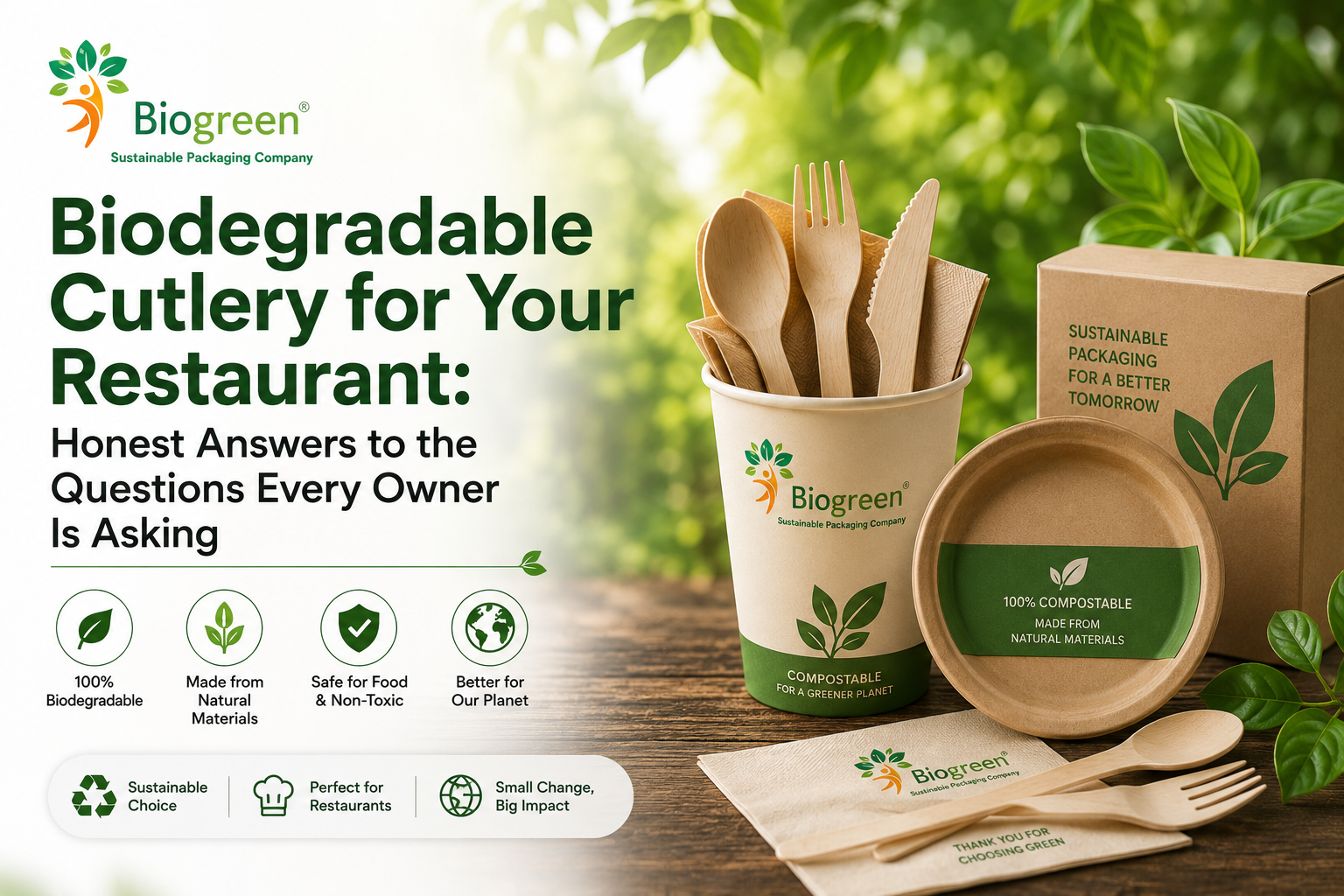
India’s plastic cutlery ban hit the food service industry in 2022, and the operational consequences are still playing out. Restaurants, canteens, cloud kitchens, event caterers, and street food vendors all had to make rapid switches to alternatives — some planned, many improvised. Two years on, the alternatives market has matured significantly, but confusion persists about which materials work for which applications, what the cost implications are, and how to source reliably.
This guide cuts through the marketing claims and gives you straight answers about biodegradable and compostable cutlery, biodegradable spoons, and biodegradable straws for commercial food service use in India.
India’s Plastic Cutlery Ban — What’s Covered and What’s Not
The single-use plastic ban under India’s Plastic Waste Management Rules (effective July 2022) specifically prohibits the manufacture, import, stocking, distribution, and sale of certain single-use plastic items, including:
- Plastic stirrers
- Plastic cutlery: spoons, forks, knives, trays, plates
- Plastic straws (with exceptions for certain medical and pharmaceutical applications)
The ban applies to items made from conventional plastic, including those marketed as Oxo-biodegradable. Certified compostable alternatives meeting IS 17088 or equivalent standards are legal and compliant under the framework.
For food service operators, the practical implication is clear: any cutlery or straw you provide to customers must be either biodegradable/compostable (certified), wood, bamboo, bagasse, or paper. The cheap plastic alternatives are no longer an option.
What Are Biodegradable Spoons and Straws Made Of?
Understanding the materials helps you choose the right product for your specific use case, because different materials have different performance profiles.
CPLA (Crystallised Polylactic Acid)
CPLA is the most widely used material for certified compostable cutlery. PLA made from corn starch is crystallised to increase its heat deflection temperature—standard PLA starts to soften around 55°C, which is too low for hot food applications. CPLA can handle temperatures up to around 85°C, making it suitable for hot soups, curries, and hot beverages.
Biodegradable spoons made from CPLA are the closest performance equivalent to conventional plastic cutlery—similar feel, similar rigidity, and certified compostable. They’re the default choice for most full-service restaurant and cloud kitchen applications.
Bagasse (Sugarcane Pulp)
Biogreen Bagasse is the fibrous residue left after sugarcane juice extraction. It’s a completely natural material that is compostable, heat-resistant (handles hot food well), and has good structural strength for cutlery and plates. Bagasse cutlery tends to feel more substantial than CPLA and handles heavy, grainy foods better.
For high-volume canteens and institutional use where a robust product is needed and slight variation in colour and texture is acceptable, bagasse is a strong choice.
Wood and Bamboo
Wood and bamboo cutlery are natural, compostable, and require no processing into biopolymers. They’re popular in premium and eco-branded food service contexts for the natural aesthetic. The limitation is cost—wood and bamboo cutlery is typically 20–40% more expensive than CPLA alternatives at comparable quality.
Do They Actually Hold Up During Service?
The performance question is what food service operators care about most. Here’s the honest assessment.
Testing Spoons in Hot Liquids
CPLA spoons hold up well in hot liquids at serving temperature (70–85°C) for the duration of a meal. They don’t soften or bend in hot curries or soups the way standard PLA spoons would. Where CPLA performs slightly below conventional plastic is under sustained high heat—don’t use CPLA spoons for cooking or as serving implements in pots held at above 85°C.
For practical canteen and restaurant use—providing a spoon with a meal, serving food at serving temperature—CPLA cutlery performs comparably to conventional plastic.
Bagasse spoons have better heat resistance than CPLA and don’t have a maximum-temperature concern in standard food-service applications. The trade-off is that bagasse can absorb some moisture over extended contact with very wet or oily foods.
Straws in Cold and Hot Drinks
Biodegradable CPLA straws perform well in cold drinks, including thick beverages. They don’t collapse or go soggy the way paper straws do—the most common complaint about paper straw alternatives. In hot beverages, CPLA straws hold their shape at serving temperatures.
The key specification to check when buying CPLA straws for milkshake or smoothie applications is the bore size (inner diameter) — wider bore straws handle thick drinks better. Standard beverage straws are 6–8mm; milkshake straws are typically 8–10mm.
Cost Comparison: Biodegradable vs Standard Disposable Cutlery
Let’s be concrete about costs because vague “slightly more expensive” statements aren’t useful for planning.
| Item | Conventional Plastic (approx.) | CPLA Compostable (approx.) | Premium over plastic |
| Spoon | Rs 0.40–0.60 each | Rs 0.90–1.50 each | 100–150% |
| Straw | Rs 0.15–0.25 each | Rs 0.50–0.80 each | 100–200% |
| Fork | Rs 0.50–0.70 each | Rs 1.00–1.60 each | 80–120% |
These are indicative prices at moderate commercial volumes. At higher volumes (100,000+ pieces per order), prices come down considerably — typically 20–35% below the above estimates.
The cost premium is real, and food service operators need to factor it into pricing or absorb it as a cost of regulatory compliance. The most common approach is a small increase in per-item packaging cost that’s absorbed into menu pricing—at typical restaurant usage rates, this is Rs 1–3 per cover, which is manageable for most operations.
Which Option Makes Sense for Your Type of Food Business?
Full-service restaurants and fine dining: CPLA cutlery for the quality feel; bamboo for premium positioning. CPLA straws for beverages.
Cloud kitchens and delivery: CPLA spoons and cutlery packed with orders. Straws are only provided where the menu requires. Keeping packaging minimal reduces cost — include only what’s actually needed for the order.
Event catering and corporate canteens: CPLA or bagasse, depending on volume and budget. Bagasse compostable plates and compostable bowls pair well with CPLA cutlery. Bagasse is generally better for very high-volume events where the slightly lower per-unit cost and better heat tolerance matter.
Street food and quick service: Bagasse is typically the best value-for-performance choice at the volumes and handling conditions of QSR and street food operations.
How to Source in Bulk Without the Headache
A few points that matter for commercial sourcing:
Verify food contact safety certification: Compostable cutlery should carry food contact safety documentation—not just compostability certification. These are separate tests. Ask your supplier specifically for food contact compliance documentation.
Order samples before committing to bulk: Run the spoons through a typical service scenario—hot curry for 30 minutes, milkshakes, and cold drinks. Test straws in your thickest beverage item. Two days of testing prevent a costly mistake on a bulk order.
Specify whether you need individual wrapping: Individually wrapped cutlery costs more but is required for many delivery and premium service applications. Unwrapped bulk cutlery is appropriate for self-service stations and institutional canteens.
Confirm delivery lead time: Certified compostable cutlery is manufactured and shipped from specific locations—lead times for bulk orders are typically 1–2 weeks for the Indian domestic supply. Plan your buffer stock accordingly.
Conclusion
Biodegradable cutlery and straws are not a compromise solution for restaurants forced out of plastic by regulation. The better materials — CPLA and bagasse — perform well across standard food service applications, hold up in hot food and cold beverage contexts, and are available in India at commercial volumes with food contact certification.
The cost premium is real but manageable. The operational reality is that most restaurants and cloud kitchens have already made the switch and found the alternatives workable. The question now is not whether to use them but how to source them reliably at the right price.
FAQs
Ans: CPLA spoons are rated up to approximately 85°C — they hold up in hot curries and soups at serving temperature. Standard PLA (not crystallised) softens at lower temperatures and is not suitable for hot food applications.
Ans: CPL A straw holds its shape in thick, cold beverages. For milkshakes and smoothies, use a wide-bore CPLA straw (8–10mm inner diameter) to ensure comfortable flow.
Ans: MOQ varies by product and supplier—typically 5,000–10,000 pieces per SKU. Contact Biogreen Bags’ team for the current MOQ and bulk pricing for your specific cutlery requirements.
Ans: Quality CPLA and bagasse cutlery carry food contact safety certification in addition to compostability certification. Always ask your supplier for both documents—they cover different requirements.
Ans: Custom branding on biodegradable cutlery is available for larger orders. Contact the sales team for minimum quantities and lead times for branded compostable cutlery.